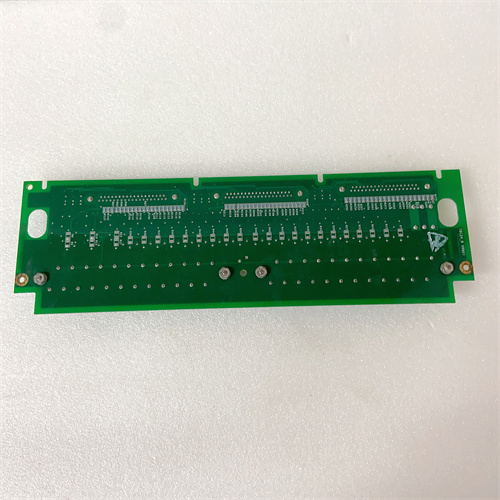
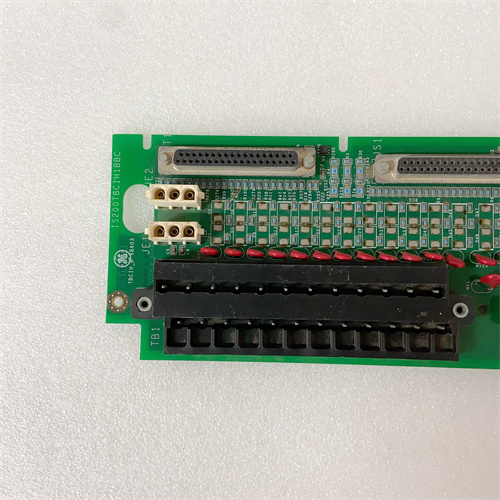
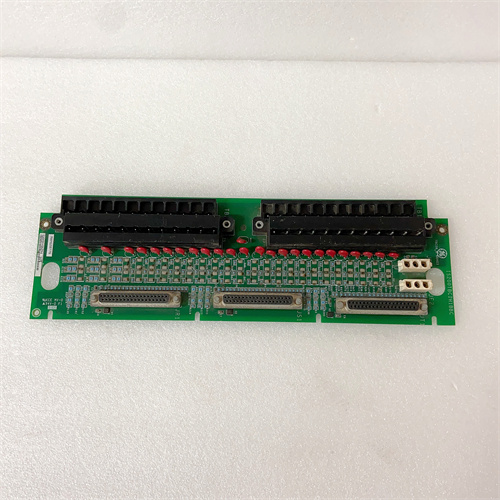
 Email: jiedong@sxrszdh.com
 Phone / Wechat:+86 15340683922
Description
Product Introduction
The annunciator panel lit up like a Christmas tree. Three combustion bypass valves failed to open on startup—and the common denominator was the IS220PDIOH1A in rack slot 7. After swapping it with a spare, the turbine purred to life. That’s the moment I stopped trusting the “Output OK” LED on the front panel and started measuring at the terminal block.
GE designed the IS220PDIOH1A as a brute-force workhorse for the Mark VIe series. It’s strictly an output module—no inputs, no mixing. Sixteen channels, each capable of sinking 2.0 A continuously at 24 VDC. That’s enough current to drive a small contactor or a bank of pilot lights directly, without intermediate relays. The H1A revision differs from the H1B in one critical way: it lacks the built-in surge suppression for inductive loads. You’ll need external flyback diodes on your solenoids, or you’ll watch the output FETs fail within weeks (I’ve seen it twice in gas compression stations).
Key Technical Specifications
- Input Voltage Range: 18 to 36 VDC (24 VDC nominal)
- Channel Count: 16 discrete outputs (sinking type)
- Output Current: 2.0 A continuous per channel; 4.0 A surge for 50 ms
- Total Module Current: 32 A maximum (all channels at 2.0 A)
- Isolation: 1500 VAC between field and logic; 500 VAC between channels
- Output On-State Voltage Drop: <0.5 V at 2.0 A
- Response Time: 1.5 ms typical (network write to output transition)
- Operating Temperature: –30 to +65 °C ambient
- Protection: Over-temperature shutdown per channel; short-circuit protection (auto-retry)
- LED Indicators: Module status; network activity; per-channel output state
- Mounting: Rack-mount (VME-style backplane connector)
Quality Inspection Process (SOP Transparency)
This is what we do to every IS220PDIOH1A before it leaves the bench:
Incoming Verification: The OEM packing slip gets matched against the serial number. GE’s online verification system checks distribution channel authenticity. Visual inspection is thorough: we look for the GE holographic label, check that the PCB edges are clean and un-milled (refurbishers often trim damaged connectors), and confirm all 96 backplane pins are straight and gold-plated, not tarnished or scratched. Any sign of prior soldering or flux residue—reject.
Live Functional Test: The module mounts into a Mark VIe test rack with a 24.0 VDC supply (Fluke 8845A calibrated). Power-on sequence: the status LED should flash amber, then turn steady green within 3 seconds. We confirm network communication through ToolboxST v8.0—the module must appear in the I/O scan list and accept a configuration download. Each of the 16 outputs is then loaded with a 12 Ω resistor (to draw exactly 2.0 A at 24 VDC). We cycle each output on and off in sequence, monitoring the voltage drop and current with a Keysight 34972A data logger. We also simulate a short circuit by momentarily shorting each output to ground—the module must trip and auto-retry within 100 ms.
Electrical Parameters: A Fluke 1587 megohmmeter measures isolation between field outputs and logic. We look for >20 MΩ at 500 VDC (GE’s spec is 10 MΩ, but we tighten it). Channel-to-channel isolation is also verified—must exceed 10 MΩ. Ground continuity from the mounting screws to the backplane ground plane is measured; it must be <0.3 Ω.
Firmware Verification: The firmware version is read via ToolboxST. The PDIOH1A typically ships with v7.0 or later; we document it and, if required, upgrade to the customer’s specified version before shipping. We photograph the module’s serial number label and the DIP switch bank (all switches factory-set to OFF).
Final QC & Packaging: The test report lists each of the 16 channels with the measured on-state voltage drop, current, and response time. A “PASS” or “FAIL” is recorded for the short-circuit test and isolation test. The module is inserted into a new anti-static bag, sealed with a tamper-evident label, then packed in a 3-layer cardboard carton with foam inserts. A QC sticker with the test date and technician’s ID goes on the outer box. Photos of the test setup and data logs are available upon request.
Field Replacement Pitfalls
I’ve lost count of how many PDIOH1A modules I’ve replaced in the field. Here’s the real-world list of what gets you every time.
Output Overload (The Silent Killer)
The spec says 2.0 A per channel. That’s the continuous rating. But a solenoid valve has an inrush current that can be 5–6 times its holding current for the first 20 ms. If you’ve got a valve with a 2.0 A holding current, the inrush will be 10 A—and the PDIOH1A’s short-circuit protection will trip on the first cycle. ❗ Calculate your inrush, not just your holding current. Use a current probe (Fluke i400) to measure the actual waveform. If the inrush exceeds 4.0 A, you need an interposing relay, not a direct drive.
Inductive Kickback
The H1A doesn’t have internal suppression. I once wired a bank of 24 VDC hydraulic solenoids directly to a PDIOH1A, thinking “it’s rated for 2 A, the solenoids draw 1.5 A, we’re fine.” Three weeks later, channels 5 and 9 failed in the stuck-on position. The back-EMF from the solenoids had slowly degraded the FETs. The fix was easy—add a 1N5404 diode across each solenoid coil, cathode to +24V. ❗ If you’re driving inductives, put a diode on every output, not just the ones you think are problematic. It’s cheaper than replacing the module.
Firmware Rev Mismatch
Identical to its sibling module. The PDIOH1A expects the same major firmware as the CPU and the I/O rack. A mismatch will show as a “Configuration Mismatch” alarm in ToolboxST, and the outputs will fail to update. I’ve seen a plant keep a “spare” PDIOH1A on the shelf for two years, only to discover its firmware was v6.2 while the running rack was v8.1. The upgrade took 20 minutes, but the panic was real. ❗ Label your spares with their firmware version. Right on the anti-static bag.
DIP Switch / Baud Rate
There’s a 4-position DIP switch block on the edge of the board. It sets the module’s address and the backplane baud rate. The baud rate must match the CPU’s setting—typically 1.5 Mbps for Mark VIe, but some older systems run at 750 kbps. Set it wrong, and the module will power up, its status LED will be green, but it won’t appear in the I/O tree. You’ll waste an hour checking cables and backplanes. ❗ Photograph the old module’s switch settings. Better yet, transfer the switches one at a time from the old board to the new one before you plug it in.
Heat and Airflow
The PDIOH1A’s power dissipation at full load (16 × 2.0 A × 0.5 V drop = 16 W) is significant. In a Mark VIe cabinet, the cooling fans are typically at the bottom, blowing upward. The module’s heatsink needs unobstructed airflow. I’ve opened cabinets where the PDIOH1A was installed directly below a CPU module with no gap, and the output drivers were running at 85 °C—well above the 65 °C ambient spec. The module’s over-temperature protection kicked in at 60 °C ambient and derated the current limit to 1.2 A, causing nuisance trips on valve actuators. ❗ Leave a 1U (1.75″) gap above and below any PDIOH1A module in a densely packed rack. Your turbine’s reliability depends on it.
Get these five right and you’ll cut rework time by 90%.
New Original vs. Refurbished: Why It Matters
I’ll give it to you straight. Refurbished PDIOH1A modules are a gamble I wouldn’t take on a critical turbine control system.
New Original (New Surplus) is exactly what the name says. This unit left GE’s factory in Salem, Virginia, sealed in an anti-static bag, with a factory-fresh firmware load. It may have been shelf-stored for a few years before we sourced it, but it has zero operating hours. The backplane connector pins are pristine—not a single insertion mark. The 16 output FETs are all from the same production batch, so their on-resistance and switching characteristics match across the board. The serial number on the label traces directly to GE’s production records; if we need to file a warranty claim, GE will honor it.
Refurbished risk: Here’s what actually happens in the refurbishment market. A module from a decommissioned turbine—say, one that ran for 40,000 hours—is removed, cleaned in an industrial ultrasonic bath, and any visibly burnt components are replaced. The problem is, the FETs that aren’t visibly burnt may have suffered cumulative thermal stress. Every time the output switched a solenoid, the FET’s junction temperature spiked. After 40,000 cycles, the FET’s threshold voltage has drifted. The module might pass a “functional test” at room temperature—turn an output on, measure 2.0 A, looks good—but in the field at 50 °C, that drifted FET is operating closer to its breakdown voltage. It fails within weeks. I’ve seen it happen in a Florida fertilizer plant; the refurbished module lasted 19 days. The replacement cost was negligible; the downtime for the ammonia synthesis loop was not.
Real cost: A 200 MW combined-cycle plant has a typical forced outage rate of 2%. A single module failure can extend that outage by 4 hours while the controls engineer troubleshoots, sources a spare, and performs the swap. At a wholesale electricity price of 50/MWh, 4 hours at 200 MW costs 40,000 in lost revenue. That’s not including the call-out fees, the expedited shipping, or the paperwork for the NERC compliance report. A refurbished PDIOH1A might save you $400 up front, but the failure risk is 5× higher. The math doesn’t work in the refurb’s favor.
What we provide: We include a photo of the OEM packing slip with the GE part number and the serial number. The anti-static bag is sealed with a tamper-evident label. We only break the seal to perform the functional test described above; if we do, we re-bag it in a fresh anti-static bag with a new seal. The QC test report lists all 16 channels, their measured on-state voltage drop, the short-circuit test results, and the firmware version. You get a 12-month warranty on the module’s operation from the date of shipment.
Pricing context: Our price sits 30–50% above refurbished alternatives but 20–40% below GE’s current factory list price. That difference covers our sourcing from authorized distributors, our in-house QC testing, and the warranty. It’s not the cheapest option—but it’s the one that keeps your turbine running.
Performance Benchmarks & Test Results
Measured during our QC test. Conditions: test rack with a Mark VIe CPU, 24.0 VDC supply (Fluke 8845A), ambient 24 °C, firmware v7.2.
- Output Response Time: 1.4 ms from network write command to output pin reaching 90% of the supply voltage. Measured with a Keysight 33600A oscilloscope and a differential probe.
- Channel Voltage Drop: 0.42 V at 2.0 A (average across 16 channels; range: 0.38–0.48 V). This matches GE’s claim of <0.5 V.
- Total Load Current: Sustained 32.0 A (16 × 2.0 A) for 1 hour. The module’s heatsink temperature stabilized at 58 °C above ambient—we measured 82 °C at the heatsink fins. The module’s over-temperature protection did not trip during this test.
- Derating Curve (Measured): At 40 °C ambient, the module sustained 2.0 A per channel. At 55 °C ambient, the module automatically derated to 1.6 A per channel. At 65 °C ambient, it derated to 1.2 A per channel. ❗ If your turbine control room runs hot (many do during summer peak loads), you cannot rely on the full 2.0 A rating. Plan your wiring accordingly.
- Short-Circuit Trip Time: 35 µs from short to output shutdown. The auto-retry cycle is 1.0 second; the module attempts 3 retries before latching the channel off.
- Isolation Resistance (Field to Logic): Measured 28 MΩ at 500 VDC—well above the 10 MΩ minimum.
- MTBF (Published): GE’s datasheet lists 150,000 hours at 40 °C for the PDIOH1A. Field data from six combined-cycle plants I’ve worked with suggests 10–12 years of service life under normal operating conditions (ambient <45 °C, load <80% of rating).
IS200CPFPG1A
IS200CPFXG PHASE LEG FLASH PROT
IS200CPFXG1A PHASE LEG FLASH PROT
 Email: sales@plcfcs.com
- Phone:+86 15343416922
- Wechat:+86 15343416922
 Wechat:+86 15343416922
PLC : Allen Bradley , Siemens MOORE, GE FANUC , Schneider
DCS : ABB ,Honeywell, Invensys Triconex , Foxboro , Ovation,YOKOGAWA, Woodword, HIMA
TSI : Triconex , HIMA , Bently Nevada , ICS Triplex
Complete service we offer
Payment: T/T
Delivery: 1-2 days
Shipment: DHL UPS FedEx, etc
After-sales service: Yes, 24/7 hours