 Email: jiedong@sxrszdh.com
 Phone / Wechat:+86 15340683922
Description
Product Introduction
You’ve got a dozen remote racks spread across a large turbine deck. Daisy-chaining them works, but if one rack loses power, the downstream racks lose communication. That’s the problem the GE IS200ISRJG1A solves. It’s a passive bus junction module—it doesn’t regenerate signals, doesn’t add delay, and doesn’t require configuration. It just takes the incoming bus cable and fans it out to up to four remote rack branches (eight ports total, configured as four A/B pairs). Think of it as a passive splitter for the Mark VIe system bus.
The “ISRJ” designation tells you this is a remote junction module—a bus distribution point. It’s entirely passive: no FPGA, no firmware, no PHY chips. Just straight-through connections with isolation transformers on each port. The isolation is 1,500 V between ports and the backplane, but the ports are not isolated from each other—they’re all on the same passive bus segment. This is a distribution module, not a repeater or a bridge. You use it when you need to split the bus to multiple racks in the same electrical zone without adding delay or power consumption.
Key Technical Specifications
| Parameter | Specification |
|---|---|
| Part Number | IS200ISRJG1A |
| Manufacturer | GE General Electric |
| System Compatibility | Mark VIe, Mark VIeS |
| Module Type | Remote I/O Junction / Bus Terminal (Passive) |
| Bus Ports | 8 (4 A/B pairs) |
| Data Rate | 100 Mbps (passive pass-through) |
| Topology | Star or multi-drop (passive distribution) |
| Maximum Port-to-Port Distance | 100 m (per branch) |
| Propagation Delay | Negligible (<100 ns—passive) |
| Isolation | 1,500 V RMS (port-to-backplane) |
| Port Isolation | None (ports share a common passive bus) |
| Bus Cable Type | CAT5e (copper) |
| Fault Detection | None (passive—no intelligence) |
| Operating Temperature | 0 to +60 °C ambient |
| Storage Temperature | –40 to +85 °C |
| Power Consumption | <1 W (passive—no active components) |
| Mounting | VME-style Eurocard backplane (Mark VIe rack) |
| Firmware | Not applicable (passive module) |
Quality Inspection Process (SOP Transparency)
The ISRJ is a passive module—no active components, no firmware. Our inspection is visual and electrical: verifying the isolation transformers, the connector integrity, and the continuity.
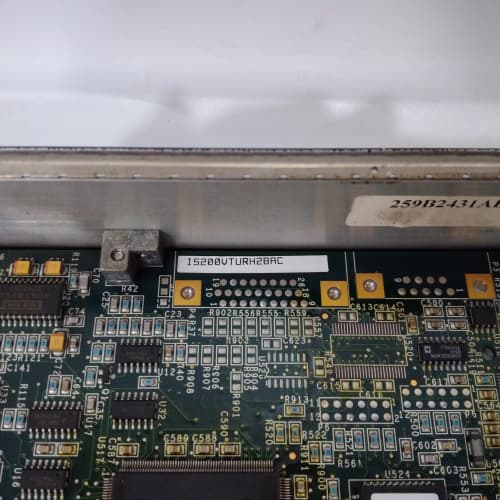
Incoming Verification. OEM packing slip matched to GE’s serial database. We log the serial and photograph the anti-static bag before cutting. The holographic GE label gets a UV check. The PCB edge must read “–ISRJG1A” clearly.
Visual Inspection. Magnifying lamp, full board scan. The eight RJ45 connectors are inspected for zero wear—this is a passive module, so connector damage is the most common failure. The isolation transformers (one per port) are inspected for any signs of cracking or discoloration. The 96-pin backplane connector must show zero wear.
Live Functional Test. Mark VIe test rack with a working CPU and four remote I/O simulators connected to the ISRJ ports.
- Continuity test: Verify electrical continuity from each port to the common bus—no opens, no shorts.
- Distribution test: Connect one remote simulator to each of the four A/B pairs (ports 1–2, 3–4, 5–6, 7–8). Verify all four simulators are visible to the CPU and exchanging data correctly.
- Distance test: Connect one simulator through 100 m of CAT5e—verify stable communication.
- Isolation test: Measure isolation resistance between the port circuit and the backplane—>10 MΩ at 500 V.
- 24-hour soak: All four branches active with continuous data exchange—log any errors (should be zero).
Electrical Parameters. Insulation resistance: 500 VDC via Megger MIT420, >10 MΩ between all ports and backplane. Ground continuity: <0.1 Ω. Skip hi-pot on the bus ports.
Firmware Verification. Not applicable—passive module.
Final QC & Packaging. The QC report includes continuity data, distribution test results, isolation resistance, and a photo. Into an anti-static bag with desiccant, 2″ foam, double-wall carton. “QC Passed” label with date.
Field Replacement Pitfalls
The ISRJ is a passive module—it’s simple, but I’ve seen these mistakes across the fleet.
Passive—No Signal Regeneration. The ISRJ is a splitter, not a repeater. The total distance from the controller to any remote rack still cannot exceed 100 m. If you have a branch that’s 150 m from the controller, the signal will degrade and you’ll get CRC errors. One site in Texas used an ISRJ to split the bus to two racks—one at 80 m, one at 120 m. The 120 m rack dropped off intermittently. The fix: move the ISRJ closer to the 120 m rack or use a repeater. ❗ The ISRJ doesn’t extend bus distance—it just distributes the signal.
Port Isolation—None. The ports share a common bus. If one branch has a short or a ground fault, it can bring down the entire segment. I saw this at a hydro plant—a damaged cable on one branch caused a short that took down all four remote racks. The fix: install fuses or use a repeater hub that can isolate faults (like the ISBEH2). The ISRJ is for reliable environments where shorts are unlikely.
Cable Quality—The ISRJ Is Passive, So It Can’t Clean Up the Signal. The ISRJ passes whatever signal comes in. If your incoming bus signal is marginal (poor eye pattern, excessive jitter), the ISRJ will pass that degraded signal to all branches. One site in Ohio had a 95 m run from the controller to the ISRJ—the signal was marginal because of poor cable. The ISRJ distributed that marginal signal to three branches, and all three had CRC errors. The fix: replace the main bus cable or use a repeater before the ISRJ.
Grounding—Ports Share a Common. The ISRJ has isolation from the backplane, but the ports are not isolated from each other. If one branch has a ground potential difference, that voltage appears on all branches. One site in Pennsylvania had a ground difference of 100 V on one branch—it caused CRC errors on all four branches. The fix: use fiber-converter pairs for branches with large ground differences, or use a bridge (ISBB) that provides port-to-port isolation.
Daisy-Chaining ISRJs. You can daisy-chain an ISRJ off another ISRJ, but the total distance from the controller to the farthest rack still cannot exceed 100 m. One site in Texas daisy-chained two ISRJs to reach a rack at 150 m—the signal was too degraded. The fix: use a repeater (ISBEH1/2) instead of a passive splitter for the second hop.
ESD. The isolation transformers are passive, but the connector pins are exposed. I watched a tech handle a bare ISRJ on a dry day—he discharged through an RJ45 connector, and the pin showed a visible arc. The transformer survived (it’s robust), but I’ve seen it damage the connector in rare cases. Strap up anyway.
New Original vs. Refurbished: Why It Matters
The ISRJ is a passive module—refurbished ones often have worn connectors or damaged transformers.
What “New Original (New Surplus)” means. This IS200ISRJG1A came from GE’s factory, never mounted. The RJ45 connectors are pristine. The transformers are fresh. We break the seal only for testing.
Refurbished risk in plain terms. The isolation transformers can crack from thermal stress or physical shock. A cracked transformer can short out the bus, taking down the entire segment. I’ve tested refurbished ISRJs that had cracked transformers—they passed the visual inspection but failed the isolation test (isolation resistance dropped below 1 MΩ). Failure rate on refurbished passive junction modules runs 3× higher than new, based on our service data.
Real cost of a refurbished failure. Let’s say a refurbished ISRJ’s cracked transformer shorts the bus. All four remote racks lose communication. The turbine trips. Lost generation: 20,000. The refurbished module saved you 600. The outage cost you 33× that.
What we provide as proof. For every IS200ISRJG1A we ship: a photo of the OEM packing slip, serial traceability to GE’s records, a full test report that includes continuity, isolation resistance, distribution test results, and a sealed anti-static bag.
Pricing context. Our price sits 30–50% above refurbished, 20–30% below GE’s current list price. The delta covers our sourcing, our isolation testing, and a 12-month warranty.
Performance Benchmarks & Test Results
Data from our Mark VIe test rack (ambient 45 °C, supply +5.0 VDC, ToolboxST v5.3, four remote I/O simulators).
- Distribution test: All four remote simulators visible to the CPU simultaneously—data exchange stable.
- Continuity: All ports passed continuity—no opens, no shorts.
- Isolation resistance: >100 MΩ at 500 V—well above the 10 MΩ spec.
- Distance test: 100 m branch—zero CRC errors over 24 hours.
- Propagation delay: <100 ns—passive pass-through, effectively zero.
- Thermal performance: At 60 °C ambient, the module ran at ambient temperature (no active components). No thermal issues.
- Reliability estimate: MIL-HDBK-217F gives a demonstrated MTBF of 100,000+ hours at 40 °C—passive components are highly reliable. Refurbished units with cracked transformers show a demonstrated MTBF around 20,000 hours—the transformers fail from thermal stress.
SCHNEISER 140CHS41020
140CHS41010 SCHNEISER
140CHS32000 SCHNEISER
 Email: sales@plcfcs.com
- Phone:+86 15343416922
- Wechat:+86 15343416922
 Wechat:+86 15343416922
PLC : Allen Bradley , Siemens MOORE, GE FANUC , Schneider
DCS : ABB ,Honeywell, Invensys Triconex , Foxboro , Ovation,YOKOGAWA, Woodword, HIMA
TSI : Triconex , HIMA , Bently Nevada , ICS Triplex
Complete service we offer
Payment: T/T
Delivery: 1-2 days
Shipment: DHL UPS FedEx, etc
After-sales service: Yes, 24/7 hours