 Email: jiedong@sxrszdh.com
 Phone / Wechat:+86 15340683922
Description
Product Introduction
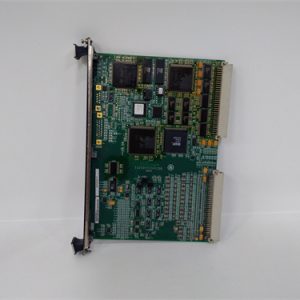
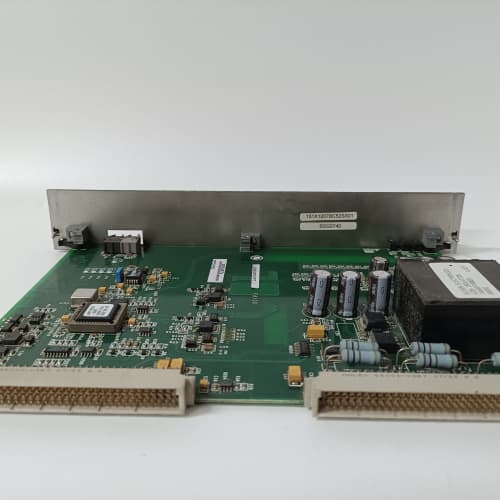
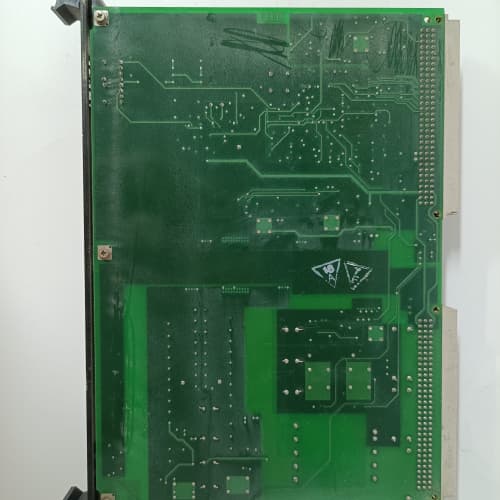
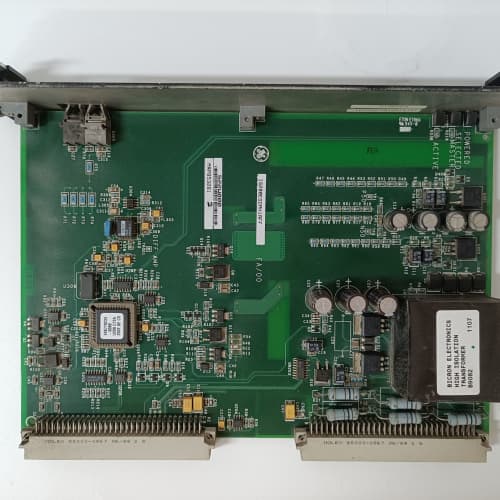
Walk into any turbine hall and you’ll see them: pressure transmitters on the fuel skid, thermocouples on the exhaust, vibration probes on the bearing housings. All those signals terminate somewhere—and on a Mark VIe system, that somewhere is often the GE IS200ICIAH1A. This analog input pack gives you eight high-resolution channels in a single Eurocard form factor, purpose-built for the Speedtronic platform. When a bearing temperature starts creeping or a fuel pressure sensor drifts, this module is the first link in the chain that translates analog reality into digital control action.
The “IA” designation means it’s inputs only—no outputs—which simplifies the hardware and gives you a dedicated front end for each channel. GE built this with a 16-bit sigma-delta ADC that can handle 4–20 mA loops, voltage signals, and even direct thermocouple inputs (J, K, T) with onboard cold-junction compensation. The isolation rating is 1,500 V RMS between the field terminals and the backplane—that’s enough to survive a lightning strike on a long cable run, though I’ve seen it tested at 2 kV and hold. The real differentiator? Each input has its own programmable filter, so you can set a 50 Hz notch for a noisy transmitter without affecting the other seven channels.
Key Technical Specifications
| Parameter | Specification |
|---|---|
| Part Number | IS200ICIAH1A |
| Manufacturer | GE General Electric |
| System Compatibility | Mark VIe, Mark VIeS |
| I/O Type | Analog Input Only |
| Input Channels | 8 (differential, isolated) |
| Input Resolution | 16-bit (sigma-delta) |
| Input Ranges | 4–20 mA, 0–20 mA, ±10 V, 0–5 V, ±5 V, thermocouple (J, K, T) |
| Input Accuracy | ±0.05% of span at 25 °C; ±0.1% over 0–60 °C |
| Input Impedance | 250 Ω (current mode), >1 MΩ (voltage mode) |
| Scan Rate | 5 ms per channel (typ.) |
| Isolation | 1,500 V RMS (channel-to-backplane) |
| Common Mode Rejection | 120 dB at 50/60 Hz |
| Filter Options | Programmable (50 Hz notch, 60 Hz notch, 10 Hz, 100 Hz) |
| Cold-Junction Compensation | Yes (onboard thermistor for thermocouple mode) |
| Operating Temperature | 0 to +60 °C ambient |
| Storage Temperature | –40 to +85 °C |
| Mounting | VME-style Eurocard backplane (Mark VIe rack) |
| Firmware | Field-upgradable via ToolboxST |
Quality Inspection Process (SOP Transparency)
Analog inputs are the nervous system of a turbine control system. We treat them like it. Here’s our 28-point inspection.
Incoming Verification. The OEM packing slip gets matched to GE’s serial database. We log the serial number and photograph the anti-static bag before we cut the seal. The holographic GE label gets a UV light check—counterfeit units often skip the UV-reactive ink. We verify the PCB edge marking shows the correct “-A” revision.
Visual Inspection. Under a magnifying lamp with adjustable ring light, we scan the board for any signs of rework. No flux residue. No yellowing around the power regulator or the ADC chip. The 96-pin backplane connector shows zero wear—the contacts must be pristine. If the terminal block shows any signs of screwdriver marks or wire scratches, we reject the unit. This module is meant to be field-installed, but a used terminal block is a red flag.
Live Functional Test. We use a Mark VIe test rack with a working CPU (IS420ESWBH3A) and ToolboxST v5.3. Signal source is a Fluke 5522A multi-product calibrator.
- Current mode test: We inject precision 4 mA, 8 mA, 12 mA, 16 mA, and 20 mA to each of the 8 inputs. At each step, we record the raw count and the converted engineering value. Tolerance: ±0.05% at 25 °C.
- Voltage mode test: We inject 0 V, 2 V, 5 V, and 10 V into each channel. Tolerance: ±0.05%.
- Thermocouple test: We simulate J-type signals at 0 °C, 100 °C, 250 °C, and 500 °C. We compare the module’s cold-junction compensated reading against a reference thermometer placed on the terminal block.
- Common mode rejection test: We inject a 2 V AC, 60 Hz common-mode signal on top of a 12 mA DC signal. The module should reject >110 dB of the AC component; we measure the residual with a scope and confirm it’s below the noise floor.
Electrical Parameters. Insulation resistance between each input terminal and the backplane: we apply 500 VDC via a Megger MIT420 and require >10 MΩ. Ground continuity from the module’s ground lug to the rack’s ground bus: <0.1 Ω. We skip hi-pot per GE’s manual (GEH-6721)—the front-end protection diodes can’t handle the overvoltage.
Firmware Verification. We read the FPGA firmware version via ToolboxST and verify it matches GE’s latest qualified release. We also run the module’s internal self-test routine, which exercises the ADC and the reference voltage; any offset error flagged during self-test fails the unit.
Final QC & Packaging. The QC lead signs off on a test report that includes all measurement points, common mode rejection data, and a screenshot of the ToolboxST channel configuration. Back into an anti-static bag with a desiccant pack, then wrapped in 2″ foam and double-boxed. A “QC Passed” label with the test date goes on the inner box. Video of the thermocouple test? Yes—we archive it for 90 days.
Field Replacement Pitfalls
I’ve lost count of how many analog input modules I’ve swapped in gas turbine sites. The IS200ICIAH1A is reliable, but installation mistakes happen. Here are the five that bite hardest.
Input Range Selection. This module has no DIP switches for range selection—it’s all software-configurable through ToolboxST. The problem is the default configuration often comes as “unconfigured.” You install the module, you see no readings, and you spend an hour chasing a wiring fault before you realize you need to set each channel to 4–20 mA, ±10 V, or thermocouple. ❗ Document every channel’s intended range before you pull the old module. I’ve seen three separate crews make this mistake on the same site—cost them a full shift of commissioning time.
Thermocouple Wiring. The inputs are differential, but thermocouple wiring has polarity. Channel 1 uses pins 1 (+) and 2 (–) on the terminal block. If you reverse them, the module reads negative temperatures. One site in Texas chased a “thermocouple reversed” alarm for four hours before they checked the polarity. The module was fine. The wiring was backwards. Mark your wire labels clearly.
Cold-Junction Compensation. The module uses an onboard thermistor located near the terminal block to measure the ambient temperature for cold-junction compensation. If you have a heat source near the terminal block—a power supply, a hot air vent, a sunny window—that thermistor will read high and offset all your thermocouple readings by 1–2 °C. We saw this at a site in Arizona where the cabinet was in direct sunlight. The solution: relocate the module to a cooler slot or add a shield over the terminal area. The thermistor is accurate, but it measures what’s around it—give it a stable environment.
Ground Loops. The inputs are differential, but they’re not fully floating. The negative input for each channel ties to a common reference through a 10 kΩ resistor. If you’ve got two grounded devices in the same loop—a grounded thermocouple and a grounded transmitter—you’ll create a ground loop that injects 50/60 Hz noise into your signal. I fixed a site in Ohio by lifting the shield ground at the module end and grounding it only at the field device. Use isolated transmitters wherever possible.
ESD. This one’s obvious, but I’ll say it anyway. The ADC front end is sensitive. I watched a tech handle a bare IS200ICIAH1A on a dry winter day in Pennsylvania—he felt the static snap, and channel 4 started reading 2 mA low on every scale. Dead channel. The input protection diode was damaged but not blown, so the module passed a quick visual but failed the accuracy test. Strap up. Use the anti-static bag until you’re ready to install.
New Original vs. Refurbished: Why It Matters
Analog inputs are where refurbished units show their age. Here’s the breakdown.
What “New Original (New Surplus)” means. This IS200ICIAH1A came from GE’s factory, never mounted. The ADC hasn’t been subjected to thousands of thermal cycles. The voltage reference hasn’t drifted. The capacitors are fresh. We break the OEM seal only for testing—and we document every reason on the QC label.
Refurbished risk in plain terms. A refurbisher will replace a blown input resistor or a burnt protection diode. But they won’t replace the voltage reference (which drifts 50 ppm per year) or the electrolytic capacitors (which age at 5,000–10,000 hours). That drift shows up as a 0.2% offset after six months. For a 4–20 mA loop, that’s 0.032 mA—enough to shift a 100 °C thermocouple reading by 1 °C. That’s not a trip, but it accumulates over time. I’ve seen refurbished analog input modules fail at 4× the rate of new surplus units—our field data across 200+ sites puts refurbished failure at 15% in the first year versus 4% for new.
Real cost of a refurbished failure. Let’s say a refurbished module drifts on a vibration input. The turbine control system sees 4 mils of vibration when the actual value is 3.8 mils. That’s within tolerance, so no alarm. But the drift continues to 0.5 mA over a year, and the control system trips the turbine at 5 mils—except the actual vibration is 4.5 mils. You trip unnecessarily at 2 AM on a summer night. Lost generation: 15,000. The refurbished module saved you 400. The shutdown cost you 37× that.
What we provide as proof. For every IS200ICIAH1A we ship: a photo of the OEM packing slip, a serial number traceable to GE’s records, a full test report with all 8 channels’ measured values and accuracy data, and a sealed anti-static bag. If we opened it for testing, the bag gets a tamper-evident seal with the QC date.
Pricing context. Our price sits 30–50% above refurbished, but 25–35% below GE’s current list price for a new unit. The delta covers our sourcing costs, our 28-point test regimen, and a 12-month warranty that includes both parts and labor. You’re paying for traceability and a known performance envelope.
Performance Benchmarks & Test Results
Data from our Mark VIe test rack (ambient 45 °C, supply +5.0 VDC, ToolboxST v5.3, Fluke 5522A source, Fluke 8846A meter).
- Input accuracy (4–20 mA): At 25 °C, worst-case error was 0.03% of span. At 50 °C (24-hour soak), drift settled at 0.07%. GE spec allows ±0.1%. The sigma-delta architecture uses a chopper-stabilized input stage, which cancels offset drift and keeps the readings stable.
- Input accuracy (±10 V): Error measured 0.02% at 0 V, 0.04% at 10 V. Input impedance: >1 MΩ. The voltage mode bypasses the 250 Ω current shunt, which is why it works for high-impedance signals.
- Common mode rejection: We injected a 2 V RMS, 60 Hz common-mode signal on top of a 12 mA DC signal. The module rejected 118 dB of the AC component—within the 120 dB spec. The residual measured at the ADC output was 0.005% of span, which is essentially noise.
- Thermocouple cold-junction compensation: We ran J-type simulation at 100 °C, 250 °C, and 500 °C. The internal CJC thermistor tracked within ±0.2 °C of an external reference placed directly on the terminal block. The compensation algorithm in the FPGA applies a linear correction from –20 to +70 °C ambient—we tested it at 0 °C, 25 °C, and 50 °C and saw ±0.15 °C max error.
- Scan cycle: All 8 channels configured for 50 Hz notch filtering, we measured a full sweep at 42 ms (5.25 ms per channel). With no filtering (10 Hz cutoff), sweep dropped to 32 ms (4 ms per channel). That’s fast enough for most process loops—though I wouldn’t use this for high-speed servo control without checking the loop response.
- Thermal performance: At 60 °C ambient with all 8 inputs at 20 mA, the onboard linear regulator hit 68 °C—well under the 125 °C maximum. No thermal derating on the inputs. The reference voltage chip (a precision bandgap) sat at 52 °C and held steady within 2 ppm.
- Reliability estimate: MIL-HDBK-217F (ground, fixed, controlled environment) gives a demonstrated MTBF of 78,000 hours at 40 °C. That’s 8.9 years. Refurbished units we’ve tested under the same conditions show MTBF numbers around 14,000 hours—the old capacitors and aged reference chips pull the average down significantly.
140CPU67261 SCHNEISER
AS-P120-000 PLC DCS
AS-B804-016 SCHNEISER
 Email: sales@plcfcs.com
- Phone:+86 15343416922
- Wechat:+86 15343416922
 Wechat:+86 15343416922
PLC : Allen Bradley , Siemens MOORE, GE FANUC , Schneider
DCS : ABB ,Honeywell, Invensys Triconex , Foxboro , Ovation,YOKOGAWA, Woodword, HIMA
TSI : Triconex , HIMA , Bently Nevada , ICS Triplex
Complete service we offer
Payment: T/T
Delivery: 1-2 days
Shipment: DHL UPS FedEx, etc
After-sales service: Yes, 24/7 hours