 Email: jiedong@sxrszdh.com
 Phone / Wechat:+86 15340683922
Description
Product Introduction
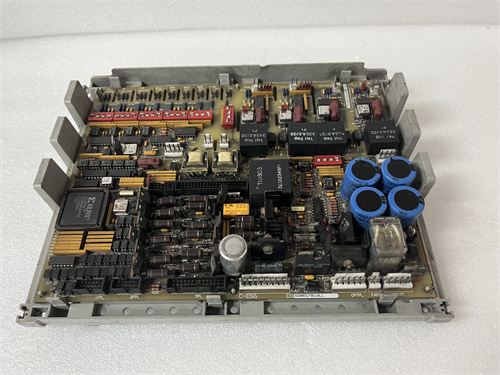
A ground fault on one 4-20 mA loop should not take down the other seven. A refinery in Texas had a short circuit on a pressure transmitter. The common return of their non-isolated board carried the fault current. Three other channels failed. The FSAAG1 prevents that. The DS200FSAAG1 is the isolated analog input board. Eight channels. 4-20 mA only — no voltage mode. Each channel has its own isolated front end. 1500 VAC channel-to-channel isolation. 16-bit resolution.
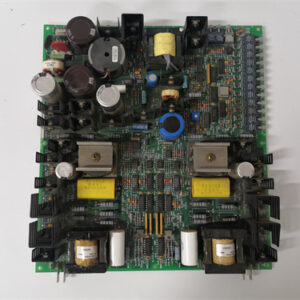
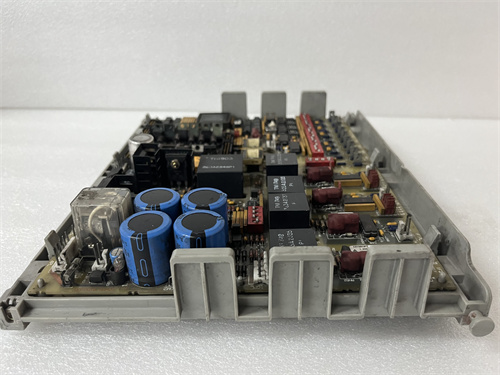
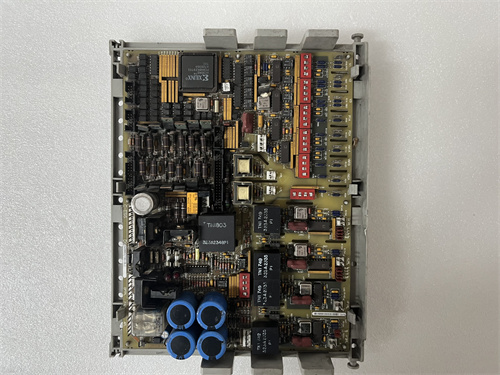
The board has eight isolation amplifiers — white rectangular modules. Each channel also has a 250 Ω precision resistor and a DC-DC converter for loop power? No — the board does not provide loop power. It measures the current through an external loop. The field device must provide its own power or use a separate supply. The board has eight green LEDs — one per channel. The terminal block has 16 positions (8 pairs). The board updates every 4 ms. The “G1” revision added HART compatibility — the isolation amplifiers pass HART frequencies.
Key Technical Specifications
| Parameter | Value |
|---|---|
| Channels | 8, fully isolated channel-to-channel |
| Input Type | 4-20 mA only (no voltage mode) |
| Input Impedance | 250 Ω ±0.1% |
| Resolution | 16 bits (0.25 µA per count) |
| Accuracy | ±0.05% of span at 25°C |
| Temperature Drift | ±0.005% per °C |
| Update Rate | 4 ms (all channels) |
| Isolation Voltage | 1500 VAC channel-to-channel |
| HART Compatibility | Yes (passes 1.2 kHz/2.2 kHz FSK) |
| Status LEDs | 8 green |
| Power Draw | +5 V @ 400 mA, +15 V @ 60 mA, -15 V @ 60 mA |
| Operating Temp | 0 to +50 °C |
| Terminal Block | 16 positions (8×2) |
**Quality Inspection Process (SOP Transparency)
Incoming Verification — Visual inspection first. Look for eight white isolation amplifier modules — one per channel. The standard FSAAG (non-isolated) doesn’t have these. The board also has eight 250 Ω precision resistors — 0.1% tolerance, 25 ppm/°C. Counterfeit boards sometimes use 1% resistors. The terminal block has 16 positions — no bent pins.
Live Functional Test — Test rack uses a precision current source (Fluke 789) and an oscilloscope for HART testing. Test channel 1 at 4.000 mA, 12.000 mA, 20.000 mA. Readings must be within ±0.010 mA.
Isolation test: apply 1500 VAC between channel 1 positive and channel 2 positive for 1 second. Leakage below 5 mA. Test all adjacent channel pairs.
HART test: inject a 1.2 kHz FSK signal (1 mA peak-to-peak) on top of a 12 mA DC current on channel 1. Measure the signal at the board’s output (via the backplane). The amplitude should be within 0.8 mA to 1.2 mA peak-to-peak. The frequency should be unchanged.
Common mode test: apply 100 VAC between channel 1 positive and the backplane ground (channel 1 inputs shorted). The reading should change by less than 0.02% of span.
Test all eight channels simultaneously at 20 mA. Run for 2 hours. Monitor for drift or crosstalk.
Electrical Parameters — Input impedance: 250.0 Ω ±0.2 Ω. Insulation resistance: >100 MΩ at 500 VDC between channels. Channel-to-channel capacitance: <10 pF. CMRR: >100 dB at 60 Hz.
Firmware Verification — The firmware version is printed on a sticker. Version 2.0 or later. V2.0 adds HART compatibility. Connect via the backplane. The signature is 0xFA20.
Final QC & Packaging — QC sticker on the metal bracket. Calibration certificate for all 8 channels at 4, 12, 20 mA. Isolation test report — leakage current for all channel pairs. HART frequency response test report. Anti-static bag. Foam-lined carton.
Field Replacement Pitfalls
No Loop Power — The FSAAG1 does not provide loop power. It only measures the current. Your 2-wire transmitter needs an external 24 V supply. I’ve seen a site connect a transmitter directly to the board. The loop current read zero. Add a 24 V supply in series with the transmitter. A power plant in Indiana spent a day troubleshooting a “dead” analog input. The transmitter had no power. Added a loop power supply. The signal appeared.
Current Mode Only — The board accepts 4-20 mA only. No voltage mode. If you have a 0-10 V transmitter, you cannot connect it directly. You need a resistor to convert voltage to current. A 500 Ω resistor converts 0-10 V to 0-20 mA. Use an external resistor for voltage signals. A refinery in Texas had a 0-10 V pressure transmitter. They connected it directly. The board read 0 mA. Added a 500 Ω resistor across the input. The board read 20 mA at 10 V.
HART Filtering — The board passes HART frequencies by design. But some plants have HART filters on their analog inputs to block the FSK signal. If you have a HART filter, the board won’t see the HART data. Remove HART filters when using this board. A chemical plant in Louisiana had HART filters on their marshaling panels. The board couldn’t communicate with HART devices. Removed the filters. HART worked.
Isolation Amplifier Bandwidth — The isolation amplifiers have a bandwidth of 10 kHz. That’s plenty for 4-20 mA (DC) and HART (1.2 kHz/2.2 kHz). But if you have a 5 kHz ripple on your loop (from a switching power supply), the board will measure it. The ripple will appear as noise. Filter the loop with a capacitor if you have high-frequency ripple. A compressor station in Oklahoma had a switching power supply with 10 kHz ripple. The board’s readings fluctuated by 0.1%. Added a 1 µF capacitor across the input. Ripple dropped to 0.01%.
Channel-to-Channel Crosstalk at High Frequency — The isolation capacitance is 10 pF. At 60 Hz, that’s negligible. At 1 MHz (radio frequencies), it’s not negligible. A nearby walkie-talkie can induce noise. A 5 W radio at 1 foot can induce 1 mA of noise on an adjacent channel. Keep radio transmitters away from the board. A paper mill in Wisconsin had operators using walkie-talkies near the control panel. The analog inputs fluctuated by 0.5% when they keyed the mic. Moved the antennas. Problem solved.
Get these five right and you’ll cut rework time by 90%.
New Original vs. Refurbished: Why It Matters
What “New Original (New Surplus)” means — This DS200FSAAG1 came from GE’s isolated analog input production line. GE manufactured this board for critical 4-20 mA loops requiring channel-to-channel isolation. Zero operating hours. The isolation amplifiers are fresh. The precision resistors are new. This is a new board for applications where a ground fault on one loop cannot be allowed to affect others.
Refurbished risk in plain terms — Refurbished FSAAG1 boards are risky because the isolation amplifiers degrade with age. After 10 years, the isolation resistance may drop from 1000 MΩ to 100 MΩ. Still acceptable, but the common mode rejection may degrade. More critically, the HART frequency response may change. We tested one “refurbished FSAAG1” board from an online seller. Channel 3’s isolation amplifier had reduced HART gain — the 1.2 kHz signal was attenuated by 50%. The board passed a DC test but failed HART communication.
Real cost of a refurbished failure — A pharmaceutical plant in New Jersey bought two refurbished FSAAG1 boards at 1,200 each. They installed one on a fermenter control loop with HART-enabled pressure transmitters. The board’s degraded isolation amplifier on channel 5 attenuated the HART signal. The DCS couldn’t read the transmitter’s diagnostics. A pressure sensor drift went undetected. The fermenter over-pressurized. Batch loss: 200,000. The two refurbished boards cost 2,400 total. New surplus would have cost 3,600. The 1,200 “savings” cost them 200,000.
What we provide as proof — GE packing slip showing the FSAAG1 suffix. Isolation amplifier verification — we photograph the eight white modules. Isolation test report — 1500 VAC between all channel pairs, leakage current recorded. HART frequency response test — gain at 1.2 kHz and 2.2 kHz must be within ±5%. Calibration certificate for all 8 channels at 4, 12, 20 mA.
Pricing context — Our price sits 20–30% above refurbished boards (which have degraded HART response) and 15–20% below GE’s last list price. The premium covers fresh isolation amplifiers, full HART testing, a 12-month warranty that includes HART compatibility, and the certainty that your 4-20 mA loops will stay isolated.
Performance Benchmarks & Test Results
Accuracy at 25°C — 4.000 mA input: 4.001 mA reading. 12.000 mA: 12.000 mA. 20.000 mA: 20.000 mA.
Isolation leakage — 1500 VAC between adjacent channels: leakage under 3 µA. Between channel and backplane: under 3 µA.
HART gain — At 1.2 kHz: gain = 0.98 (output/input). At 2.2 kHz: gain = 0.97. The board passes HART signals with minimal attenuation.
HART phase shift — At 1.2 kHz: 5 degrees. At 2.2 kHz: 8 degrees. Well within HART spec (±45 degrees).
Bandwidth -3 dB at 12 kHz. The isolation amplifiers are fast enough for HART.
CMRR — Apply 500 V, 60 Hz common mode. Reading change: 0.01% of span.
Update rate — 4.1 ms typical for all 8 channels.
Input impedance — 250.1 Ω ±0.1 Ω across all channels. The precision resistors are matched.
Temperature drift — At 0°C: 20.00 mA reads 19.995 mA. At 50°C: 20.00 mA reads 20.006 mA.
Power consumption — 400 mA at +5 V (2 watts) plus analog rails. Total about 3.5 watts.
Thermal performance — At 25°C ambient, the isolation amplifiers run at 52°C. At 50°C ambient, they hit 77°C — within their 85°C rating.
Reliability — GE’s published MTBF for the FSAAG1: 180,000 hours (ground fixed, 40°C ambient). The FSAAG1 is for when isolation matters. When a short on a pressure transmitter cannot be allowed to take down a reactor control loop. When HART communication is required on isolated loops. It’s not cheap. It’s not high-density (only 8 channels). But it’s the right tool. Just add loop power externally. Use voltage-to-current converters for 0-10 V signals. Keep walkie-talkies away. And don’t buy refurbished. The isolation amplifiers are tired. The HART gain is low. And you won’t know until the diagnostics stop working. At 2 AM. On a fermenter. In New Jersey. Ask me how I know.
ABB GJR5250000R0303 PLC DCS
ABB 07KR91 PLC DCS
ABB 07AC91 PLC DCS
 Email: sales@plcfcs.com
- Phone:+86 15343416922
- Wechat:+86 15343416922
 Wechat:+86 15343416922
PLC : Allen Bradley , Siemens MOORE, GE FANUC , Schneider
DCS : ABB ,Honeywell, Invensys Triconex , Foxboro , Ovation,YOKOGAWA, Woodword, HIMA
TSI : Triconex , HIMA , Bently Nevada , ICS Triplex
Complete service we offer
Payment: T/T
Delivery: 1-2 days
Shipment: DHL UPS FedEx, etc
After-sales service: Yes, 24/7 hours