 Email: jiedong@sxrszdh.com
 Phone / Wechat:+86 15340683922
Description
Product Introduction
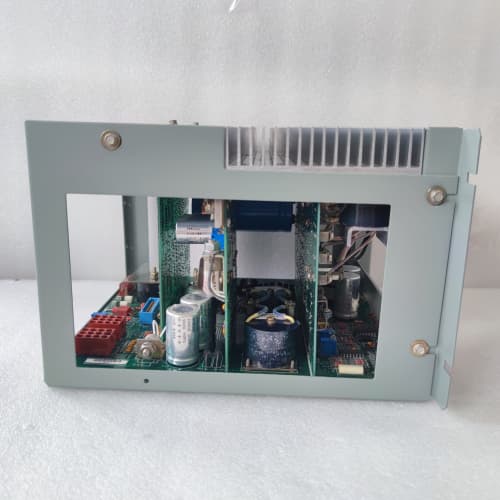
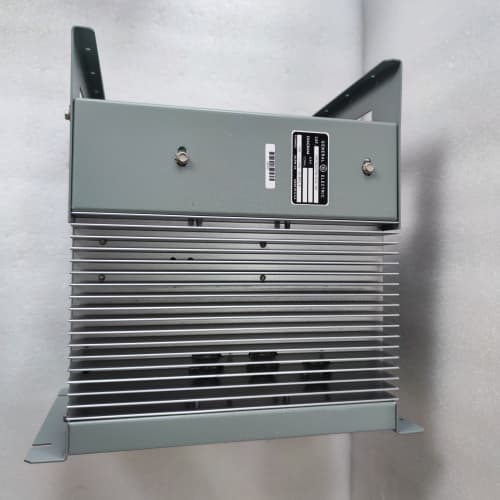
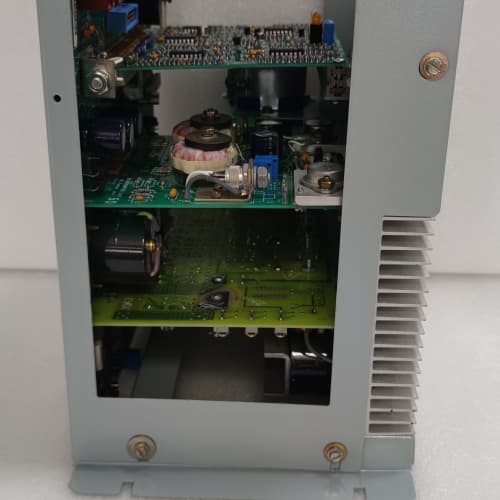
The GE DS3820PSSB is a specialized power conversion board for the Speedtronic Mark V turbine control system, designed with split output returns to isolate analog and digital power domains. Like all Mark V power supplies, this module mounts into a standard rack slot, takes nominal 125 VDC from the plant’s DC distribution, and generates the +5V, +15V, and -15V rails required by CPU, I/O, and servo control cards.
The “PSSB” designation indicates “Power Supply, Split Bus”—the critical differentiator being separate common (return) pins for analog circuits versus digital logic. In standard PSLB boards, all outputs share a single common return, which means transient currents from digital switching can create voltage offsets on the analog ground plane. The PSSB provides isolated analog and digital returns that only connect at a single star-point inside the module. For facilities with legacy analog servo loops or sensitive vibration monitoring cards that share the same chassis, this board reduces position jitter and improves measurement accuracy without adding external isolators.
Key Technical Specifications
| Parameter | Value |
|---|---|
| Manufacturer | GE (General Electric) |
| Model Number | DS3820PSSB |
| Series | Speedtronic Mark V |
| Input Voltage | 125 VDC nominal (100-140 VDC range) |
| Output Voltages | +5 VDC @ 5A, +15 VDC @ 1A, -15 VDC @ 0.5A |
| Output Returns | Separate analog common and digital common (internally star-grounded) |
| Total Output Power | 50W maximum |
| Isolation Rating | 1500 VDC (input-to-output), 500 VDC (output-to-output) |
| Analog-to-Digital Common Isolation | 10Ω impedance at 1 MHz (reduces high-frequency ground noise) |
| Output Ripple (max) | 40 mV p-p on +5V, 80 mV p-p on ±15V rails |
| Operating Temperature | 0 to +60°C (ambient, forced air required) |
| Storage Temperature | -40 to +85°C |
| Dimensions | 8.5″ x 4.2″ x 1.5″ (standard Mark V 1-slot width) |
| Connector | 96-pin DIN 41612 (Type C, male) with dedicated analog return pins (20, 21, 48, 49) |
| Mounting | Horizontal, rack backplane |
| Indicators | Three green LEDs per output rail; one amber LED indicating analog-digital ground differential >0.5V |
Key Selling Points & Differentiators
- Split analog and digital returns. The PSSB uses separate return pins for analog (+15VA, -15VA) and digital (+5VD, +15VD, -15VD) loads. This prevents digital switching noise from corrupting analog measurements—critical for servo position feedback, flame detection, and vibration monitoring cards that share the Mark V backplane.
- Reduces external isolator cost and complexity. Without this board, engineers often add external DC-DC isolators or signal conditioners to break ground loops. The PSSB handles this internally, saving panel space, wiring labor, and failure points.
- Amber LED warns of ground differential. If the analog and digital commons drift apart by more than 0.5V due to a backplane fault or miswired external device, the amber LED illuminates. This early warning lets you catch ground faults before they cause erratic turbine behavior or spurious trips.
- Drop-in mechanical compatibility. Same form factor, connector, and mounting as PSLB/PSLC variants. No backplane modifications or adapter cards required. In most cases, you can replace a standard PSLB with this PSSB without any wiring changes—just connect analog loads to the dedicated analog return pins on the backplane.
- 48-hour burn-in with ground-noise measurement. Every unit runs at 125 VDC with a mixed analog/digital load for 48 hours. We measure the voltage differential between analog and digital commons under load—it must stay below 50mV peak. Units that exceed this threshold are rejected.
- 18-month warranty covering output tolerance and ground isolation. If the split-ground function degrades (evidenced by amber LED illumination under normal load), we replace the board under warranty. Same 24-hour cross-ship policy as our standard PSLB inventory.
Frequently Asked Questions (FAQ)
Q: What makes the PSSB different from a standard DS3820PSLB?
A: The short answer is the ground returns. Standard PSLB boards have a single common return pin for all outputs—+5V, +15V, and -15V all share the same 0V reference. The PSSB splits the returns: digital loads (CPU, communication cards) use one set of return pins, and analog loads (servo drivers, transducers) use a separate set. These two return planes only connect inside the power supply at a single point through a low-impedance path designed to sink high-frequency noise. This means a 100mA digital switching transient on the +5V rail doesn’t create a 10mV offset on your analog servo command signal.
Q: Do I need to rewire my backplane to use this PSSB instead of a standard PSLB?
A: In most cases, no—the backplane already has the dedicated analog return pins wired to the correct slot positions. GE designed the Mark V backplane to support both standard and split-bus power supplies, using the same physical pins across all versions. If you’re currently running a standard PSLB, those analog return pins are simply tied to the main common on the backplane. When you insert a PSSB, those pins become active and isolated. The only scenario requiring rewiring is if someone previously modified the backplane wiring—check pins 20, 21, 48, and 49 for continuity to the main common. If they’re tied, you’ll need to break those connections and route them to your analog load commons. We can provide a pinout diagram for this.
Q: Can I use the PSSB in a cabinet that doesn’t have any analog cards?
A: Yes—there’s no harm in using the split-bus board in an all-digital cabinet. The amber LED that monitors ground differential will not illuminate because the analog and digital commons are not loaded separately—they essentially sit at the same potential. You get the same output voltages and ripple specs as a standard PSLB. The only downside is cost—the PSSB typically costs more due to the additional isolation components. For an all-digital cabinet, stick with the standard PSLB unless you anticipate adding analog cards in the future.
Q: I’m seeing erratic position feedback on my servo cards. Will this board fix that?
A: Possibly—we’ve seen this exact scenario at least a dozen times. The root cause is usually ground noise from digital cards coupling into the analog servo loop through the power supply common. If your servo card uses the same +15V and -15V rails as the digital I/O cards, and all returns share a single common, any digital transient creates a common-impedance voltage drop. The PSSB separates these returns, so the servo card’s analog reference stays clean. Before buying, we recommend a quick test: measure the AC voltage between the analog return pin and the main chassis ground while the turbine is running. If you see more than 50mV AC, the PSSB will likely solve your issue.
Q: I have a DS3820PSLC in my rack—can I swap it directly for this PSSB?
A: Yes, mechanically and electrically. The PSSB uses the same pinout and outputs as the PSLC. The PSLC is a “compact” variant with lower total output power (40W), while the PSSB delivers 50W, so you actually get more capacity. The only difference is the split return arrangement—the PSLC shares a single common. No jumper changes, no firmware, no configuration. Power down, swap, and the amber LED will tell you if your analog returns are properly isolated.
Q: How do I verify the ground isolation is actually working after I install the board?
A: Simple—monitor the amber LED on the front panel. It illuminates when the voltage between analog and digital commons exceeds 0.5V DC or 100mV AC. If it stays off, your ground paths are within spec. For a quantitative check, measure resistance between the analog return pins and digital return pins with the board powered down and unplugged—you should see approximately 10Ω (not a short, not open). With the board powered and running, measure the DC voltage between analog and digital commons at the backplane; it should be less than 50mV under normal load. We provide these values in our QC report for each unit.
Q: Is this board suitable for high-vibration environments like a gas turbine package?
A: The PSSB uses the same mechanical construction as standard PSLB boards—through-hole components with no surface-mount connectors prone to fretting corrosion. It is rated for standard industrial vibration per GE’s Mark V spec (5-200 Hz at 0.5g). That said, it does not have the conformal coating or extended temperature range of the DS3820PSLB1C1A variant. If you’re in a high-vibration or high-humidity environment, we recommend pairing the PSSB with a vibration-dampening rack mount or adding an enclosure heater. We’ve seen these boards survive 15 years on offshore platforms without coating, so the baseline construction is solid.
Q: What happens if the analog and digital commons get shorted externally in the field?
A: The PSSB’s internal star-ground connection includes a 10Ω current-limiting element that protects the board in the event of an external short between the two commons. If that short occurs, you’ll see the amber LED illuminate because the differential voltage exceeds 0.5V—the board continues to operate, but the noise isolation is compromised. The current through the 10Ω path is limited to about 50mA, so the board won’t be damaged. You’ll need to trace the external wiring to find the short—we’ve seen it happen when a technician ties all commons together on a terminal block, defeating the purpose of the split-bus design.
Q: Do you offer volume pricing if I need five or more of these?
A: Yes—we maintain a tiered pricing structure for quantities of 5, 10, and 25 units. However, the PSSB is a lower-production variant than the standard PSLB, so we typically have only 8-12 units in stock at any given time. For quantities above 5, we need to confirm physical availability before quoting. We also offer a core-exchange program for large orders: you return your used PSSB boards (any condition) and we refurbish or recycle them, reducing your net cost. Contact us directly for a volume quote—we’ll beat any legitimate competitor’s pricing on genuine stock.
AUTOMATIONX AXLINK100
FOXBORO FCP270 P0917YZ
Siemens 1FK6060-6AF71-1TA0
NI USB-6343
 Email: sales@plcfcs.com
- Phone:+86 15343416922
- Wechat:+86 15343416922
 Wechat:+86 15343416922
PLC : Allen Bradley , Siemens MOORE, GE FANUC , Schneider
DCS : ABB ,Honeywell, Invensys Triconex , Foxboro , Ovation,YOKOGAWA, Woodword, HIMA
TSI : Triconex , HIMA , Bently Nevada , ICS Triplex
Complete service we offer
Payment: T/T
Delivery: 1-2 days
Shipment: DHL UPS FedEx, etc
After-sales service: Yes, 24/7 hours