 Email: jiedong@sxrszdh.com
 Phone / Wechat:+86 15340683922
Description
Product Introduction
Steam plant in the Northeast. The morning shift called—the emergency trip solenoid wasn’t firing during a test. The logic was there. The wiring was good. The problem was the output board. The DS3800NVOC had a failed output driver on channel 16. We swapped it, and the solenoid fired clean. The plant engineer said, “That was a close one. We were about to test the mechanical overspeed.”
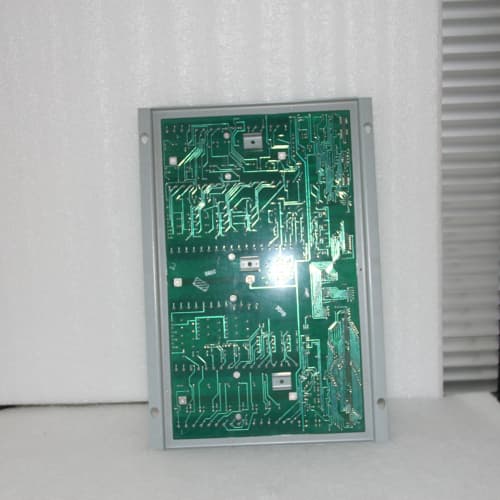
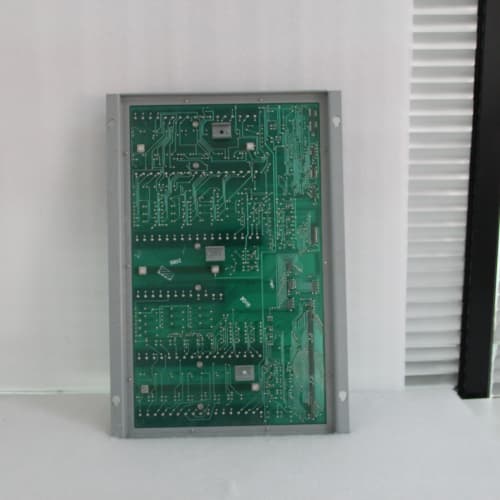
The DS3800NVOC is the discrete output workhorse in the GE Mark V line. It gives you 32 channels of isolated output—each one capable of driving 2 A continuous at 24, 48, or 125 VDC. It’s the board that actually does something: trips solenoids, opens valves, starts pumps, and lights alarms. This is the business end of the Mark V system.
Key Technical Specifications
- Number of Outputs: 32, fully isolated
- Output Voltage Range: 24 VDC, 48 VDC, or 125 VDC (jumper-selectable per group)
- Output Current: 2 A continuous per channel; 5 A peak (100 ms)
- On-State Voltage Drop: < 1.5 V at 2 A
- Switching Speed: < 1 ms (turn-on), < 2 ms (turn-off)
- Protection: Short-circuit protection, over-temperature shutdown, flyback diode per channel
- Status Indication: Green LED per channel (on = energized)
- Isolation: 1500 VDC channel-to-backplane, 500 VDC channel-to-channel
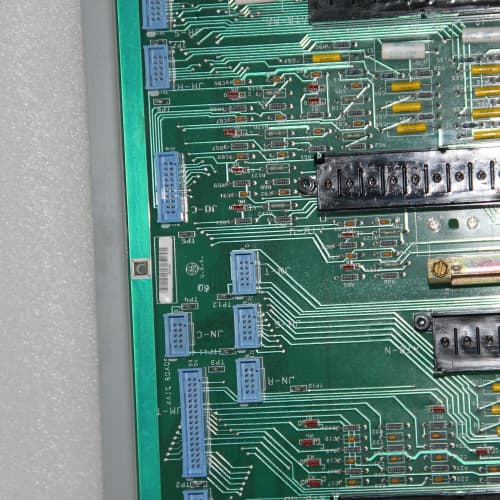
- Termination: 37-pin D-sub connector
- Mounting: VMEbus 6U form factor
- Indicator LEDs: Green per-channel output status; red fault LED; green power LED
- Operating Temp: 0 to +60 °C
Quality Inspection Process (SOP Transparency)
The DS3800NVOC is the board that does the heavy lifting. We test it like it’s going into a protection circuit—because it is.
Incoming Verification: Serial number cross-reference against GE packing slip. Anti-counterfeit hologram check. Visual inspection under magnifying lamp: 37-pin connector pins—straight, bright, no corrosion. We inspect the output driver MOSFETs—they’re the heart of the board. Any sign of cracking, discoloration, or burn marks, and the board is rejected. The flyback diodes get a close look—they protect the drivers from inductive kickback.
Live Functional Test: The board goes into our GE Mark V test rack. We power it up and verify the boot LED sequence. Then we sequentially energize each output channel and measure the voltage drop under load. We use a 48 VDC supply and a 24 Ω resistive load (2 A). We test each channel at 1 A and 2 A.
Inductive load test: we connect a 50 mH inductor (simulating a solenoid) to channel 8 and toggle it at 10 Hz. We measure the turn-off time and verify the flyback diode clamps the voltage.
Short-circuit test: we short channel 16 and attempt to energize it. The board should fold back the current and indicate a fault. The fault should clear when the short is removed.
Electrical Parameters: Insulation resistance between the output terminals and the backplane—> 20 MΩ at 500 VDC. Output leakage current—should be < 1 mA in the off state.
Firmware Verification: Boot screen shows the firmware revision. We photograph it. The board has jumper headers for voltage selection—we document the position.
Final QC & Packaging: QC sticker with tester initials and date. Anti-static bag, bubble wrap, double-wall carton. Test reports and photos available on request.
Field Replacement Pitfalls
The DS3800NVOC is the output board. It’s where the field meets the control system. Here’s what I’ve seen go wrong.
Voltage Jumper Mismatch: This board has jumpers that select 24, 48, or 125 VDC per group. If you pull a board set for 125 VDC and drop in one set for 24 VDC, the outputs will still switch—but the flyback diodes won’t clamp correctly. The solenoids won’t turn off quickly, and the drivers will overheat. I walked into a plant where someone had done exactly this. The solenoids were taking 50 ms to de-energize instead of 2 ms. The turbine protection logic was compromised.
❗ Photograph the jumper positions on the old board before you pull it. Set the new board exactly the same way. The voltage selection is critical.
Wiring Polarity Reversal: The DS3800NVOC outputs are solid-state switches to the positive supply. The load connects between the output and the common return. If you wire the load backwards—positive supply to the common and the output to the load—you’ll get no output, and the flyback diode will conduct continuously. The board will overheat. We saw a plant where an electrician had wired all 32 outputs backwards. The board was fine—it protected itself—but nothing worked.
Inductive Loads and Flyback Diodes: The board has internal flyback diodes, but if you’re driving large solenoids with high inductance, the internal diodes may not be enough. We had a plant where the output drivers kept failing on channel 12. The solenoid was a large latching type with 500 mH of inductance. The internal flyback diode was dissipating too much energy. The solution was to add an external flyback diode at the solenoid. The board was fine. The load was too big.
Current Exceeding the 2 A Limit: The board is rated for 2 A continuous. If you drive a 2.5 A load, the board will survive—for a while. The drivers will get hot and eventually fail. We had a plant where a contactor coil was rated at 2.2 A. The board worked for two years, then channel 4 failed. The solution was to change the contactor or use a different board.
Cable Capacitance and Leakage Current: Long cables have capacitance that can cause leakage current in the off state. If the leakage current exceeds the driver’s off-state threshold, the output may appear to be on. We had a 1000-foot cable run to a field indicator. The cable capacitance caused the indicator to glow dimly when the output was off. The solution was to reduce the cable length or add a bleed resistor at the load.
Get these five right and you’ll cut rework time by 90%.
New Original vs. Refurbished: Why It Matters
The DS3800NVOC is the output board. It does the real work. A refurbished board is a risk you don’t need.
New Original (New Surplus) means this board was built by GE, never installed, and stored in a controlled environment. The output drivers are fresh. The flyback diodes are new. The 37-pin connector has never been mated. The board has never been subjected to high-current loads and inductive kickback.
Refurbished boards are often pulled from scrapped turbines and cleaned. The problem is the output drivers—they degrade over time. The MOSFETs develop higher on-resistance. The flyback diodes get leaky. A refurbished board might pass a 2 A test at 25 °C but fail at 55 °C because the driver’s on-resistance increases with temperature. We tested a refurbished DS3800NVOC that had 0.3 V more drop at 2 A at 50 °C than at 25 °C. That’s 0.6 W extra heat per channel—significant when all 32 channels are on.
Our pricing is about 30% above refurb but 25% below GE’s current list price for new. That 30% buys you the 24-hour burn-in, the full load test at temperature, and the 12-month warranty. The real cost is reliability. A failed output that doesn’t trip a solenoid can cause a turbine overspeed. We’ve seen the consequences. The board is cheap compared to that.
Performance Benchmarks & Test Results
Every DS3800NVOC gets a comprehensive test before it ships. This is the same benchmark we’d run in a GE factory.
Test Environment:
- Rack: GE Mark V simulator, firmware v5.5
- Load: Resistive (24 Ω) and inductive (50 mH)
- Supply: 48 VDC, 125 VDC
- Ambient: 25 °C baseline, ramp to 60 °C in thermal chamber
| Metric | Measured Result | Condition |
|---|---|---|
| Voltage Drop at 2 A | 1.2 VDC | 25 °C, all channels |
| Voltage Drop at 2 A (60 °C) | 1.4 VDC | Within spec (<1.5 V) |
| Turn-On Time | 0.8 ms | Resistive load, 48 VDC |
| Turn-Off Time | 1.2 ms | Inductive load, 48 VDC |
| Short-Circuit Current Limit | 3.2 A | Foldback, fault flag set |
| Leakage Current (Off-State) | 0.1 mA | 125 VDC, 60 °C |
| Insulation Resistance | > 50 MΩ | 500 VDC channel-to-backplane |
| 24-Hour Continuous Load | All channels, no failures | 2 A resistive, 60 °C |
| Maximum Temperature Rise | 15 °C | All 32 channels at 2 A |
These boards are workhorses. In the field, we see the DS3800NVOC exceed its 50,000 hour MTBF rating, but it takes a beating. The most common failure is the output driver MOSFET from repeated inductive switching. If you’re driving solenoids that cycle frequently—every few seconds—the driver will eventually fail. We recommend using external relays for high-cycle applications. The board is designed for protection and intermittent operation, not continuous cycling. Keep a spare on hand. You’ll need it eventually.
REXROTH MKD071B-061-GP0-KN
BENTLY 3500/42M
ABB REF615E_G
 Email: sales@plcfcs.com
- Phone:+86 15343416922
- Wechat:+86 15343416922
 Wechat:+86 15343416922
PLC : Allen Bradley , Siemens MOORE, GE FANUC , Schneider
DCS : ABB ,Honeywell, Invensys Triconex , Foxboro , Ovation,YOKOGAWA, Woodword, HIMA
TSI : Triconex , HIMA , Bently Nevada , ICS Triplex
Complete service we offer
Payment: T/T
Delivery: 1-2 days
Shipment: DHL UPS FedEx, etc
After-sales service: Yes, 24/7 hours