 Email: jiedong@sxrszdh.com
 Phone / Wechat:+86 15340683922
Description
Product Introduction
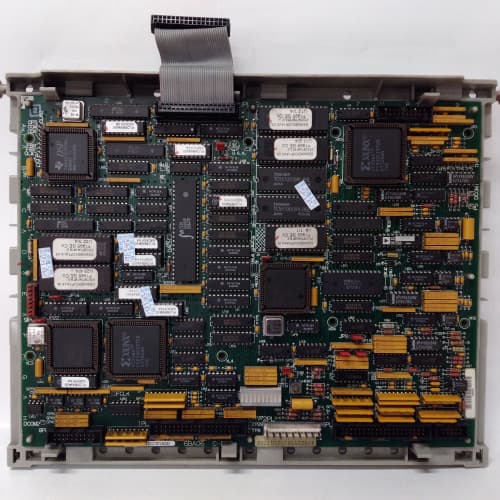
The GE DS2020BRCAG3 functions as the Bridge Rectifier Control (BRCA) module within the Mark VIe control platform, providing precision firing control and comprehensive monitoring for SCR-based power bridges used in generator excitation systems and variable-speed drive applications. This module interfaces directly with the Mark VIe controller via ISBus communication, generating precisely-timed firing pulses for up to 12 SCRs in 6-pulse, 12-pulse, or dual-bridge configurations, while continuously monitoring AC voltage, DC current, and bridge health parameters.
The primary differentiator is the third-generation firing algorithm with adaptive phase-angle control—the BRCA dynamically adjusts firing angles in response to real-time AC waveform distortion, load changes, and harmonic content, delivering stable DC output under challenging grid conditions. The G3 version includes enhanced diagnostic capabilities (individual SCR health monitoring, shoot-through detection, and di/dt reporting), improved noise immunity on feedback signals, and 16-bit resolution on all analog inputs. The module communicates with the main controller via high-speed ISBus and provides 12 optically-isolated fiber-optic firing outputs with configurable pulse width.
Key Technical Specifications
| Parameter | Value |
|---|---|
| Model Number | DS2020BRCAG3 |
| Manufacturer | GE Energy (now GE Vernova) |
| Series | Mark VIe |
| Function | Bridge Rectifier Control – SCR Firing Control and Monitoring for Power Bridges |
| Input Voltage | 24 V DC ±10% (via UPL or external supply) |
| Typical Current Draw | 350 mA at 24 V |
| SCR Firing Outputs | 12 channels, optically isolated, fiber-optic (ST-type connector) |
| Firing Pulse Width | 10-120 µs, configurable per channel |
| Firing Resolution | 0.1° (phase angle control) |
| Firing Accuracy | ±0.2° electrical (at 50/60 Hz) |
| Maximum dV/dt | 10 V/µs (firing signal) |
| AC Voltage Feedback | 6 channels (3-phase, two isolated sets for dual-bridge) |
| AC Voltage Range | 0-600 V AC (isolated via voltage transformers) |
| AC Voltage Resolution | 16-bit (0.0015% of full scale) |
| DC Current Feedback | 4 channels, 0-100 mA or 4-20 mA (isolated inputs) |
| DC Current Resolution | 16-bit (0.0015% of full scale) |
| Firing Algorithm | Adaptive phase-angle control with active harmonic compensation |
| Protection Features | Shoot-through detection, phase-loss detection, current imbalance detection, di/dt overshoot detection |
| SCR Health Monitoring | Individual SCR resistance measurement (on-command), conduction monitoring, temperature estimation |
| Diagnostic Reporting | Per-SCR firing verification, feedback validation, fault status, bridge health status (via ISBus) |
| Communication | ISBus (500 kbps) |
| Operating Temperature | -25 to +60°C (ambient, forced air recommended above 50°C) |
| Storage Temperature | -40 to +85°C |
| Mounting | DIN-rail mount (standard 35 mm) |
| Terminals | Spring-clamp (push-in) for feedback signals; fiber-optic ST ports for firing outputs |
| LED Status | Power, ISBus Active, Fault, Firing Active, Feedback Valid, Shoot-Through Detected |
Key Selling Points & Differentiators
- Adaptive Firing Control: Third-generation firing algorithm with active harmonic compensation adjusts firing angles dynamically based on AC waveform distortion—delivers stable DC output even with utility grid harmonics, load transients, or non-ideal AC waveforms.
- High-Resolution Firing: 0.1° firing resolution with ±0.2° accuracy—enables precise DC voltage control for generator excitation and motor drives, reducing output ripple and improving system efficiency.
- 12 Optically-Isolated Firing Outputs: Supports 6-pulse, 12-pulse, and dual-bridge configurations—flexible for a wide range of excitation and drive applications.
- Comprehensive SCR Health Monitoring: Individual SCR resistance measurement, conduction monitoring, and temperature estimation—enables predictive maintenance and early warning of SCR degradation or failure.
- Advanced Protection: Shoot-through detection (response time <10 µs), phase-loss detection, and di/dt overshoot monitoring—prevents catastrophic bridge failures and protects power semiconductors.
- Dual-Bridge Support: 6 AC voltage feedback inputs (two independent 3-phase sets) support dual-bridge (series or parallel) configurations for high-current or high-voltage applications.
- Full Live Test Certification: Each unit undergoes a 48-hour burn-in with full firing simulation (all 12 channels), AC and DC feedback simulation, and protection feature validation. We log the MAC ID, firing calibration data, and diagnostic baselines for traceability.
- Direct Drop-In Replacement: Form-fit-function compatible with DS2020BRCAG1, G2, and earlier BRCA revisions. Existing wiring and fiber-optic connections remain unchanged.
- 90-Day Warranty: Includes technical support and cross-ship replacement within 24 hours if the module fails to generate firing pulses, reports incorrect feedback values, protection circuits fail to detect faults, or diagnostics report false health status.
Frequently Asked Questions (FAQ)
Q1: What’s the difference between the DS2020BRCAG3 and the DS2020BRCAG2?
The G3 has three major improvements: (1) adaptive firing algorithm with harmonic compensation—dynamically adjusts for AC waveform distortion, (2) SCR health monitoring (individual resistance measurement, conduction monitoring, temperature estimation), and (3) improved protection features (di/dt overshoot detection and faster shoot-through response). The G3 also includes improved EMI immunity on the feedback inputs and higher vibration tolerance. Functionally, both modules control SCR bridges, but the G3 provides better performance under non-ideal grid conditions and enhanced predictive maintenance capabilities.
Q2: What types of SCR bridges can the BRCA control?
The BRCA controls 6-pulse, 12-pulse, and dual-bridge configurations (series or parallel) for both line-commutated and forced-commutated SCR bridges. It supports firing angles from 0° to 180° (for rectifier mode) and 180° to 360° (for inverter mode). The 12 firing outputs are independently configurable, so you can drive 12-pulse bridges (six SCRs in each of two bridges) or dual-bridge systems with separate firing angles. The BRCA also supports pulse-width modulation (PWM) for high-frequency switching applications, though this is less common for line-commutated bridges.
Q3: How do I configure the firing angle and pulse width?
Configuration is done through ToolboxST using the BRCA configuration block. You set the firing angle (in degrees), pulse width (in microseconds), and firing mode (rectifier or inverter) per channel or per bridge. The BRCA includes built-in phase-locked loop (PLL) for synchronization with the AC line frequency—the firing angle is relative to the zero-crossing of the AC voltage. The adaptive harmonic compensation is enabled by default, but you can disable it if you have a clean AC source and prefer fixed firing angles. We recommend enabling it for most applications.
Q4: The shoot-through detection triggered during commissioning—what could be the cause?
Shoot-through occurs when two SCRs on the same bridge leg conduct simultaneously, causing a short-circuit across the DC bus. The BRCA’s shoot-through detection monitors the firing signals and AC current feedback. If the module detects shoot-through, it immediately blocks all firing pulses and reports a fault. Common causes: (1) incorrect firing sequence configuration (SCRs firing in the wrong order), (2) misfiring SCRs (a faulty SCR that turns on at the wrong time), (3) incorrect firing angle causing excessive commutation overlap, or (4) a shorted SCR that’s conducting all the time. During commissioning, we recommend starting with firing angles near 90° (balanced) and verifying each SCR’s conduction with an oscilloscope before advancing to full power.
Q5: Does the BRCA support fiber-optic firing cables, and what’s the maximum cable length?
Yes. The BRCA uses standard ST-type fiber-optic connectors for the firing outputs. The maximum cable length is 50 meters with standard industrial fiber-optic cables (multimode, 62.5/125 µm). For longer distances, use optical amplifiers or repeaters. The fiber-optic firing signals are optically isolated from the module’s internal electronics, providing excellent immunity to EMI and ground loops. The G3 version includes diagnostic feedback on the fiber-optic link—the module monitors the optical power level and reports a warning if the link degrades.
Q6: What’s the purpose of the SCR health monitoring, and how does it work?
The SCR health monitoring feature provides predictive maintenance for the power bridge. During a scheduled test (e.g., during plant shutdown), the BRCA applies a small test voltage to each SCR in sequence and measures the leakage current and resistance. This detects: (1) degraded SCRs with increased leakage current, (2) open-circuit SCRs (no conduction), and (3) shorted SCRs (continuous conduction). The module also monitors the SCR’s conduction time and temperature (via the thermal model) during normal operation. If the module detects degradation, it reports a maintenance alert. This allows you to replace SCRs before they fail unexpectedly, preventing catastrophic bridge failures and unplanned outages.
Q7: What’s the typical lead time for the BRCAG3, and do you recommend stocking spares?
The BRCAG3 is a moderately stocked module—we maintain 3-5 units in inventory. Standard lead time for orders of 1-3 units is 1-2 weeks due to the specialized firing calibration and validation. For critical generators with SCR exciters, we strongly recommend stocking one spare BRCA per site. If you have a fleet of 5+ turbines, a 20% spare ratio is standard practice due to the criticality of the module. If the BRCA fails, the generator may lose excitation, leading to a turbine trip. If you need immediate delivery and the G3 is out of stock, consider the G2 as a substitute—it’s drop-in compatible with the same wiring and fiber-optic connections, just without the adaptive harmonic compensation. Call our support line for expedited options.
GE FANUC IS230TCISH7C DCSPLC
GE FANUC IS230TCISH9 PLC
GE FANUC IS230TDBTH6A PLC
 Email: sales@plcfcs.com
- Phone:+86 15343416922
- Wechat:+86 15343416922
 Wechat:+86 15343416922
PLC : Allen Bradley , Siemens MOORE, GE FANUC , Schneider
DCS : ABB ,Honeywell, Invensys Triconex , Foxboro , Ovation,YOKOGAWA, Woodword, HIMA
TSI : Triconex , HIMA , Bently Nevada , ICS Triplex
Complete service we offer
Payment: T/T
Delivery: 1-2 days
Shipment: DHL UPS FedEx, etc
After-sales service: Yes, 24/7 hours