 Email: jiedong@sxrszdh.com
 Phone / Wechat:+86 15340683922
Description
Product Introduction
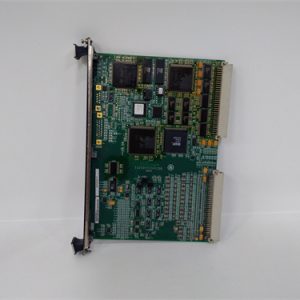
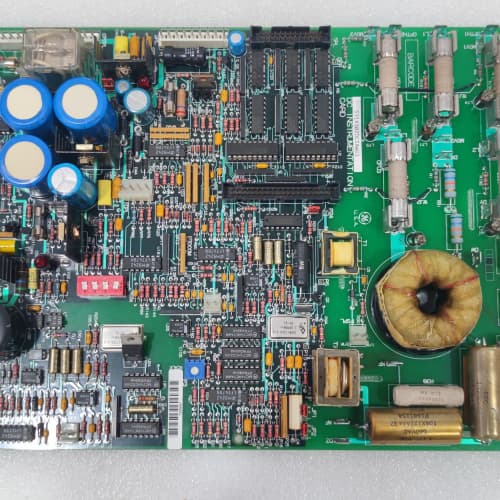
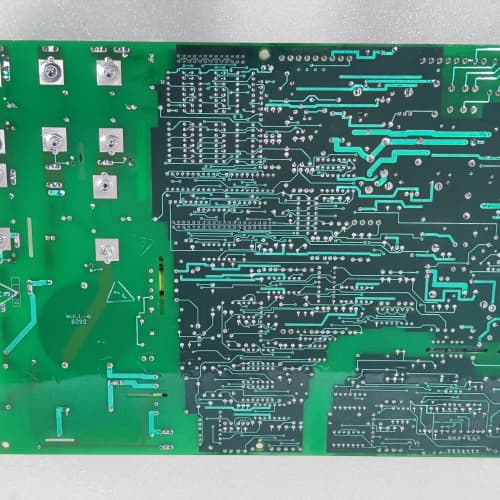
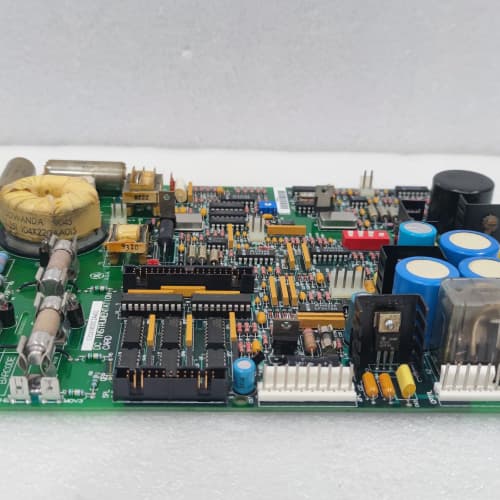
This GE 531X306LCCBKM1 is a logic and communications controller designed for complex multi-vendor integration. The “K” suffix indicates enhanced protocol support beyond the standard GE proprietary and Modbus RTU capabilities. This board is built for systems where the drive must communicate with multiple different devices using different protocols simultaneously.
The board provides 4 isolated analog inputs, 4 isolated analog outputs, 8 differential digital inputs, 8 standard configurable I/O channels, and dual serial ports (RS-232 and RS-422/485). The enhanced protocol stack includes support for GE proprietary, Modbus RTU, and additional protocols such as DF1 (Allen-Bradley) and various legacy industrial protocols. This board is ideal for retrofits and modernizations where the drive must coexist with older proprietary equipment without requiring external protocol converters.
Key Technical Specifications
| Parameter | Value |
|---|---|
| Manufacturer | GE (General Electric) |
| Model Number | 531X306LCCBKM1 |
| Product Type | Logic and Communications Controller Board (Analog + Differential + Multi-Protocol) |
| Serial Ports | 2 (RS-232, RS-422/485) |
| Baud Rate | 300 to 38,400 bps |
| Digital I/O | 16 channels (8 differential inputs, 8 single-ended configurable) |
| Input Type (Ch 1-8) | Differential, ±10 V common-mode rejection |
| Input Type (Ch 9-16) | Single-ended configurable input/output |
| Output Drive | 0.5 A per digital output channel |
| Analog Inputs | 4 channels (4-20 mA or 0-10 V, software selectable) |
| Analog Input Resolution | 12-bit (0.1% accuracy) |
| Analog Outputs | 4 channels (4-20 mA or 0-10 V, software selectable) |
| Analog Output Resolution | 12-bit (0.1% accuracy) |
| Analog Isolation | 2500 V (channel-to-channel) |
| Protocol Support | GE proprietary, Modbus RTU, DF1, plus custom/legacy protocols |
| Co-Processor | Dedicated communications processor with enhanced firmware |
| Communication | 50-pin ribbon cable to main regulator board |
| Operating Temperature | 0 to +55 °C |
| Storage Temperature | -40 to +85 °C |
| Board Dimensions | 12.7 in x 6.0 in (approx) |
Key Selling Points & Differentiators
- Multi-Protocol Support: Enhanced firmware supports DF1 (Allen-Bradley) and various legacy protocols in addition to GE proprietary and Modbus RTU. This eliminates the need for external protocol converters in mixed-vendor systems.
- Full I/O Capability: Combines 8 analog channels, 8 differential digital inputs, and 8 standard I/O. Handles virtually any industrial signal type.
- Differential Digital Inputs: Channels 1-8 reject common-mode noise up to ±10 V. Essential for remote sensors in electrically noisy environments.
- Quantified Testing Protocol: We test each protocol supported by the board’s firmware. We verify GE proprietary, Modbus RTU, and DF1 communication with actual PLCs or simulators. Analog and digital I/O are tested to full specification.
- Warranty & Support: 2-year functional warranty. We provide a comprehensive multi-protocol configuration guide and wiring documentation. We also verify the specific protocol versions supported by the firmware on your board.
Frequently Asked Questions (FAQ)
Q1: What protocols does the “K” variant support?
A: The “K” variant supports GE proprietary, Modbus RTU, and DF1 (Allen-Bradley) protocols. Some boards may also support additional legacy protocols depending on the specific firmware version. We verify the exact protocol support during our QC process. The enhanced protocol stack is stored in the board’s EPROM. We can confirm the supported protocols for each board in our inventory before shipping.
Q2: What is the difference between the LCCBKM1 and the LCCBBM1?
A: The LCCBKM1 has enhanced protocol support (multi-protocol) with the same hardware as the LCCBBM1. The LCCBBM1 supports GE proprietary and Modbus RTU only. If you need DF1 or other legacy protocols, you need the K variant. The analog and digital I/O are identical on both boards.
Q3: Can I use this board to connect to an Allen-Bradley PLC?
A: Yes, the board supports the DF1 protocol used by Allen-Bradley PLC-5, SLC 500, and older ControlLogix chassis with serial modules. The board operates as a DF1 slave. It does not support DF1 full-duplex with the DH-485 protocol variant. We have verified compatibility with PLC-5/40 and SLC 5/04 processors at 19.2 kbps. We provide the DF1 configuration parameters in our documentation.
Q4: Does this board support simultaneous communication on both serial ports?
A: Yes, both serial ports operate independently and can run different protocols simultaneously. For example, Port 1 (RS-232) can run GE proprietary for a local HMI, while Port 2 (RS-422/485) runs Modbus RTU for a PLC network. The communications co-processor handles both protocols without degrading performance. This is a key advantage of this board in mixed-vendor systems.
Q5: Can I use the differential inputs with a standard two-wire proximity sensor?
A: No. Two-wire sensors do not provide a separate return for the differential pair. For the differential inputs, you need a three-wire sensor (power, signal, and return). If you have two-wire sensors, use channels 9-16 (single-ended). The differential inputs on channels 1-8 require a separate return wire to reject common-mode noise.
Q6: What is the common-mode voltage range for the differential inputs?
A: The differential inputs reject common-mode noise up to ±10 V. This is sufficient for most industrial environments with properly grounded equipment. The inputs have a 4 µs response time. Do not use them for high-speed pulse trains above 5 kHz.
Q7: Are the analog inputs and outputs isolated?
A: Yes, each of the 8 analog channels (4 inputs, 4 outputs) is individually isolated from the others, from the digital I/O, and from the logic. The isolation rating is 2500 V. This prevents ground loops and protects the drive from field wiring faults on the analog side.
Q8: Does this board support Modbus RTU and DF1 simultaneously on the same port?
A: No, each port can run only one protocol at a time. However, the two ports are independent, so you can run Modbus RTU on Port 2 and DF1 on Port 1 simultaneously. The protocols cannot be mixed on a single port because they use different framing and data formats. The protocol is selected through drive parameters.
Q9: How do I configure the protocol on each serial port?
A: The protocol for each port is set through drive parameters. You select the protocol (GE proprietary, Modbus RTU, DF1, etc.) and configure the baud rate, data bits, parity, and stop bits. We provide the parameter paths in our documentation. The board does not have jumpers for protocol selection—it is entirely software-configured.
Q10: What is the lifecycle status of the LCCBKM1?
A: This is one of the rarer boards in the 306 series. GE produced the multi-protocol variant in limited quantities for OEMs requiring mixed-vendor integration. We have a small batch of new surplus units. Used pulls are uncommon because the enhanced protocol firmware is often specific to an OEM application. If your system relies on the multi-protocol capability, we recommend securing a spare. Our new surplus units are fully tested and verified for protocol support. We do not expect to source more of this variant.
ABB TC512V1 3BSE018059R1
EPRO MMS6110
HONEYWELL FS-SAI-1620M/A
GE IC693CMM321
 Email: sales@plcfcs.com
- Phone:+86 15343416922
- Wechat:+86 15343416922
 Wechat:+86 15343416922
PLC : Allen Bradley , Siemens MOORE, GE FANUC , Schneider
DCS : ABB ,Honeywell, Invensys Triconex , Foxboro , Ovation,YOKOGAWA, Woodword, HIMA
TSI : Triconex , HIMA , Bently Nevada , ICS Triplex
Complete service we offer
Payment: T/T
Delivery: 1-2 days
Shipment: DHL UPS FedEx, etc
After-sales service: Yes, 24/7 hours