 Email: jiedong@sxrszdh.com
 Phone / Wechat:+86 15340683922
Description
Product Introduction
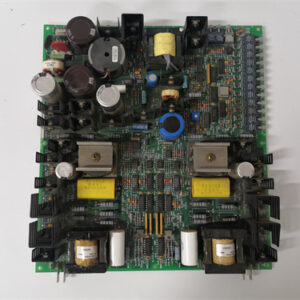
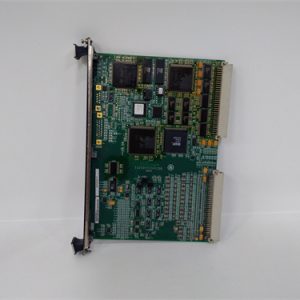
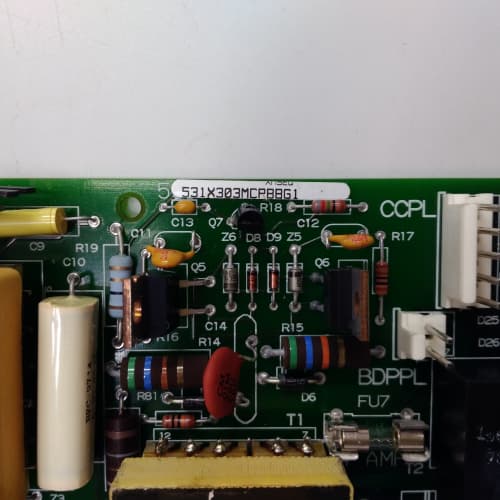
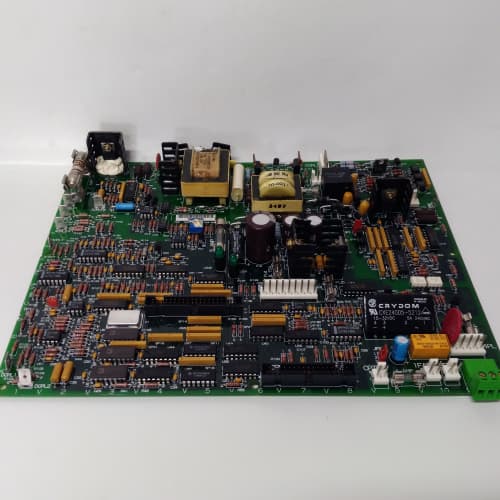
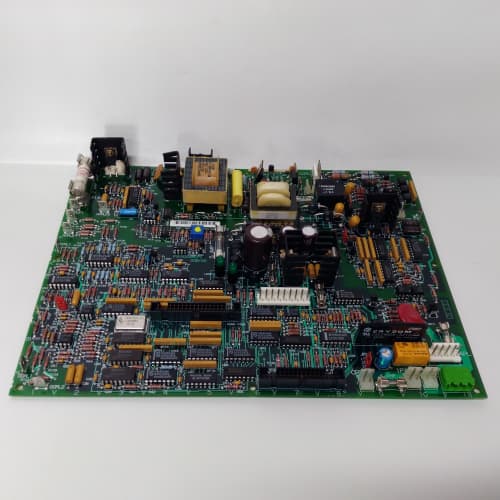
This GE 531X306LCCBEM1 is an Ethernet-enabled logic and communications controller combining isolated analog I/O with modern network connectivity. The “E” suffix adds dual Ethernet ports with an integrated switch to the analog I/O and digital capabilities of the LCCB series. This board is designed for process control applications requiring integration with modern PLCs and SCADA systems over Ethernet.
The board provides 4 isolated analog inputs, 4 isolated analog outputs, 16 configurable digital I/O points, and dual 10/100 Ethernet ports with an integrated switch. This allows daisy-chaining of drives and simplifies network topology. The board supports Modbus TCP, Ethernet/IP, and GE proprietary protocols. The onboard co-processor handles the Ethernet protocol stacks, offloading the main drive CPU. This is a complete process control solution with modern network connectivity, eliminating the need for separate analog modules, serial converters, or protocol gateways.
Key Technical Specifications
| Parameter | Value |
|---|---|
| Manufacturer | GE (General Electric) |
| Model Number | 531X306LCCBEM1 |
| Product Type | Logic and Communications Controller Board (Analog I/O + Ethernet) |
| Ethernet Ports | 2 (10/100 Mbps, integrated switch) |
| Serial Ports | 1 (RS-232) |
| Baud Rate | 300 to 19,200 bps |
| Digital I/O | 16 configurable inputs/outputs (24 VDC) |
| Output Drive | 0.5 A per digital output channel |
| Analog Inputs | 4 channels (4-20 mA or 0-10 V, software selectable) |
| Analog Input Resolution | 12-bit (0.1% accuracy) |
| Analog Outputs | 4 channels (4-20 mA or 0-10 V, software selectable) |
| Analog Output Resolution | 12-bit (0.1% accuracy) |
| Analog Isolation | 2500 V (channel-to-channel) |
| Protocol Support | Modbus TCP, Ethernet/IP, GE proprietary |
| Co-Processor | Dedicated communications processor |
| Communication | 50-pin ribbon cable to main regulator board |
| Operating Temperature | 0 to +55 °C |
| Storage Temperature | -40 to +85 °C |
| Board Dimensions | 12.7 in x 6.0 in (approx) |
Key Selling Points & Differentiators
- Analog I/O + Ethernet on One Board: Combines 8 analog channels and 16 digital I/O with dual Ethernet ports. No separate analog modules or gateways needed. This saves rack space and reduces installation cost.
- Dual Ethernet Ports with Integrated Switch: Daisy-chain multiple drives without external switches. Simplifies network cabling and reduces infrastructure cost.
- Multi-Protocol Support: Handles Modbus TCP and Ethernet/IP natively. Compatible with Allen-Bradley and Siemens PLCs and most modern SCADA systems.
- Quantified Testing Protocol: We test analog inputs and outputs against precision references to 0.1% accuracy. Ethernet ports are tested at 100 Mbps full-duplex with continuous communication for 8 hours.
- Warranty & Support: 2-year functional warranty. We provide a complete network and process wiring guide covering IP addressing, analog loop wiring, and protocol selection.
Frequently Asked Questions (FAQ)
Q1: What is the difference between the LCCBEM1 and the LCCBAM1?
A: The LCCBAM1 has dual serial ports (RS-232 and RS-422/485) but no Ethernet. The LCCBEM1 replaces the RS-422/485 port with dual Ethernet ports and an integrated switch. The LCCBEM1 also has only one RS-232 port for local programming. The analog and digital I/O are identical. Choose based on your network infrastructure. The LCCBEM1 is for modern Ethernet networks; the LCCBAM1 is for legacy serial networks.
Q2: Does this board support Ethernet/IP as a scanner or adapter?
A: The board operates as an Ethernet/IP adapter (slave) only. It responds to I/O messages from a PLC or scanner. It does not act as a scanner/master. This is typical for drive applications. The board supports implicit (I/O) and explicit messaging. If you need the drive to initiate communications, you would need additional gateway hardware.
Q3: Can I use both Ethernet ports to connect to two separate networks?
A: No, both ports are part of the same internal switch and operate on the same IP subnet. They are for daisy-chaining devices on the same network, not for dual-homing. The board does not support VLAN tagging or routing. If you need redundant network connections, consider the NTBANG1 variant or use an external switch with redundancy features.
Q4: Are the analog inputs and outputs isolated?
A: Yes, each of the 8 analog channels (4 inputs, 4 outputs) is individually isolated from the others, from the digital I/O, and from the Ethernet and logic. The isolation rating is 2500 V. This is critical in process control applications where ground loops and sensor faults are common. A short on one analog input will not affect the other channels or the Ethernet communication.
Q5: Can I use 4-20 mA sensors that are externally powered?
A: Yes, the analog inputs accept 4-20 mA signals from both self-powered and loop-powered transmitters. The board provides a built-in 24 VDC supply for each analog input for loop power, which can be enabled per channel. Be careful not to enable loop power on a channel connected to a self-powered transmitter—that could damage both devices. The analog outputs can drive 4-20 mA loops with a maximum load of 600Ω.
Q6: Does this board support Modbus TCP?
A: Yes, the board supports Modbus TCP as a slave. The Modbus TCP server supports up to 16 simultaneous connections. The analog and digital I/O data are mapped to holding registers. We provide the complete register map in our documentation. We test Modbus TCP communication during QC with a Modbus master simulator at full network load.
Q7: What is the maximum cable length for the Ethernet ports?
A: Standard 100Base-TX specification applies: 100 meters (328 feet) with Cat5e or better cable. The board has auto-MDI/MDIX, so either straight-through or crossover cables can be used. We recommend shielded Cat6 cable in industrial environments for noise immunity. For runs longer than 100 meters, use a switch or a media converter.
Q8: How many drives can I daisy-chain with this board?
A: The integrated switch supports up to 32 drives in a daisy-chain topology. With 16 drives running at a 5 ms update cycle, the network bandwidth usage is approximately 60%. Beyond 20 drives, we recommend a star topology to avoid excessive hop delays. The board’s internal switch does not introduce significant latency, but each additional hop adds about 2 µs of delay.
Q9: Does the board have an RS-232 port for local programming?
A: Yes, the board retains one RS-232 port for local programming or HMI connection. This is useful for commissioning and troubleshooting when the Ethernet network is not available. The RS-232 port operates independently from the Ethernet ports and uses the same protocol as the serial variants. You can connect a laptop with a serial cable for parameter configuration.
Q10: What is the lifecycle status of the LCCBEM1?
A: This board is extremely rare. GE produced it in limited quantities for applications requiring both analog I/O and Ethernet. We have a small batch of new surplus units. Used pulls are practically non-existent. If your application requires this combination of features, we recommend securing a spare. Our new surplus units are fully tested, calibrated, and guaranteed. Once this stock is sold, this board will be extremely difficult to source.
PROSOFT MVI56-MCMR
JETTER DIMA3-ES-16
ABB DSMB-01C
 Email: sales@plcfcs.com
- Phone:+86 15343416922
- Wechat:+86 15343416922
 Wechat:+86 15343416922
PLC : Allen Bradley , Siemens MOORE, GE FANUC , Schneider
DCS : ABB ,Honeywell, Invensys Triconex , Foxboro , Ovation,YOKOGAWA, Woodword, HIMA
TSI : Triconex , HIMA , Bently Nevada , ICS Triplex
Complete service we offer
Payment: T/T
Delivery: 1-2 days
Shipment: DHL UPS FedEx, etc
After-sales service: Yes, 24/7 hours