 Email: jiedong@sxrszdh.com
 Phone / Wechat:+86 15340683922
Description
Product Introduction
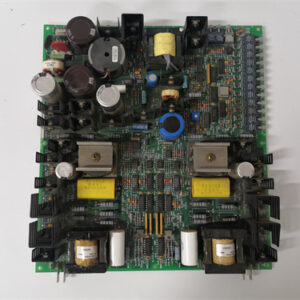
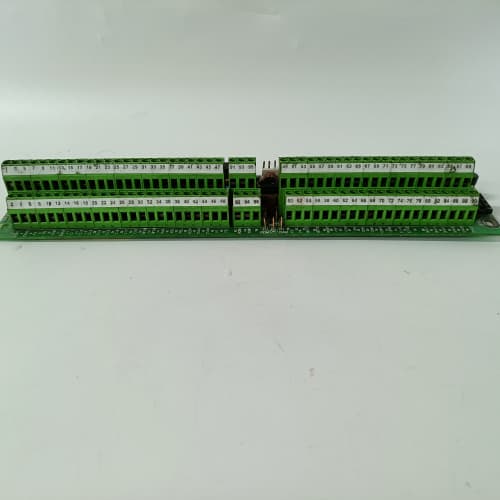
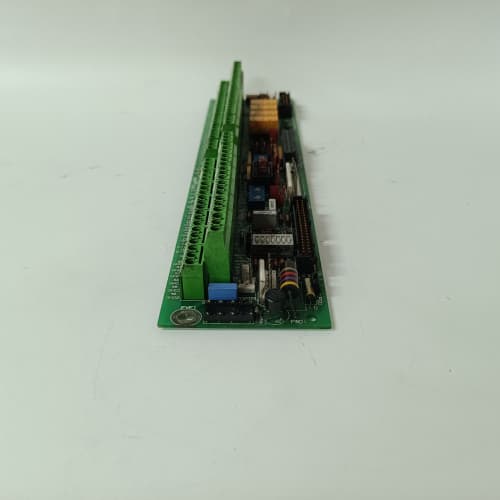
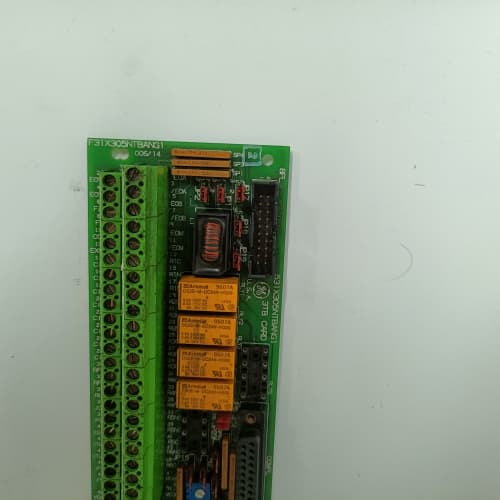
This GE 531X306LCCAEM1 is an Ethernet-enabled logic and communications controller for the DC-300 and AC-300 drive platforms. The “E” suffix designates the addition of dual Ethernet ports with an integrated switch, providing modern network connectivity alongside the board’s high-density I/O and serial communication capabilities.
The board combines 24 configurable digital I/O points with dual 10/100 Ethernet ports for network communication. The integrated two-port switch allows daisy-chaining of drives without external switches, simplifying network topology. The onboard co-processor handles both the serial and Ethernet protocol stacks, offloading the main drive CPU. The board supports Modbus TCP, Ethernet/IP, and GE proprietary protocols, making it suitable for integration with modern PLCs and SCADA systems.
Key Technical Specifications
| Parameter | Value |
|---|---|
| Manufacturer | GE (General Electric) |
| Model Number | 531X306LCCAEM1 |
| Product Type | Logic and Communications Controller Board (Ethernet) |
| Ethernet Ports | 2 (10/100 Mbps, integrated switch) |
| Serial Ports | 1 (RS-232) |
| Baud Rate | 300 to 19,200 bps |
| Digital I/O | 24 configurable inputs/outputs (24 VDC) |
| Output Drive | 0.5 A per digital output channel |
| Protocol Support | Modbus TCP, Ethernet/IP, GE proprietary |
| Co-Processor | Dedicated communications processor |
| Isolation | 2500 V (opto-isolated I/O, transformer-isolated Ethernet) |
| Communication | 50-pin ribbon cable to main regulator board |
| Operating Temperature | 0 to +55 °C |
| Storage Temperature | -40 to +85 °C |
| Board Dimensions | 12.7 in x 6.0 in (approx) |
Key Selling Points & Differentiators
- Dual Ethernet Ports with Integrated Switch: Daisy-chain multiple drives without external network switches. Reduces cabling and simplifies network architecture.
- 24 Configurable I/O Points: High-density I/O capacity eliminates the need for separate I/O boards in most applications. Each channel can be individually configured as input or output.
- Multi-Protocol Support: Handles Modbus TCP and Ethernet/IP natively. Compatible with Allen-Bradley and Siemens PLCs without additional gateway hardware.
- Quantified Testing Protocol: We test the Ethernet ports at 100 Mbps full-duplex with continuous communication for 8 hours. We also test the I/O points at full load and the RS-232 port at all baud rates.
- Warranty & Support: 2-year functional warranty. We provide a network configuration guide covering IP addressing, switch settings, and protocol selection. A common mistake is incorrect IP addressing—our guide prevents it.
Frequently Asked Questions (FAQ)
Q1: What is the difference between the LCCAEM1 and the LCCAAM1?
A: The LCCAAM1 has dual serial ports (RS-232 and RS-422/485) but no Ethernet. The LCCAEM1 replaces the RS-422/485 port with dual Ethernet ports and an integrated switch. The LCCAEM1 also has only one RS-232 port for local programming. The I/O count (24 points) is identical. The LCCAEM1 is for modern Ethernet networks; the LCCAAM1 is for legacy serial networks. Choose based on your network infrastructure.
Q2: Does this board support Ethernet/IP as a scanner or adapter?
A: The board operates as an Ethernet/IP adapter (slave) only. It responds to I/O messages from a PLC or scanner device. It does not act as a scanner/master. This is typical for drive applications—the drive is a target device. The board supports implicit messaging for I/O data and explicit messaging for parameter access. If you need the drive to initiate communications, you would need additional gateway hardware.
Q3: Can I use both Ethernet ports to connect to two separate networks?
A: No, both ports are part of the same internal switch and operate on the same IP subnet. They are for daisy-chaining devices on the same network, not for dual-homing to separate networks. If you need to connect the drive to two different networks, you need an external router or an additional network interface card. The board does not support VLAN tagging or routing.
Q4: What is the maximum cable length for the Ethernet ports?
A: Standard 100Base-TX specification applies: 100 meters (328 feet) with Cat5e or better cable. The board has auto-MDI/MDIX, so either straight-through or crossover cables can be used. We recommend shielded Cat6 cable in industrial environments for noise immunity. In high-EMI environments, fiber-optic Ethernet (via external media converters) is recommended, though the board itself is copper-only.
Q5: How many drives can I daisy-chain with this board?
A: The integrated switch supports up to 32 drives in a daisy-chain topology. The limiting factor is the network load—each drive adds traffic, and the 100 Mbps bandwidth is shared. With 32 drives, you will need to optimize update rates. In our test lab, 16 drives running at a 5 ms update cycle consumed about 60% of the network bandwidth. Beyond 20 drives, we recommend using a star topology with a central industrial switch to avoid excessive hop delays.
Q6: Does this board have a serial port for local programming?
A: Yes, the board retains one RS-232 port for local programming or HMI connection. This is useful for commissioning and troubleshooting when the Ethernet network is not available. The RS-232 port operates independently from the Ethernet ports. You can connect a laptop with a serial cable to the drive while it is on the Ethernet network without interference.
Q7: Does the board support Modbus TCP?
A: Yes, the board supports Modbus TCP as a slave. It responds to Modbus TCP requests from a PLC or SCADA system. The Modbus TCP server supports multiple simultaneous connections—up to 16. The data mapping follows the same register addresses as the Modbus RTU implementation. We test Modbus TCP communication during our QC process with a Modbus master simulator.
Q8: Is this board a drop-in replacement for the LCCAAM1?
A: Physically, yes—the same dimensions, mounting holes, and 50-pin ribbon connector. However, the terminal block wiring is different because the serial ports are not in the same positions. The LCCAEM1 has only one RS-232 port, so you would need to re-terminate your serial wiring. Also, if your application relies on RS-422/485 networking, you will need to migrate to Ethernet. Plan the upgrade carefully.
Q9: What is the lifecycle status of the LCCAEM1?
A: This board is rare. GE produced the Ethernet variant in limited quantities for customers migrating from serial to Ethernet networks. We have a small batch of new surplus units. This is the only board in the 306 series with Ethernet capability, making it valuable for modernizing legacy GE drive systems. Once our stock is sold, this board will be difficult to source. Used pulls often have damaged Ethernet ports from electrical surges. Our new surplus units are free from that risk.
A-B 2711-T10C8
ABB EHDB280
Motorola MVME5100
DIA SCM-DTU2
 Email: sales@plcfcs.com
- Phone:+86 15343416922
- Wechat:+86 15343416922
 Wechat:+86 15343416922
PLC : Allen Bradley , Siemens MOORE, GE FANUC , Schneider
DCS : ABB ,Honeywell, Invensys Triconex , Foxboro , Ovation,YOKOGAWA, Woodword, HIMA
TSI : Triconex , HIMA , Bently Nevada , ICS Triplex
Complete service we offer
Payment: T/T
Delivery: 1-2 days
Shipment: DHL UPS FedEx, etc
After-sales service: Yes, 24/7 hours