 Email: jiedong@sxrszdh.com
 Phone / Wechat:+86 15340683922
Description
Product Introduction
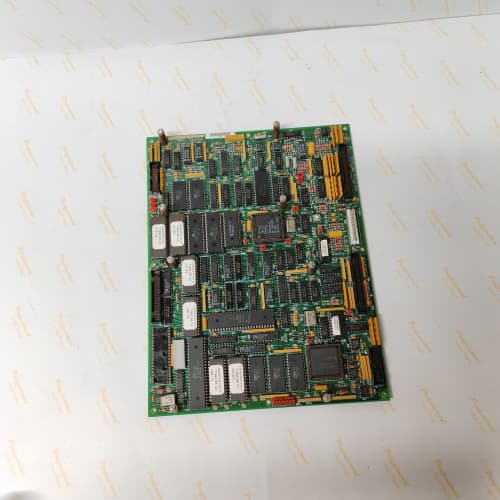
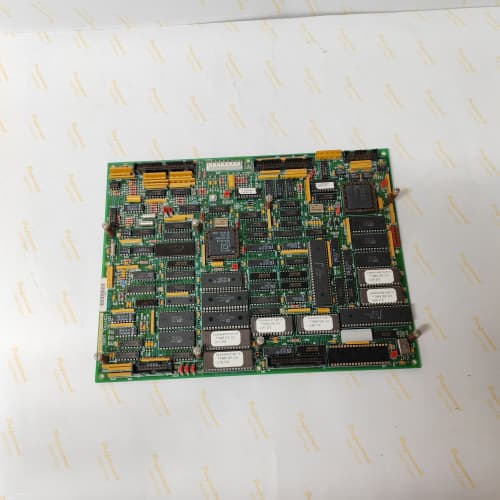
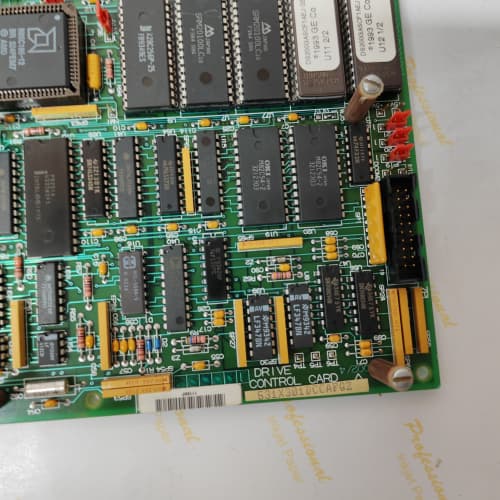
This GE 531X305NTBAEG1 is an advanced Ethernet communication board for the DC-300 and AC-300 drive platforms. The “E” suffix designates the Ethernet variant with support for 10/100 Mbps auto-negotiation, integrated switching capabilities, and support for industrial Ethernet protocols. This board moves beyond the GE proprietary network and fiber-optic options found in earlier NTB boards, aligning with open standards widely used in modern factories.
The board includes dual Ethernet ports with an integrated two-port switch, allowing daisy-chaining of drives without external switches. The onboard co-processor handles all TCP/IP stack processing, including Modbus TCP and Ethernet/IP protocol handling, offloading this from the main drive CPU. This design provides deterministic performance for coordinated motion applications, with typical cycle times of 2-5 ms in a multi-drive network. The board also features 16 configurable digital I/O points and is a drop-in replacement for earlier NTB variants, using the same 50-pin ribbon interface to the regulator.
Key Technical Specifications
| Parameter | Value |
|---|---|
| Manufacturer | GE (General Electric) |
| Model Number | 531X305NTBAEG1 |
| Product Type | Network Interface / Ethernet Communication Board |
| Communication Speed | 10/100 Mbps auto-negotiating |
| Ports | 2 independent Ethernet ports (integrated switch) |
| Physical Layer | 10Base-T / 100Base-TX (twisted pair, RJ45) |
| Protocol Support | Modbus TCP, Ethernet/IP, GE proprietary over TCP/IP |
| Co-Processor | Dedicated network processor with TCP/IP stack |
| Digital I/O | 16 configurable inputs/outputs (24 VDC) |
| Output Drive | 0.5 A per digital output channel |
| Isolation | 2500 V (opto-isolated I/O, transformer-isolated Ethernet) |
| Communication | 50-pin ribbon cable to main regulator board |
| Operating Temperature | 0 to +55 °C |
| Storage Temperature | -40 to +85 °C |
| Board Dimensions | 12.7 in x 6.0 in (approx) |
Key Selling Points & Differentiators
- Dual Ethernet Ports with Integrated Switch: Daisy-chain multiple drives without external network switches. The onboard switch handles traffic forwarding without using the drive CPU.
- Industrial Ethernet Protocol Support: Supports Modbus TCP and Ethernet/IP natively. This is a major upgrade from the proprietary GE Genius network on earlier NTB boards. No protocol converters required for modern PLCs.
- Dedicated Co-Processor for TCP/IP Stack: The main drive CPU is not burdened with TCP/IP processing, maintaining deterministic performance for motor control loops. The co-processor handles all packet processing, retries, and TCP connection management.
- Quantified Testing Protocol: We test the board on a live network with 16 drives, running continuous Ethernet/IP communication at a 2 ms cycle. We monitor packet loss and latency. Each board passes an 8-hour burn-in with 10,000 packet transmissions per minute. We also verify both Ethernet ports for correct switching behavior.
- Warranty & Support: 2-year functional warranty. We provide a network configuration guide, including IP addressing, subnetting, and switch settings. We also offer a guide for integrating the board with Allen-Bradley ControlLogix and Siemens S7 PLCs.
Frequently Asked Questions (FAQ)
Q1: What is the difference between the NTBAEG1 and the NTBACG1?
A: The NTBACG1 uses either 10 Mbps Ethernet or a proprietary fiber-optic physical layer. The NTBAEG1 uses standard 10/100Base-T Ethernet with RJ45 connectors. The “E” board supports open protocols like Ethernet/IP and Modbus TCP, whereas the “C” board was typically used with the GE Genius proprietary network. The “E” board has auto-negotiation and more advanced protocol handling. The “C” board is older and primarily found in legacy GE networks. If you are connecting to modern PLCs, the NTBAEG1 is the preferred choice.
Q2: Does this board support Ethernet/IP as a scanner or adapter?
A: The board operates as an EtherNet/IP adapter (slave) only. It responds to I/O messages from a PLC or scanner device. It does not act as a scanner/master. If you need the drive to initiate communications, you would need additional gateway hardware. Most applications use the drive as a target device in a PLC-controlled network, so this is rarely a limitation. The board supports the typical EtherNet/IP objects for drive control, including speed reference, torque reference, and status feedback.
Q3: Can I use both Ethernet ports to connect to two separate networks?
A: No, both ports are part of the same internal switch and operate on the same IP subnet. They are for daisy-chaining devices on the same network, not for dual-homing to separate networks. If you need to connect the drive to two different networks, you would need an external router or an additional network interface card. The board does not support VLAN tagging or routing.
Q4: What is the maximum cable length for the Ethernet ports?
A: Standard 100Base-TX specification applies: 100 meters (328 feet) with Cat5e or better cable. The board has auto-MDI/MDIX, so either straight-through or crossover cables can be used. We recommend shielded Cat6 cable in industrial environments for noise immunity. We have seen installations at 120 meters with good quality cable, but do not rely on exceeding the specification.
Q5: How many drives can I daisy-chain with this board?
A: The integrated switch supports up to 32 drives in a daisy-chain topology. The limiting factor is the network load—each drive adds traffic, and the 100 Mbps bandwidth is shared. With 32 drives, you will need to optimize update rates. In our test lab, 16 drives running at a 5 ms update cycle consumed about 60% of the network bandwidth. Beyond 20 drives, we recommend using a star topology with a central industrial switch to avoid excessive hop delays.
Q6: Does this board require configuration for the TCP/IP stack?
A: Yes, the IP address, subnet mask, and gateway are set through the drive’s parameter system. There are no jumpers on the board for IP configuration. The drive’s keypad or configuration software is used to assign the network settings. We include the parameter path in our documentation. The co-processor will not initialize the TCP/IP stack until valid network parameters are set. Common mistakes include overlapping IP addresses and incorrect subnet masks—check these before power-up.
Q7: Can I use this board as a replacement for an NTBACG1 in an existing system?
A: Physically, yes—same mounting and same 50-pin ribbon connector. However, the protocol must be compatible. If your existing system uses the GE proprietary Genius protocol over Ethernet, you need to confirm that the NTBAEG1 firmware supports that. The “E” board was primarily designed for Modbus TCP and Ethernet/IP, not the Genius protocol. If your system uses Ethernet/IP, the NTBAEG1 will work. If it uses Genius, stick with the NTBACG1. We can verify the firmware protocol support before you order.
Q8: What are the Ethernet link status LEDs, and how do I interpret them?
A: The board has two LEDs per port—one for link status (green) and one for activity (yellow). A solid green link LED indicates a valid network connection at 100 Mbps. A blinking green link LED indicates 10 Mbps. A yellow activity LED flashes when packets are transmitted or received. No link light indicates a cabling issue or a defective port. During our QC testing, we verify both ports link up at 100 Mbps full-duplex. We also test that the ports auto-negotiate correctly with switches and other devices.
Q9: What is the deterministic performance of this board?
A: In our tests, the board maintains a 2 ms cycle time on a 16-drive network with zero packet loss. The co-processor ensures that the main drive CPU is not interrupted by network traffic. The jitter (variation in cycle time) is less than 0.5 ms. This is sufficient for most coordinated motion applications. However, the deterministic performance of Ethernet/IP depends on the entire network—switches, cables, and other devices. The board itself is not the limiting factor; it is the network infrastructure. We recommend using managed switches with QoS (Quality of Service) for time-critical applications.
Q10: Is this board still supported by GE?
A: No, GE discontinued the entire 305 series network boards around 2014. There is no direct replacement. If your drive system uses the NTBAEG1, you should consider securing spare units while they are still available in new surplus condition. We have a limited quantity of these boards. Once they are gone, repair lead times can be lengthy, and used pulls are often damaged. This board has a history of Ethernet port failures due to electrical surges—our new surplus units have never been field-installed, so they are free from that risk.
EPRO PR6423/003-030
B&R 7EX484.50-1
GE DS200RTBAG3AEB
 Email: sales@plcfcs.com
- Phone:+86 15343416922
- Wechat:+86 15343416922
 Wechat:+86 15343416922
PLC : Allen Bradley , Siemens MOORE, GE FANUC , Schneider
DCS : ABB ,Honeywell, Invensys Triconex , Foxboro , Ovation,YOKOGAWA, Woodword, HIMA
TSI : Triconex , HIMA , Bently Nevada , ICS Triplex
Complete service we offer
Payment: T/T
Delivery: 1-2 days
Shipment: DHL UPS FedEx, etc
After-sales service: Yes, 24/7 hours