 Email: jiedong@sxrszdh.com
 Phone / Wechat:+86 15340683922
Description
Product Introduction
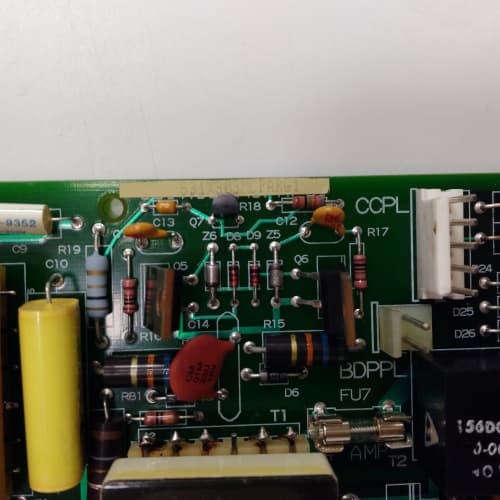
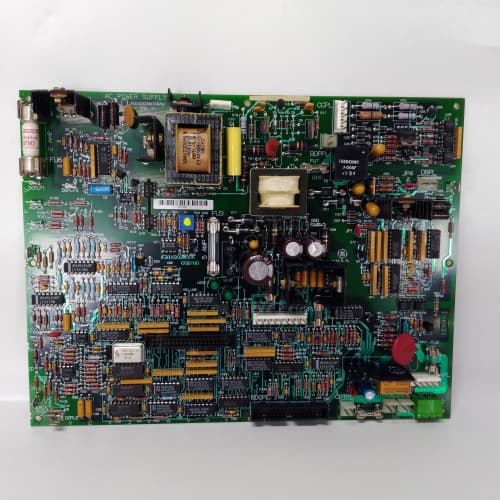
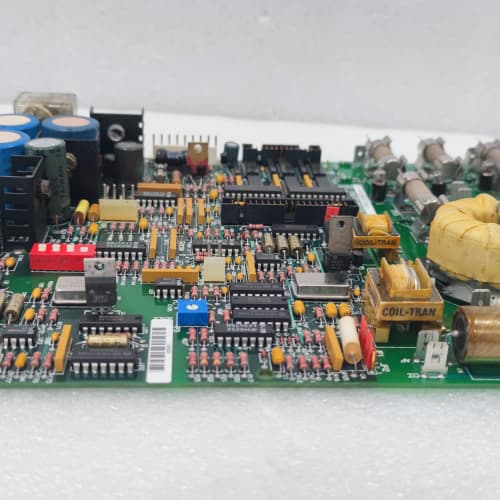
This GE 531X304IBDAHG1 is a communication and interface board for the DC-300 and AC-300 drive families. The “IBD” designation identifies it as an interface board with dual serial communication channels. It provides the physical layer connectivity between the drive’s main processor and external devices—operator panels, PLCs, host computers, and other drives.
The board carries two independent serial ports. One is configurable for RS-232, and the other supports RS-422 or RS-485 multidrop networks. This allows you to connect a local programming terminal to one port while maintaining a factory network connection on the other. The board also includes 16 configurable digital I/O points, making it useful for handshaking and status signaling in communication-intensive applications. GE designed this board for systems requiring both high-speed data exchange and discrete signal control on a single card.
Key Technical Specifications
| Parameter | Value |
|---|---|
| Manufacturer | GE (General Electric) |
| Model Number | 531X304IBDAHG1 |
| Product Type | Interface / Communication Board |
| Serial Ports | 2 independent ports |
| Port 1 | RS-232 (DCE configuration) |
| Port 2 | RS-422 or RS-485 (jumper selectable) |
| Baud Rate (Port 1) | 300 to 19,200 bps |
| Baud Rate (Port 2) | 300 to 38,400 bps |
| Data Format | 7 or 8 bits, parity optional |
| Protocol Support | GE proprietary, Modbus RTU (configurable) |
| Digital I/O | 16 configurable inputs/outputs (24 VDC) |
| Output Drive | 0.5 A per digital output channel |
| Isolation | 2500 V (opto-isolated I/O) |
| Communication | 50-pin ribbon cable to main regulator board |
| Operating Temperature | 0 to +55 °C |
| Storage Temperature | -40 to +85 °C |
| Board Dimensions | 12.7 in x 6.0 in (approx) |
Key Selling Points & Differentiators
- Dual-Port Communication: One RS-232 port for local programming and one RS-422/485 port for factory network integration. You can simultaneously maintain a programming connection and a network connection.
- Flexible Protocol Support: The board supports GE’s proprietary protocol and Modbus RTU. Protocol selection is done through drive parameters—no hardware changes required. This makes it compatible with most PLCs and HMIs on the market.
- Integrated Digital I/O: 16 configurable points eliminate the need for a separate I/O board in many applications. Use these for handshaking, fault reporting, or status LED drivers.
- Quantified Testing Protocol: We test both serial ports at their maximum baud rates with loopback and actual device communications. We also test the digital I/O points for correct sink/source behavior. Each board runs a 12-hour burn-in with continuous data transmission.
- Warranty & Support: 2-year functional warranty. We include a cable wiring diagram and parameter guide for common protocol configurations. RS-485 termination is a frequent field issue—our guide covers the 120Ω resistor rules.
Frequently Asked Questions (FAQ)
Q1: What is the difference between the 531X304IBDAHG1 and a standard 302 I/O board?
A: The 304 series boards are communication-focused. The 302 boards are strictly I/O interfaces. The 304IBD gives you serial communication ports plus 16 digital I/O points on one board. A 302 board gives you 8 or 16 I/O points with no serial capability. If you need to talk to a PLC or an operator panel, you need the 304. If you only need discrete field wiring, the 302 is sufficient and cheaper.
Q2: Can I use Port 2 as RS-232 instead of RS-422/485?
A: No. Port 2 is hardware-configured for RS-422 or RS-485 only. It uses differential drivers and receivers. There is no single-ended option on Port 2. Port 1 is fixed RS-232. If you need two RS-232 ports, this board will not work for you. You would need two separate RS-232 boards or an external converter. We have seen customers order this board thinking both ports were RS-232. Verify your wiring standard before ordering.
Q3: What is the maximum cable length for RS-485 on Port 2?
A: RS-485 on this board is rated for 4,000 feet (1,200 meters) at 38,400 baud. The actual length depends on baud rate and cable quality. At 38.4k, you can reliably get 4,000 feet with Belden 9842 cable. At 19.2k, you can push to 5,000 feet. The cable must be terminated with 120Ω resistors at both ends of the network. We also recommend biasing resistors on the master device. If the network is unterminated, you will get communication errors and data corruption.
Q4: Does this board support Modbus RTU as a slave or master?
A: The board supports Modbus RTU as a slave only. The drive responds to Modbus requests from a PLC or HMI master. It does not initiate Modbus communications. If you need a master interface, you need a separate gateway device. The board can be addressed at any slave address from 1 to 247. The address is set through drive parameters, not jumpers. We have verified Modbus compatibility with Allen-Bradley, Siemens, and Schneider PLCs.
Q5: Can I use the 16 digital I/O points as independent inputs and outputs?
A: Yes, each of the 16 channels is independently configurable as an input or output. The configuration is set in the drive’s I/O mapping parameters—there are no jumpers on the board. Inputs are 24 VDC compatible with sink or source wiring. Outputs are Darlington drivers rated at 0.5 A each. The outputs do not have short-circuit protection, so external fuses are recommended for inductive loads.
Q6: Is the serial communication isolated from the drive power?
A: The RS-232 port is not isolated. It shares a common ground with the drive logic. The RS-422/485 port has galvanic isolation through optocouplers on the data lines. This is typical for differential networks—the isolation prevents ground loops in multidrop systems. The RS-232 ground reference is the same as the drive’s 0 V. If your programming terminal is on a different ground potential, you may need an isolated RS-232 converter. We have seen ground loops cause RS-232 errors in large cabinets.
Q7: How do you test the serial ports during QC?
A: We connect Port 1 to a terminal emulator and send data at all baud rates from 300 to 19,200 bps. We verify both receive and transmit using a loopback connector. For Port 2, we use an RS-485 network with two other devices and run a continuous ping test for 2 hours. We check for CRC errors and dropped frames. If we see more than 1 error in 100,000 frames, we reject the board. We also test protocol switching between GE proprietary and Modbus RTU.
Q8: What is the status of this board—is it still supported by GE?
A: GE discontinued the 531X304 series in 2015. There is no direct replacement from GE. The current DC-300 and AC-300 aftermarket is served by third-party suppliers. Our batch is new surplus from a failed OEM project. We have approximately 25 units remaining. Once these are sold, availability will be limited to used pulls. If you have a machine running on this board, we recommend securing a spare. We have seen repair lead times extend to 6 weeks for communication boards.
Q9: Can I daisy-chain multiple drives on Port 2 RS-485?
A: Yes, the RS-485 port supports multidrop networks. You can connect up to 32 drives on a single RS-485 bus without repeaters. Each drive must have a unique address. The network must be terminated at both ends. The board’s RS-485 driver is rated for 32 unit loads. If you exceed 32 nodes, you need a repeater or a lower-power driver. In our experience, 16 drives is a practical maximum before performance degrades. We recommend drawing a network topology diagram before installation to avoid communication issues.
GE IC693CPU374
A-B 2711P-T10C4D1
A-B 2711P-T10C4D1
FOXBORO FBM216B
 Email: sales@plcfcs.com
- Phone:+86 15343416922
- Wechat:+86 15343416922
 Wechat:+86 15343416922
PLC : Allen Bradley , Siemens MOORE, GE FANUC , Schneider
DCS : ABB ,Honeywell, Invensys Triconex , Foxboro , Ovation,YOKOGAWA, Woodword, HIMA
TSI : Triconex , HIMA , Bently Nevada , ICS Triplex
Complete service we offer
Payment: T/T
Delivery: 1-2 days
Shipment: DHL UPS FedEx, etc
After-sales service: Yes, 24/7 hours