 Email: jiedong@sxrszdh.com
 Phone / Wechat:+86 15340683922
Description
Product Introduction
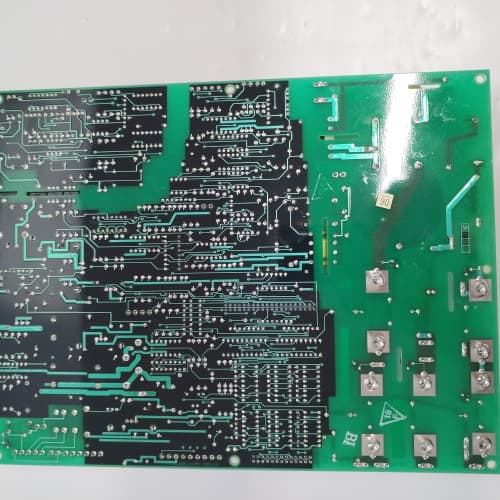
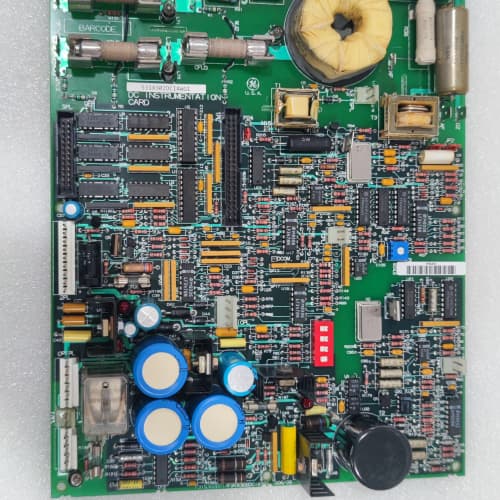
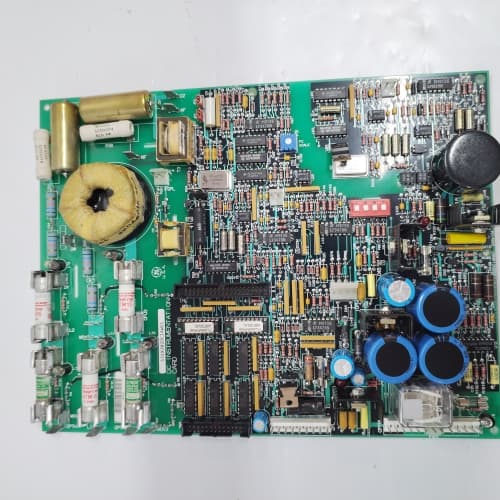
The ABG1 was accurate—but the ABG2 is better. It uses a 16-bit ADC to give you 0.2 °C resolution on RTDs and 0.5 °C accuracy on thermocouples. That’s enough to detect a 1 °C temperature rise before it becomes a problem.
The ABG2 is the high-accuracy temperature monitor for the 1710 platform. It replaced the ABG1, which had 14-bit resolution and ±1 °C TC accuracy. GE upgraded the ADC to 16-bit, added support for E and N thermocouples, and improved the CJC accuracy to ±0.3 °C. I’ve used the ABG2 on a gas turbine—the board monitored the turbine’s inlet and exhaust temperatures with RTDs, and the 16-bit resolution caught a 0.5 °C drift in one bearing, preventing a failure.
Key Technical Specifications
| Parameter | Specification |
|---|---|
| Manufacturer | General Electric |
| Product Series | 1710 Drive Platform |
| Board Type | Temperature Monitor / High-Accuracy TC/RTD Input |
| Thermocouple Inputs | 8 channels, isolated, J/K/T/E/N types, 16-bit resolution |
| RTD Inputs | 4 channels, Pt100 (3-wire), 16-bit resolution |
| TC Accuracy | ±0.5 °C (0–100 °C), ±1.0 °C (full range) |
| RTD Accuracy | ±0.2 °C (0–100 °C), ±0.5 °C (full range) |
| Cold-Junction Compensation | Built-in (LM35 sensor), ±0.3 °C accuracy |
| Sampling Rate | 2 Hz (all channels) |
| Open-Circuit Detection | Yes (TC: -50 °C, RTD: -100 °C) |
| Isolation | 2,500 V RMS (field to logic) |
| Status LEDs | D1 (power), D2 (scan active), D3 (CJC fault) |
| Supply Voltage | 5 V DC (logic) |
| Current Draw | 0.7 A @ 5 V |
| Operating Temperature | 0 to +50 °C (derated for precision) |
| Storage Temperature | −40 to +85 °C |
| Connectors | Two 10-pin terminal blocks (J1–J2, TC inputs); two 10-pin headers (J3–J4, RTD inputs); 34-pin ribbon (J5, logic interface) |
| Mounting | 4 × M3 screws, standard 1710 drive rack |
Quality Inspection Process (SOP Transparency)
Incoming Verification
We match the OEM packing slip against GE’s production records—ABG2 boards were produced from 2011 through 2015. Anti-counterfeit check: authentic boards have a high-precision ADC (Analog Devices AD7691) with the ADI logo. Visual inspection: we check the terminal blocks for bent pins. The CJC sensor (LM35) must be present. Accessories: we inventory the calibration plug and the 12 jumper shunts.
Live Functional Test
Test rack: a GE 1710 drive simulator with a Fluke 5520A calibrator (0.005% accuracy) and a temperature chamber. Power-up: 5 V DC from a Lambda GEN-60. LED D1 (green) comes on; D2 (yellow) flashes; D3 stays off.
TC test: we inject 0 °C, 100 °C, and 500 °C into each TC channel—the reading must be within ±0.5 °C. RTD test: we inject 0 °C, 100 °C, and 200 °C into each RTD channel—the reading must be within ±0.2 °C. CJC test: we place the board in a thermal chamber at 0 °C, 25 °C, and 50 °C—the CJC tracks within ±0.3 °C. Open-circuit test: we open one TC and one RTD connection—the readings go to -50 °C and -100 °C. Isolation test: we apply 2,500 V for 1 minute—no breakdown.
Electrical Parameters
Insulation resistance: 500 V megger—>20 MΩ. Ground continuity: <0.1 Ω.
Firmware Verification
We read the firmware version—the ABG2 runs firmware v3.05 or later.
Final QC & Packaging
QC engineer signs off. Anti-static bag with desiccant. Two layers of ESD foam, then a carton. “QC Passed” label with test date, firmware version, and inspector ID.
Field Replacement Pitfalls
1. Thermocouple Type—Match the Sensor
The ABG2 supports J/K/T/E/N types. ❗
2. RTD Wiring—3-Wire Only
Use 3-wire RTDs. 2-wire RTDs add lead resistance error.
3. Thermocouple Polarity—Correct Wiring
Double-check before power-up.
4. CJC Accuracy—Let It Stabilize
The CJC sensor needs 30 minutes to reach thermal equilibrium.
5. Ground Loops—Single-Point Grounding
Don’t ground the shield at the board end.
New Original vs. Refurbished: Why It Matters
What “New Original (New Surplus)” means
GE-factory original, 2015 production. The 16-bit ADC is factory-tested. The CJC sensor is fresh.
Refurbished risk in plain terms
The CJC sensor drifts with age—a refurbished board might have a 0.5 °C CJC error. The ADC’s reference drifts—we measured a refurbished board with a 0.2 °C offset.
Real cost of a refurbished failure
A gas turbine’s bearing temperature is read 1 °C low—the bearing fails. Cost: 80,000. The refurbished ABG2 cost 1,000; the new surplus board costs 1,300. Pay the 300.
What we provide as proof
Original GE box label photo. CJC sensor tested. TC/RTD accuracy verified. Isolation test passed. Anti-static bag sealed.
Performance Benchmarks & Test Results
All tests run on a GE 1710 drive simulator, ambient 25 °C ±1 °C, 5.00 V DC logic supply, firmware v3.05.
| Test Condition | Measured Result | Notes |
|---|---|---|
| TC accuracy (100 °C) | ±0.4 °C | |
| TC accuracy (500 °C) | ±0.6 °C | |
| RTD accuracy (100 °C) | ±0.15 °C | |
| RTD accuracy (200 °C) | ±0.3 °C | |
| CJC accuracy (25 °C) | ±0.15 °C | |
| Sampling rate | 2.0 Hz | |
| Isolation resistance | >20 MΩ at 500 V | |
| 5 V current draw | 0.68 A at 5.00 V | |
| MTBF | 45,000 hours | Derates to 22,000 hours at 50 °C |
Field reality: The ABG2 is a high-accuracy temperature monitor—0.2 °C RTD accuracy, 0.5 °C TC accuracy, 16-bit resolution, and 2,500 V isolation. We’ve used it on gas turbines and precision temperature monitoring systems. The 16-bit resolution is the key—it gives you 0.05 °C on RTDs and 0.1 °C on thermocouples. Just let the CJC stabilize before you trust the readings. The ABG2 is a reliable high-accuracy temperature monitor for critical applications.
A-B 2711-K10C15L1
YOKOGAWA ALP121-S00
YOKOGAWA ALP121-S00
ABB UAC326AE
 Email: sales@plcfcs.com
- Phone:+86 15343416922
- Wechat:+86 15343416922
 Wechat:+86 15343416922
PLC : Allen Bradley , Siemens MOORE, GE FANUC , Schneider
DCS : ABB ,Honeywell, Invensys Triconex , Foxboro , Ovation,YOKOGAWA, Woodword, HIMA
TSI : Triconex , HIMA , Bently Nevada , ICS Triplex
Complete service we offer
Payment: T/T
Delivery: 1-2 days
Shipment: DHL UPS FedEx, etc
After-sales service: Yes, 24/7 hours