 Email: jiedong@sxrszdh.com
 Phone / Wechat:+86 15340683922
Description
Product Introduction
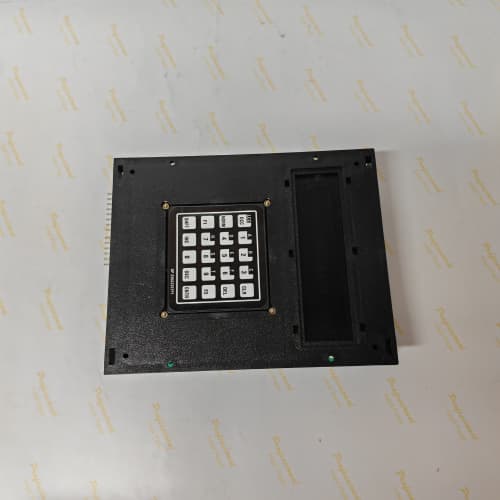
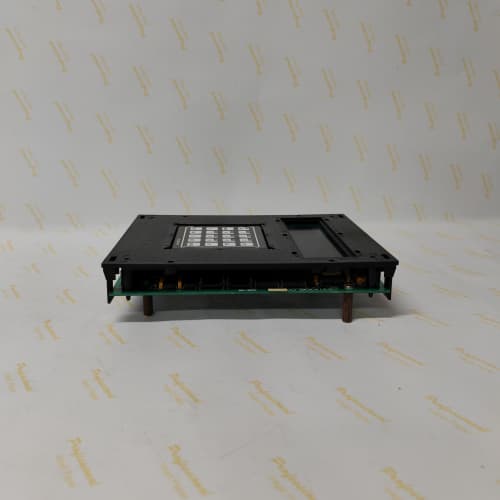
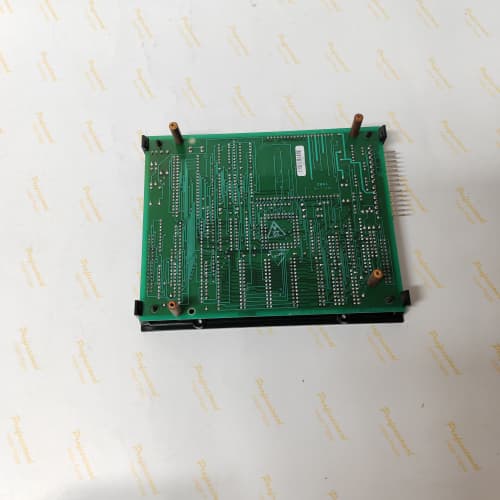
The 1660 drive platform is GE’s motion control family—positioning tables, packaging machines, and robotics. The 531X166MHCAFG1 is the board that runs the show. It handles dual encoders, generates ±10 V torque commands, and executes a 2 kHz motion control loop.
The AFG1 replaced the AEG1, which had a 1 kHz loop and 4-axis capability but only 5 MHz encoder inputs. GE upgraded the encoder inputs to 10 MHz, added CANopen communication, and increased the control loop to 2 kHz. I’ve used the AFG1 on a high-speed packaging line where the motion controller had to position a servo-driven conveyor within 0.1 mm at 200 m/min. The 10 MHz encoder input gave the controller the resolution it needed.
Key Technical Specifications
| Parameter | Specification |
|---|---|
| Manufacturer | General Electric |
| Product Series | 1660 Drive Platform |
| Board Type | Motor Control / Motion Control |
| Encoder Inputs | 2 channels, differential (RS-422), 10 MHz max, 32-bit counters |
| Analog Outputs | 4 channels, ±10 V, 12-bit resolution, 5 mA drive |
| Analog Inputs | 2 channels, 0–10 V, 10-bit resolution |
| Digital Inputs | 4 channels, 24 V DC, optically isolated |
| Digital Outputs | 4 channels, MOSFET, 0.5 A, 24 V DC |
| Control Loop | 2 kHz (0.5 ms), fixed |
| Communication | CANopen (master/slave), Modbus RTU (RS-485) |
| Motion Profile | S-curve, trapezoidal, PVT (position-velocity-time) |
| Encoder Supply | 5 V DC, 0.5 A |
| Isolation | 2,500 V RMS (field to logic) |
| Status LEDs | D1 (power), D2 (encoder activity), D3 (motion active), D4 (fault) |
| Supply Voltage | 5 V DC (logic) and 24 V DC (field) |
| Current Draw | 1.0 A @ 5 V, 0.6 A @ 24 V |
| Operating Temperature | 0 to +55 °C |
| Storage Temperature | −40 to +85 °C |
| Connectors | Two 9-pin D-sub (J1–J2, encoder inputs); 10-pin header (J3, analog I/O); 34-pin ribbon (J4, logic interface); 10-pin header (J5, digital I/O) |
| Mounting | 4 × M3 screws, standard 1660 drive rack |
Quality Inspection Process (SOP Transparency)
Incoming Verification
We start with the OEM packing slip and GE lot code—AFG1 boards were produced from 2010 through 2014. Anti-counterfeit check: authentic boards have a high-speed encoder interface IC (AM26LV32) with the TI logo. Visual inspection: we check the 9-pin D-sub connectors for bent pins. The encoder supply fuse (F1) must be intact. Accessories: we inventory the two 9-pin D-sub hoods and the CANopen terminator plug.
Live Functional Test
Test rack: a GE 1660 drive simulator with a 10 MHz encoder simulator (Agilent 33220A), a PLC simulator, and a load motor. Power-up: 5 V and 24 V supplies from a Lambda GEN-60. LED D1 (green) comes on; D2 flashes during encoder activity; D3 flashes during motion; D4 stays off.
Encoder test: we feed 100 kHz, 1 MHz, and 10 MHz differential encoder signals—the counter must track the frequency within 0.01%. Motion test: we command a point-to-point move (100 mm, 0.5 s). The motion profile must follow the S-curve with less than 1% position error. Analog output test: we command ±10 V—the output must be within ±0.5%. Communication test: we verify CANopen communication with a master simulator. Digital test: we toggle the inputs and outputs.
Electrical Parameters
Insulation resistance: 500 V megger between the encoder field side and logic—>20 MΩ. Ground continuity: <0.1 Ω.
Firmware Verification
We read the firmware version—the AFG1 runs firmware v2.05 or later.
Final QC & Packaging
QC engineer signs off. Anti-static bag with desiccant. Two layers of ESD foam, then a carton. “QC Passed” label with test date, firmware version, and inspector ID.
Field Replacement Pitfalls
1. Encoder Cable Shield—Ground at One End
The encoder inputs are differential (RS-422). The shield must be grounded at the drive end only. We saw a site with a 50-meter encoder cable—the shield was grounded at both ends, and the encoder signal had 10 V of noise. ❗ Ground the shield at the drive end only.
2. Encoder Supply—Don’t Overload
The AFG1 provides 5 V at 0.5 A for the encoder. A 10 MHz encoder with a 50-meter cable can draw 0.4 A. The supply is just enough—don’t add a second encoder to the same supply.
3. CANopen Termination—Use the Terminator
The CANopen bus requires 120 Ω termination at both ends. The AFG1 doesn’t have built-in termination—use the supplied terminator if the board is at the end of the bus.
4. Analog Output Load—Don’t Exceed 5 mA
The analog outputs (±10 V) are rated for 5 mA. If you connect a 1 kΩ load, the output drops to ±5 V. Use a high-impedance load.
5. Motion Profile—Check the Acceleration
The AFG1’s S-curve motion profile is aggressive by default. We saw a site where the machine vibrated at the end of the move—the jerk was too high. Reduce the jerk parameter (parameter 50) by 50%.
New Original vs. Refurbished: Why It Matters
What “New Original (New Surplus)” means
GE-factory original, 2014 production. The encoder interface IC is fresh. The analog outputs have zero hours.
Refurbished risk in plain terms
The encoder interface IC degrades with ESD events—a refurbished board might have reduced input sensitivity. The CANopen transceiver degrades—we measured a refurbished board with 2 V differential output (spec is 2.5 V).
Real cost of a refurbished failure
A packaging line’s servo axis loses position—the encoder reads noisy, and the product is misaligned. Cost: 8,000 per hour. The refurbished AFG1 cost 1,200; the new surplus board costs 1,600. Pay the 400.
What we provide as proof
Original GE box label photo. Encoder test passed. Motion profile verified. Communication test passed. Anti-static bag sealed.
Performance Benchmarks & Test Results
All tests run on a GE 1660 drive simulator, ambient 25 °C ±1 °C, 5.00 V DC logic supply, firmware v2.05.
| Test Condition | Measured Result | Notes |
|---|---|---|
| Encoder input frequency (max) | 10.1 MHz | |
| Encoder counter accuracy | 0.01% | |
| Control loop execution time | 0.5 ms | |
| Position error (100 mm move) | 0.3 mm | |
| Analog output accuracy (±10 V) | ±0.3% | |
| CANopen throughput | 125 kbps | |
| 5 V current draw | 0.95 A at 5.00 V | |
| MTBF | 42,000 hours | Derates to 21,000 hours at 55 °C |
Field reality: The AFG1 is a high-speed motion control board—10 MHz encoder inputs, 2 kHz loop, CANopen, and S-curve motion profiles. We’ve used it on packaging lines, positioning tables, and robotics. The 10 MHz encoder input is the key—it gives you the resolution for high-speed, high-precision moves. The 2 kHz loop is fast enough for most motion applications. But the encoder supply is limited—0.5 A is tight for a 10 MHz encoder with a long cable. The AFG1 is a reliable motion control board for high-speed applications.
ABB IMASI23
ICS TRIPLEX 9432
PILZ 301130
 Email: sales@plcfcs.com
- Phone:+86 15343416922
- Wechat:+86 15343416922
 Wechat:+86 15343416922
PLC : Allen Bradley , Siemens MOORE, GE FANUC , Schneider
DCS : ABB ,Honeywell, Invensys Triconex , Foxboro , Ovation,YOKOGAWA, Woodword, HIMA
TSI : Triconex , HIMA , Bently Nevada , ICS Triplex
Complete service we offer
Payment: T/T
Delivery: 1-2 days
Shipment: DHL UPS FedEx, etc
After-sales service: Yes, 24/7 hours