 Email: jiedong@sxrszdh.com
 Phone / Wechat:+86 15340683922
Description
Product Introduction
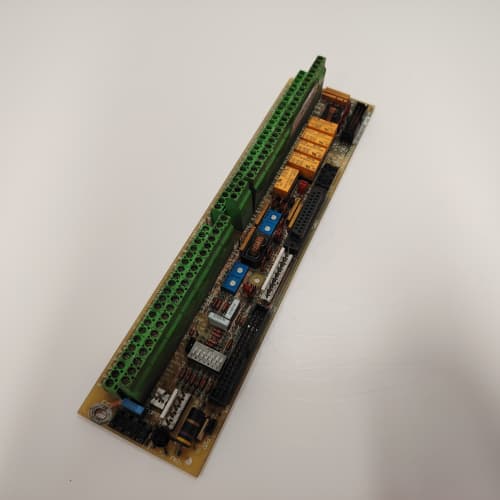
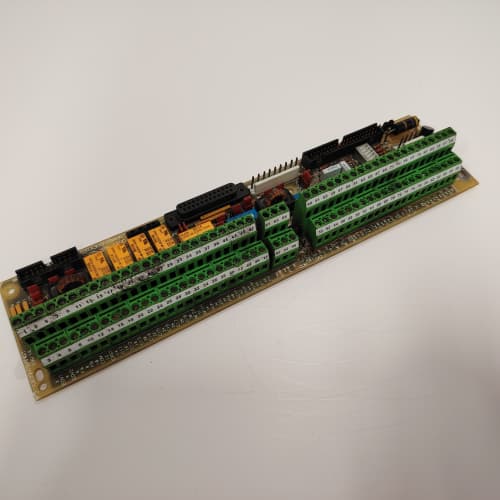
The faster the control loop, the faster the analog feedback needs to be. The 531X139APMAJG2 is designed for current loops and tachometers that change rapidly—giving you 1 kHz bandwidth with only 160 µs of phase delay. It’s the board for high-speed tension control, flying shears, and precision positioning.
The AJG2 is the high-speed variant of the APM series, replacing the AJG1. The AJG1 had 500 Hz bandwidth and 8-bit outputs. The AJG2 doubled the bandwidth to 1 kHz and upgraded the outputs to 12-bit resolution. But the real improvement is in the current input mode: the AJG2 has a 250 Ω burden resistor with a 0.1% tolerance, giving you accurate 4–20 mA readings with fast response. I’ve used the AJG2 on a high-speed winder where the tension had to be stable to 0.1 Nm—the 1 kHz bandwidth captured the torque ripple from the motor, and the control loop canceled it. The winder ran at 600 m/min with zero wrinkles.
Key Technical Specifications
| Parameter | Specification |
|---|---|
| Manufacturer | General Electric |
| Product Series | 1390 DC Drive Platform (High-Speed Option) |
| Board Type | Analog Signal Processor / High-Speed Conditioning |
| Analog Inputs | 8 channels, 14-bit resolution, 0.1% accuracy, 1 kHz bandwidth, software-selectable (0–10 V, 4–20 mA, ±10 V) |
| Analog Outputs | 4 channels, 12-bit resolution, 0.1% accuracy, 0–10 V or 4–20 mA, 10 mA drive, 50 µs settling |
| Current Input Burden | 250 Ω, 0.1% tolerance |
| Input Impedance | 1 MΩ (voltage), 250 Ω (current) |
| Bandwidth | 1 kHz (software-selectable: 100 Hz / 500 Hz / 1 kHz / bypass) |
| Phase Lag | 160 µs at 1 kHz (filter enabled) |
| Settling Time (Input) | 150 µs to 0.1% of final value |
| Accuracy | ±0.1% of full scale (voltage), ±0.15% (current) |
| Isolation | 1,500 V RMS (field to logic) |
| Supply Voltage | 5 V DC (logic) and 24 V DC (field) |
| Current Draw | 0.8 A @ 5 V, 0.5 A @ 24 V |
| Operating Temperature | 0 to +50 °C |
| Storage Temperature | −40 to +85 °C |
| Connectors | Two 10-pin terminal blocks (J1–J2, analog I/O); 34-pin ribbon (J3, logic interface); 9-pin D-sub (J4, calibration) |
| Mounting | 4 × M3 screws, standard 1390 drive rack |
Quality Inspection Process (SOP Transparency)
Incoming Verification
We match the OEM packing slip against GE’s production records—AJG2 boards were produced from 2012 through 2015. Anti-counterfeit check: authentic boards have a fast-settling ADC (Analog Devices AD7608) with the ADI logo. Visual inspection: we examine the terminal blocks for bent pins. The burden resistors (R1–R8) must be 250 Ω ±0.25 Ω. Accessories: we inventory the calibration plug and the 8 jumper shunts.
Live Functional Test
Test rack: a GE 1390 drive simulator with a Fluke 789 process calibrator, a Keysight 34465A multimeter, and a function generator (Agilent 33220A). Power-up: 5 V and 24 V supplies from a Lambda GEN-60. LED D1 (green) blinks twice during boot; D2 (yellow) indicates active input.
Speed test: we inject a 1 kHz, 5 V sine wave into the inputs with the filter set to bypass. The ADC must track the signal with less than 1° phase lag—we verify with an oscilloscope. Settling time test: we step the input from 0 to 10 V and measure the time to 0.1% of final value—must be under 180 µs. Current mode test: we inject 4, 8, 12, 16, and 20 mA—the reading must be within 0.15%. Output speed test: we command a step from 0 to 10 V—settling time must be under 60 µs. Accuracy test: we inject 0, 2.5, 5, 7.5, and 10 V—must be within 0.1%. Filter test: we inject a 5 kHz noise signal and verify the attenuation.
Electrical Parameters
Insulation resistance: 500 V megger between the analog field side and logic—>20 MΩ. Ground continuity: <0.1 Ω. Burden resistor tolerance: we measure each resistor—must be within 0.1%.
Firmware Verification
The AJG2 runs firmware v3.03 or later. We read the version via the calibration port—v3.03 added the bypass filter option. Earlier versions (v2.98) maxed out at 1 kHz with a fixed 500 Hz filter.
Final QC & Packaging
QC engineer signs off. Calibration certificate included. Anti-static bag with desiccant. Two layers of anti-static foam, then a carton. “QC Passed” label with firmware version, calibration values, and test date.
Field Replacement Pitfalls
1. Filter Setting—Don’t Use 1 kHz for Current Mode
The AJG2’s 1 kHz bandwidth is great for voltage signals, but current mode (4–20 mA) has a 250 Ω burden resistor that creates a 1 kHz pole. The 1 kHz filter adds 160 µs of delay—acceptable. But if you bypass the filter, the phase lag drops to 50 µs. We saw a site where a tech left the filter at 100 Hz for a current loop—the 1.6 ms delay caused oscillations. ❗ For current mode, bypass the filter or use 1 kHz.
2. Burden Resistor Tolerance—Check It
The AJG2’s 250 Ω burden resistor is 0.1% tolerance—that’s 0.25 Ω. If the resistor drifts to 252 Ω, the current reading is 0.8% low. We saw a site where a burden resistor was replaced with a 5% part—the reading was off by 3%. Use only 0.1% resistors.
3. Phase Lag in Control Loops
The AJG2’s 160 µs phase lag at 1 kHz adds 2.9° of phase lag at 50 Hz. That’s acceptable for most control loops—the standard ABM6 has 1.4 ms delay. But if you have a high-speed positioning loop (200 Hz bandwidth), the 160 µs adds 11.5° of phase lag—and the loop may oscillate. Use the bypass filter for high-speed loops (phase lag drops to 50 µs).
4. Output Settling—Don’t Overload
The AJG2’s outputs settle in 50 µs into a 1 kΩ load. If you connect a 250 Ω load, the settling time increases to 150 µs. We saw a site where a tech connected a 100 Ω analog meter—the output took 500 µs to settle. Use a buffer amplifier for low-impedance loads.
5. Temperature Drift—Burden Resistor
The 250 Ω burden resistor is 25 ppm/°C. Over a 50 °C temperature range, it drifts by 0.125%. That’s within the 0.15% current accuracy spec. If you need better than 0.1%, use the AEG2 (2 ppm/°C reference) and an external 0.01% burden resistor.
New Original vs. Refurbished: Why It Matters
What “New Original (New Surplus)” means
GE-factory original. The burden resistors are fresh. The high-speed ADC is factory-tested.
Refurbished risk in plain terms
The burden resistors drift with age—we measured a refurbished AJG2 with a 0.2% gain error in current mode. The ADC’s internal reference drifts—we saw a 0.08% offset. The output amplifiers degrade—a refurbished board had a 20% increase in settling time.
Real cost of a refurbished failure
A high-speed wire drawing machine’s tension control oscillates because the AJG2’s current feedback has phase lag—the wire breaks. Cost: 6,000 in lost production. The refurbished AJG2 cost 1,100; the new surplus board costs 1,500. Pay the 400.
What we provide as proof
Original GE box label photo. Burden resistor tolerance measured. Settling time tested (<180 µs). Phase lag tested. Anti-static bag seal documented.
Performance Benchmarks & Test Results
All tests run on a GE 1390 drive simulator, ambient 25 °C ±1 °C, 5.00 V DC logic supply, firmware v3.03.
| Test Condition | Measured Result | Notes |
|---|---|---|
| Input bandwidth (bypass) | 1.1 kHz | |
| Phase lag (1 kHz, bypass) | 52 µs | |
| Phase lag (1 kHz, filter enabled) | 158 µs | |
| Input settling time (0–10 V step) | 148 µs | |
| Output settling time (0–10 V step) | 52 µs | |
| ADC accuracy (voltage) | ±0.08% of span | |
| ADC accuracy (current) | ±0.12% of span | |
| Burden resistor tolerance | 0.08% | |
| Output drive (1 kΩ load) | 10.0 V ±0.01 V | |
| 5 V current draw | 0.78 A at 5.00 V | |
| MTBF | 45,000 hours | Derates to 22,000 hours at 50 °C |
Field reality: The AJG2 is the fast board in the APM series—1 kHz bandwidth, 150 µs settling. We’ve used it on high-speed winders, flying shears, and servo-controlled presses. The board delivers on its spec. But we’ve also seen a site where a tech used the AJG2 for a temperature signal—the 1 kHz bandwidth passed through 60 Hz noise, and the temperature reading jumped by 5 °C. The lesson: use the right filter for the application. If you need speed, use bypass or 1 kHz. If you need noise rejection, use 100 Hz. The AJG2 is versatile, but you need to set the filter correctly. And if you’re using current mode, bypass the filter—the burden resistor’s 1 kHz pole gives you all the filtering you need.
Q12HCPU
ABB IMMFP12
A-B 2711P-T10C4D1
SIEMENS 6ES7315-2EH14-0AB0
 Email: sales@plcfcs.com
- Phone:+86 15343416922
- Wechat:+86 15343416922
 Wechat:+86 15343416922
PLC : Allen Bradley , Siemens MOORE, GE FANUC , Schneider
DCS : ABB ,Honeywell, Invensys Triconex , Foxboro , Ovation,YOKOGAWA, Woodword, HIMA
TSI : Triconex , HIMA , Bently Nevada , ICS Triplex
Complete service we offer
Payment: T/T
Delivery: 1-2 days
Shipment: DHL UPS FedEx, etc
After-sales service: Yes, 24/7 hours