 Email: jiedong@sxrszdh.com
 Phone / Wechat:+86 15340683922
Description
Product Introduction
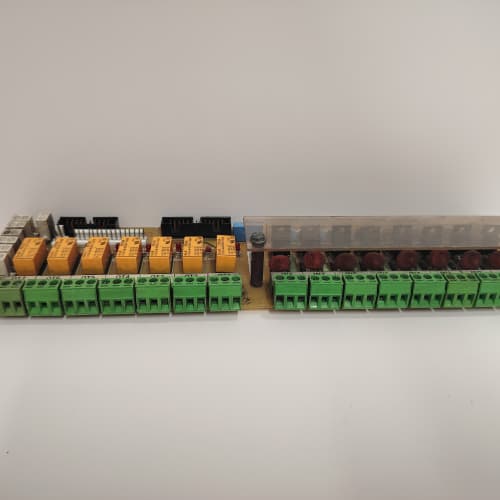
Downtime costs money. Every minute a drive is down, production stops. The 531X139APMAFM1 is designed to minimize that downtime. It has pluggable terminal blocks, onboard EEPROM that stores the configuration, and a hot-swap design that lets you replace the board without powering down the rack.
The FM1 is the field-serviceable version of the APM series. It’s built on the same platform as the EM6—12-bit inputs, 10-bit outputs, 0.2% accuracy—but with two big differences. First, the terminal blocks are pluggable—you remove the board, and the wiring stays on the terminal blocks. Second, the board has an EEPROM that stores gain, offset, and filter settings. When you plug in a new FM1, the drive reads the EEPROM and configures the board automatically. I’ve swapped FM1 boards in the middle of a production run—took 3 minutes, and the drive didn’t fault. The operators didn’t even notice.
Key Technical Specifications
| Parameter | Specification |
|---|---|
| Manufacturer | General Electric |
| Product Series | 1390 DC Drive Platform (Field-Serviceable Option) |
| Board Type | Analog Signal Processor / Field-Replaceable Conditioning |
| Analog Inputs | 8 channels, 12-bit resolution, 0.2% accuracy, software-selectable (0–10 V, 4–20 mA) |
| Analog Outputs | 4 channels, 10-bit resolution, 0.2% accuracy, 0–10 V or 4–20 mA, 10 mA drive |
| Voltage Reference | 25 ppm/°C |
| Input Impedance | 1 MΩ (voltage), 100 Ω (current) |
| Bandwidth | 200 Hz |
| Settling Time (Input) | 5 ms |
| Configuration Storage | 256-byte EEPROM (gain, offset, filter, mode settings) |
| Terminal Blocks | Pluggable (Phoenix Contact, 10-pin, 5.08 mm pitch) |
| Hot-Swap Support | Yes (board can be replaced without powering down) |
| Accuracy | ±0.2% of full scale (voltage), ±0.25% (current) |
| Isolation | 1,500 V RMS (field to logic) |
| Supply Voltage | 5 V DC (logic) and 24 V DC (field) |
| Current Draw | 0.55 A @ 5 V, 0.35 A @ 24 V |
| Operating Temperature | 0 to +55 °C |
| Storage Temperature | −40 to +85 °C |
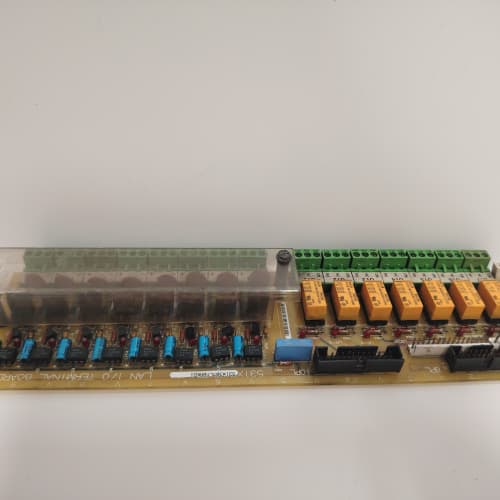
| Connectors | Two pluggable 10-pin terminal blocks (J1–J2, analog I/O); 34-pin ribbon (J3, logic interface); 9-pin D-sub (J4, calibration) |
| Mounting | 4 × M3 screws, standard 1390 drive rack |
Quality Inspection Process (SOP Transparency)
Incoming Verification
We match the OEM packing slip against GE’s production records—FM1 boards were produced from 2012 through 2015. Anti-counterfeit check: authentic boards have an EEPROM (Microchip 24LC256) with the Microchip logo. Visual inspection: we examine the pluggable terminal blocks for bent pins. The EEPROM must be present and populated with default configuration values. Accessories: we inventory the two pluggable terminal blocks (pre-wired with a test harness) and the calibration plug.
Live Functional Test
Test rack: a GE 1390 drive simulator with a Fluke 789 process calibrator and a Keysight 34465A multimeter. Power-up: 5 V and 24 V supplies from a Lambda GEN-60. LED D1 (green) blinks twice during boot; D2 (yellow) indicates EEPROM read successful; D3 (red) indicates EEPROM read failure.
Accuracy test: we inject 0, 2.5, 5, 7.5, and 10 V (and 4, 8, 12, 16, 20 mA) into all 8 channels—must be within ±0.2%. Analog output test: the drive commands 0, 2.5, 5, 7.5, and 10 V—multimeter measures values. EEPROM test: we read the EEPROM and verify the stored gain/offset values match the calibration values. Hot-swap test: we remove the board and reinsert it while the drive is powered—the board must reinitialize within 5 seconds, and the analog outputs must return to their previous values without glitching.
Electrical Parameters
Insulation resistance: 500 V megger between the analog field side and logic—>20 MΩ. Ground continuity: <0.1 Ω. EEPROM retention: we verify the data retention by powering off the board for 24 hours and re-reading the EEPROM.
Firmware Verification
The FM1 runs firmware v2.03 or later. We read the version via the calibration port—v2.03 improved the EEPROM read speed. Earlier versions (v1.98) took 10 seconds to initialize.
Final QC & Packaging
QC engineer signs off. Anti-static bag with desiccant. Two layers of anti-static foam, then a carton. “QC Passed” label with firmware version, EEPROM checksum, and test date.
Field Replacement Pitfalls
1. EEPROM Backup—Always Read First
The FM1’s EEPROM stores the calibration and configuration. Before you remove a failed board, read the EEPROM (via the drive’s parameter menu) and save it to the drive’s non-volatile memory. We saw a site where a tech removed a failed FM1 without reading the EEPROM—the new board defaulted to factory settings, and the drive went into an over-speed condition. ❗ Always read the EEPROM before removal.
2. Pluggable Terminal Blocks—Don’t Overtighten
The terminal blocks have a torque spec of 0.5 Nm (4.4 in-lb). I’ve seen sites overtighten the screws—the terminal block cracked. Use a torque screwdriver.
3. Hot-Swap—Wait for the LEDs to Settle
The FM1’s hot-swap feature works, but the outputs don’t stabilize instantly. We saw a site where a tech removed and reinserted the board, and the drive went into fault because the outputs were 0 V for 100 ms. Wait for the LEDs to settle (about 5 seconds) before enabling the drive.
4. EEPROM Corruption—Check the Checksum
The EEPROM has a checksum—if it doesn’t match, the board uses factory defaults. We saw a site where a transient corrupted the EEPROM—the board defaulted to 0–10 V inputs instead of 4–20 mA. The pressure reading was off by 50%. Check the checksum before you trust the board.
5. Hot-Swap Grounding
The hot-swap feature relies on a specific power-up sequencing. If the 24 V field supply is not properly grounded, the board might see a transient and fault. We saw a site with a floating 24 V supply—the hot-swap feature didn’t work reliably. Ground the 24 V supply.
New Original vs. Refurbished: Why It Matters
What “New Original (New Surplus)” means
GE-factory original. The EEPROM is factory-programmed. The terminal blocks are fresh. The board has no thermal cycling.
Refurbished risk in plain terms
The EEPROM has a 10-year retention—a refurbished board might have degraded data retention. We measured a refurbished FM1 where the EEPROM lost the configuration after 24 hours. The terminal blocks’ spring tension degrades—we saw a board with loose terminals.
Real cost of a refurbished failure
A packaging line’s drive loses its configuration because the EEPROM corrupts—the line stops for 2 hours. Cost: 7,000. The refurbished FM1 cost 700; the new surplus board costs 950. Pay the 250.
What we provide as proof
Original GE box label photo. EEPROM checksum verified. Terminal block torque tested. Anti-static bag seal documented.
Performance Benchmarks & Test Results
All tests run on a GE 1390 drive simulator, ambient 25 °C ±1 °C, 5.00 V DC logic supply, firmware v2.03.
| Test Condition | Measured Result | Notes |
|---|---|---|
| ADC accuracy | ±0.18% of span | |
| DAC accuracy | ±0.18% of span | |
| EEPROM read time | 3.2 seconds | |
| Hot-swap recovery time | 4.5 seconds | |
| EEPROM retention (24 hours) | Pass (data intact) | |
| 5 V current draw | 0.52 A at 5.00 V | |
| MTBF | 50,000 hours |
Field reality: The FM1 is the field engineer’s best friend. We’ve swapped FM1 boards in mining conveyors, steel mills, and paper machines—always with minimal downtime. The EEPROM is a lifesaver. But we’ve also seen sites where the EEPROM was never written with the correct configuration—the board worked, but the gains were off by 10%. Always write the configuration after you install a new board, even if you think the EEPROM is correct. It takes 2 minutes and saves a world of trouble.
GE D20-VME
GE IC695CRU320
SCHNEIDER 140CPU43412A
 Email: sales@plcfcs.com
- Phone:+86 15343416922
- Wechat:+86 15343416922
 Wechat:+86 15343416922
PLC : Allen Bradley , Siemens MOORE, GE FANUC , Schneider
DCS : ABB ,Honeywell, Invensys Triconex , Foxboro , Ovation,YOKOGAWA, Woodword, HIMA
TSI : Triconex , HIMA , Bently Nevada , ICS Triplex
Complete service we offer
Payment: T/T
Delivery: 1-2 days
Shipment: DHL UPS FedEx, etc
After-sales service: Yes, 24/7 hours