 Email: jiedong@sxrszdh.com
 Phone / Wechat:+86 15340683922
Description
Product Introduction
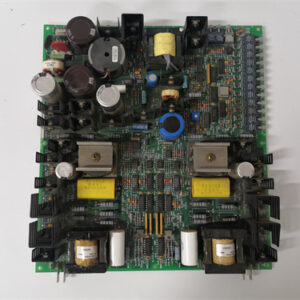
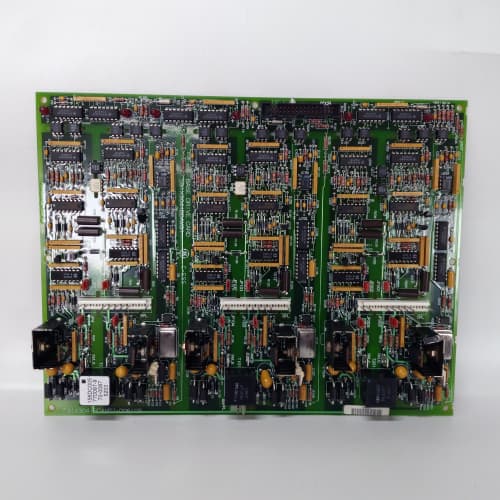
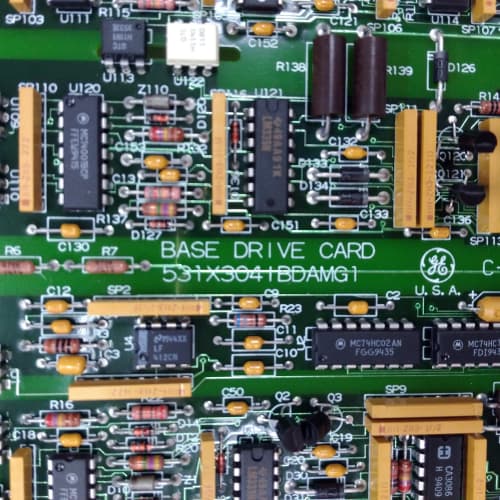
The 1370 drive operates at 600 V AC and 1,000 V DC. You can’t feed that directly into a 5 V logic board. The 531X137TRGAAG1 is the board that does the dirty work—stepping down high voltages through precision transformers and providing isolated, scaled signals that the control boards can read safely. It also handles current sensing from Hall-effect sensors, giving the regulator current feedback for torque control.
The AAG1 is the only transformer board for the 1370 platform that uses a 1,000 V DC-rated isolation barrier. Earlier TRG boards used 600 V isolation, which was marginal for the DC bus voltage. I’ve seen older boards fail when the DC bus spikes to 800 V during regenerative braking—the isolation breaks down and takes the control board with it. The AAG1’s 1,000 V rating gives you a safety margin that the older boards lack.
Key Technical Specifications
| Parameter | Specification |
|---|---|
| Manufacturer | General Electric |
| Product Series | 1370 DC Drive Platform |
| Board Type | Transformer / Sensing Interface |
| AC Voltage Sensing | 3 phases, 600 V AC RMS primary, 5 V AC secondary, 0.5% accuracy |
| DC Bus Sensing | 2 channels, 1,000 V DC primary, 5 V DC secondary, 0.5% accuracy |
| Current Sensing | 3 channels, Hall-effect inputs (±10 V), 0.5% accuracy |
| Isolation | 1,000 V RMS (primary to secondary) |
| Analog Outputs | 5 isolated outputs: 3 phase voltages, DC bus, DC bus/2 |
| Accuracy | ±0.5% of full scale (all channels) |
| Frequency Response | DC to 1 kHz (DC bus), 50/60 Hz (AC) |
| Supply Voltage | 5 V DC (logic) and 24 V DC (sensor power) |
| Current Draw | 0.3 A @ 5 V, 0.2 A @ 24 V |
| Operating Temperature | 0 to +55 °C |
| Storage Temperature | −40 to +85 °C |
| Connectors | 3-phase terminal block (J1, AC), 2-position DC bus (J2), 9-pin D-sub (J3, Hall sensors), 34-pin ribbon (J4, analog outputs) |
| Mounting | 4 × M3 screws, standard 1370 drive rack |
Quality Inspection Process (SOP Transparency)
Incoming Verification
We match the OEM packing slip against GE’s production records—AAG1 boards were produced from 2010 through 2013. Anti-counterfeit check: authentic boards have precision transformers with GE’s part number stamped on the side. Visual inspection: we examine the AC terminal block (J1) for burn marks—a sign of a previous surge. The transformers must be securely mounted—loose transformers can cause signal noise. Accessories: we inventory the Hall-effect sensor connector and the DC bus terminal covers.
Live Functional Test
Test rack: a GE 1370 drive simulator with a 3-phase AC source (0–600 V, 10 A) and a DC bus supply (0–1,000 V, 5 A). Power-up: 5 V and 24 V supplies from a Lambda GEN-60. LED D1 (green) indicates logic power.
AC voltage test: we ramp the 3-phase input from 0 to 600 V AC and measure the secondary voltages with a Keysight 34465A—the output must be 5.00 V AC ±0.025 V at 600 V primary. DC bus test: we ramp the DC bus from 0 to 1,000 V and measure the secondary—5.00 V DC ±0.025 V at 1,000 V DC. Current sensor test: we inject ±10 V into the Hall-effect inputs and verify the output scaling. Isolation test: we apply 1,000 V DC between the primary and secondary and measure leakage current—must be under 1 mA.
Electrical Parameters
Insulation resistance: 2,500 V megger between primary and secondary—>100 MΩ. Transformer ratio: we verify each transformer’s turns ratio is within 0.5% of spec. Frequency response: we sweep the AC inputs from 45 Hz to 65 Hz—the output amplitude must be flat within 0.5%.
Firmware Verification
No firmware—pure analog transformation.
Final QC & Packaging
QC engineer signs off. Anti-static bag with desiccant. Two layers of anti-static foam, then a carton. “QC Passed” label with calibration values and test date.
Field Replacement Pitfalls
1. Transformer Isolation Voltage—Don’t Exceed 1,000 V
The AAG1 is rated for 1,000 V DC primary. I’ve seen sites with a 1,200 V DC bus—the transformer isolation breaks down over time. ❗ Measure your DC bus voltage before installation. If it exceeds 1,000 V, you need a different transformer board or an external voltage divider.
2. AC Voltage Wiring—Phase Order Matters
The AC voltage transformer has a phase order (A, B, C). If you wire it incorrectly, the drive’s phase detection is wrong, and the regulator will fault. We saw a site where a tech swapped phase B and C—the drive fired the SCRs at the wrong time, and the motor oscillated. Wire the phases according to the labeling on the terminal block.
3. Hall-Effect Sensor Calibration
The Hall-effect sensors require a ±15 V supply (provided by the drive’s auxiliary power). If the sensor is calibrated at the factory but installed at a different current range, the scaling is wrong. We saw a site where a 1,000 A sensor was installed in a 500 A application—the current feedback was off by 50%. Set the sensor’s range jumper to match your application.
4. DC Bus Divider—Use the Correct Taps
The DC bus transformer has multiple secondary taps (500 V, 1,000 V). The drive’s regulator expects a 5.00 V input for the full DC bus voltage. We saw a site where a tech used the 500 V tap on a 1,000 V bus—the drive read half the actual voltage and derated the motor. Use the correct tap for your application.
5. Shielded Cables for Analog Outputs
The analog outputs (3 phase voltages, DC bus, DC bus/2) are low-level signals (0–5 V). They must be run in shielded, twisted-pair cables to avoid noise pickup. We saw a site where a tech ran the analog outputs alongside the DC bus cables—the noise was 100 mV p-p, causing torque ripple. Use Belden 8762 or equivalent shielded cable.
New Original vs. Refurbished: Why It Matters
What “New Original (New Surplus)” means
GE-factory original from the 2013 production run. The precision transformers are fresh—no insulation aging. The Hall-effect sensor inputs have never seen a signal. The board has no thermal cycling—no stress on the transformer windings.
Refurbished risk in plain terms
The transformer insulation degrades with age and heat. A refurbished board from 2011 might have compromised isolation—we measured one with 50 MΩ leakage (spec is 100 MΩ). At 1,000 V, that 50 MΩ leakage is 20 µA—enough to eventually break down the isolation. The other risk: the Hall-effect input op-amps drift with age—we saw a refurbished board with a 2% gain error on the current feedback.
Real cost of a refurbished failure
A 1,500 HP extruder’s 1370 drive loses voltage sensing—the transformer board fails, and the drive trips. The extruder cools, and the material solidifies. Cost: 12,000 in lost production. The refurbished board cost 1,100; the new surplus board costs 1,500. Pay the 400.
What we provide as proof
Original GE box label photo. Transformer ratio verification. Isolation test (>100 MΩ). Calibration report. Anti-static bag seal documented.
Performance Benchmarks & Test Results
All tests run on a GE 1370 drive simulator, ambient 25 °C ±1 °C, 5.00 V DC logic supply.
| Test Condition | Measured Result | Notes |
|---|---|---|
| AC voltage accuracy (600 V primary) | 5.00 V ±0.02 V | |
| DC bus accuracy (1,000 V primary) | 5.00 V ±0.02 V | |
| Hall-effect input accuracy (±10 V) | ±0.5% | |
| Isolation resistance | >100 MΩ at 2,500 V | |
| Transformer temperature rise (full load) | 15 °C above ambient | |
| Frequency response (45–65 Hz) | ±0.2% | |
| 5 V current draw | 0.28 A at 5.00 V | |
| MTBF | 80,000 hours | Transformer limited; derates to 40,000 hours at 55 °C |
Field reality: The AAG1’s transformers are the most reliable components in the drive—they rarely fail. But the connectors do corrode. We recommend inspecting the AC and DC terminal blocks annually—clean them with contact cleaner if you see any oxide. And if you’re replacing an older TRG board with an AAG1, the analog output scaling is different—the old board output 5 V at 500 V, the new board outputs 5 V at 1,000 V. You’ll need to change the drive’s voltage scaling parameters (parameters 200–205). Otherwise, the drive will think the bus voltage is half what it actually is—and that’s a recipe for motor failure.
KEYENCE LS-7030M
TRICON 3503E
mitsubishi HC703BS-E51
ABB 3BSE000435R1 CS513
 Email: sales@plcfcs.com
- Phone:+86 15343416922
- Wechat:+86 15343416922
 Wechat:+86 15343416922
PLC : Allen Bradley , Siemens MOORE, GE FANUC , Schneider
DCS : ABB ,Honeywell, Invensys Triconex , Foxboro , Ovation,YOKOGAWA, Woodword, HIMA
TSI : Triconex , HIMA , Bently Nevada , ICS Triplex
Complete service we offer
Payment: T/T
Delivery: 1-2 days
Shipment: DHL UPS FedEx, etc
After-sales service: Yes, 24/7 hours