 Email: jiedong@sxrszdh.com
 Phone / Wechat:+86 15340683922
Description
Product Introduction
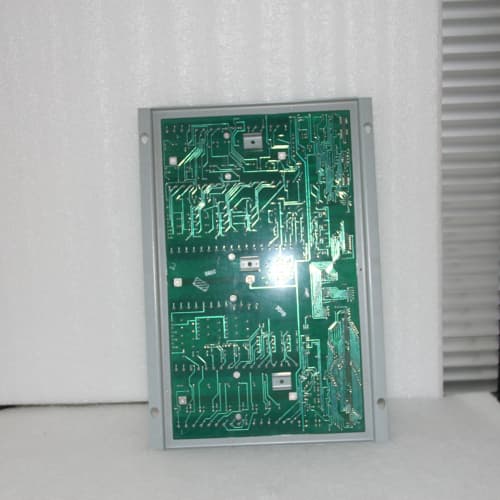
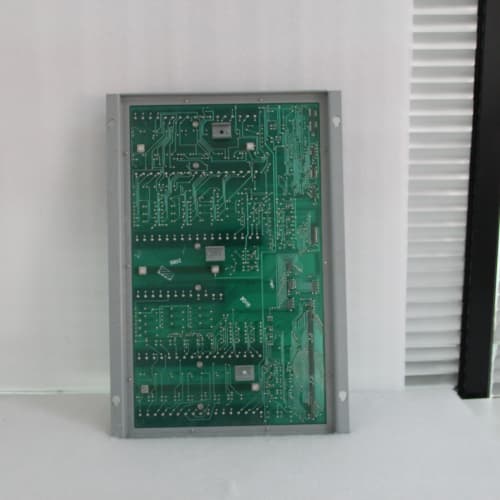
Bearing temperatures don’t lie. The DS4820B1SA gives you the data you need to monitor critical turbine bearings, generator windings, and inlet air temperatures with the precision that RTDs provide. It’s a simpler, proven design compared to the higher-resolution PRTA—eight channels, 16-bit resolution, 3-wire Pt100 support—and it’s been in the field for decades.
Compared to the DS4820B1S (non-A revision), the “A” revision adds a couple of practical improvements: the excitation current was reduced from 1mA to 500µA, cutting self-heating errors in half. The common-mode rejection was also improved from 80 dB to 90 dB at 50/60 Hz. The terminal assignment is identical—direct drop-in. No firmware changes needed.
Key Technical Specifications
| Parameter | Value / Range |
|---|---|
| Number of Inputs | 8, individually isolated |
| RTD Types Supported | Pt100, Ni120 (software-selectable per channel) |
| Configuration | 3-wire (default), 4-wire (selectable) |
| Excitation Current | 500 µA (constant) |
| Resolution | 16-bit (0.003°C for Pt100) |
| Accuracy (Overall) | ±0.1°C at 25°C, ±0.3°C over full operating range |
| Input Range | 0 to 400Ω |
| Lead Resistance Compensation | Up to 25Ω (3-wire) |
| Conversion Time | 200 ms per channel (all channels sequential) |
| Open-Circuit Detection | Yes—flags as fault when >1000Ω |
| Common-Mode Rejection | >90 dB at 50/60 Hz |
| Isolation (Channel-to-GND) | 1500 VAC |
| Status LEDs | Power (green), Fault (red), Communication (flashing) |
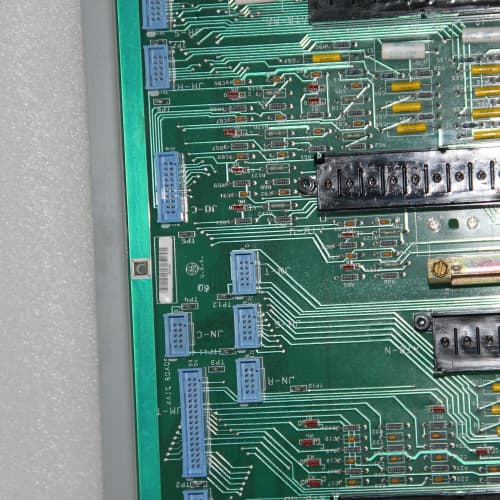
| Termination | 2 x 18-pin spring-clamp terminal blocks |
| Coating | Conformal-coated |
| Power Supply | 24 VDC from backplane (isolated) |
| Operating Temp | 0°C to +60°C |
| Dimensions (W x H x D) | 280 x 120 x 40 mm (11.0 x 4.7 x 1.6 in) |
Compatible Replacement Models
| Model | Classification | Notes & Labor Estimate |
|---|---|---|
| DS4820B1SA | ✅ Drop-in Replacement | Target model. Same form factor and terminal block. No changes. |
| DS4820B1S | ✅ Drop-in Replacement | Earlier revision—1mA excitation, 80 dB CMRR. Direct swap. |
| DS4815PRTA | ⚠️ Software Compatible | Higher-resolution RTD board (24-bit) with Pt1000 support. Hardware fits but software config differs. Budget 1-2 hours for reconfiguration. |
| IS420UIOBH4A | ❌ Hardware Incompatible | Mark VIe universal I/O module—different architecture. Not compatible. |
Frequently Asked Questions (FAQ)
Q: What’s the difference between the B1SA and the PRTA?
The B1SA is the older, simpler RTD board with 16-bit resolution and support for Pt100 and Ni120 only. The PRTA is the newer, higher-spec board with 24-bit resolution, Pt1000 support, and better accuracy. If you’re doing a new installation, go with the PRTA. If you’re replacing a failed B1S or B1SA and don’t need the extra resolution, the B1SA is a direct replacement that saves you reconfiguring the I/O map.
Q: How do I wire a 3-wire Pt100 to the B1SA?
Connect the sensor’s excitation wire (usually red) to the Ex+ terminal (for channel 1, that’s terminal 1). Connect the two sense wires (usually white or the same color) to the Input+ and Input- terminals (terminals 2 and 3). The board doesn’t care which sense wire goes where. If you have a 4-wire RTD, use the two sense wires and ignore the second excitation wire. Check GE’s manual GEK-108723 for the full pinout.
Q: The reading is showing open-circuit on channel 3, but the RTD is connected. What’s the most common cause?
A high-resistance connection. The B1SA detects an open when the resistance exceeds 1000Ω. A corroded terminal or a poor crimp at the RTD head can cause this. Measure the resistance between the Ex+ and Input+ terminals with an ohmmeter—you should see the RTD’s resistance (around 100-150Ω at room temperature). If it’s open, check the wiring at the sensor head.
Q: What’s the self-heating effect of the 500µA excitation current?
The self-heating is about 0.02°C for a Pt100 sensor (dissipation = I²R = 0.0005² × 100 = 25µW). The older B1S used 1mA (100µW), causing about 0.05°C self-heating. For small sensors or applications where the sensor is in a low-thermal-mass environment, the B1SA’s lower excitation is better.
Q: Can I use the B1SA with Pt1000 RTDs?
No—the B1SA only supports Pt100 and Ni120. Pt1000 requires a different excitation scheme and ADC scaling. If you need Pt1000, you’ll need the PRTA board.
Q: The conversion time is 200ms per channel. What’s the total scan time for 8 channels?
All 8 channels are scanned sequentially, so the total scan time is 8 × 200ms = 1.6 seconds. This is fine for slow-moving temperature signals. If you need faster updates, you can reduce the conversion time to 100ms (total 800ms) or 50ms (total 400ms) in the I/O map, but the noise will increase.
Q: The Fault LED is flashing red. What does that mean?
Flashing red indicates a communication loss with the CPU over the backplane. Reseat the board. If the fault persists, try the board in a known-good slot. If it works there, the original slot has a backplane issue. If it fails in the good slot, the board’s backplane interface may be faulty.
Q: What’s the maximum cable length for RTD inputs?
The lead resistance compensation is rated for up to 25Ω per lead. With 18 AWG copper wire (0.006Ω/ft), that’s about 4100 feet per lead. In practice, we recommend keeping it under 500 feet to minimize noise pickup. Use shielded twisted-pair cable and ground the shield at the rack end only.
Q: Can I use the B1SA for 2-wire RTDs?
Technically yes—connect the RTD across the Ex+ and Input+ terminals, and jumper Input- to the 0V return. But you’ll lose lead resistance compensation, and the cable resistance will add to the reading. For accurate measurements, use 3-wire or 4-wire sensors.
Q: Does the B1SA support HART communication?
No—this is a pure RTD input board. It doesn’t have a HART modem.
Q: What’s the lead time for a surplus B1SA?
We keep 4-6 units in stock. Domestic: 2-3 business days ground, overnight if ordered by 2 PM EST. International: 5-7 days via DHL, with customs potentially adding 1-3 days. We include a GE certificate of origin and commercial invoice with every shipment. Contact us if you need expedited shipping.
KOLLMORGEN S70602-NANANA
Schneider 140CPU65150
PROSOFT PLX82-EIP-PNC
A-B 1756-RM/A
 Email: sales@plcfcs.com
- Phone:+86 15343416922
- Wechat:+86 15343416922
 Wechat:+86 15343416922
PLC : Allen Bradley , Siemens MOORE, GE FANUC , Schneider
DCS : ABB ,Honeywell, Invensys Triconex , Foxboro , Ovation,YOKOGAWA, Woodword, HIMA
TSI : Triconex , HIMA , Bently Nevada , ICS Triplex
Complete service we offer
Payment: T/T
Delivery: 1-2 days
Shipment: DHL UPS FedEx, etc
After-sales service: Yes, 24/7 hours