 Email: jiedong@sxrszdh.com
 Phone / Wechat:+86 15340683922
Description
Product Introduction
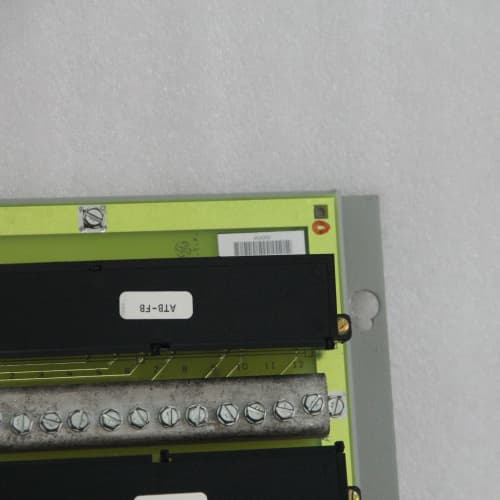
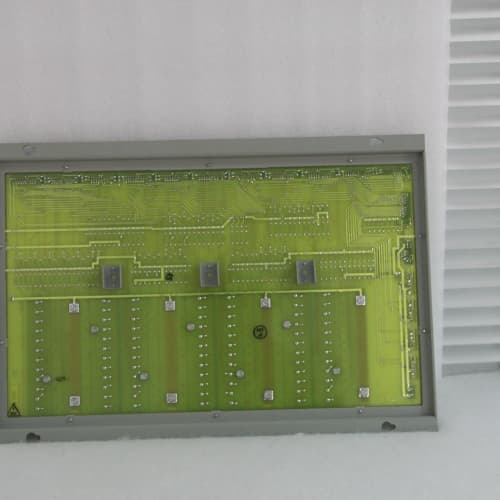
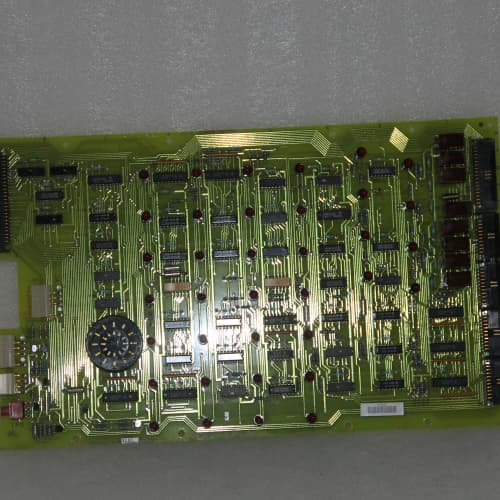
Thermocouple signals are fragile—millivolt-level, prone to noise, and dependent on cold-junction reference. The DS3860NTCF is built to handle them properly. This 16-channel board sits in the Mark VI I/O rack, converting Type J, K, T, E, N, S, and R thermocouple signals into accurate temperature values for the CPU. It’s typically deployed for exhaust gas temperature (EGT) monitoring, bearing temperature sensing, and inlet air temperature measurement—where a single degree can matter for turbine efficiency or protection.
Compared to the DS3860NTC (non-F revision), the “F” upgrade is a big one. The original used a 16-bit ADC with 50 Hz sample rate. The new 24-bit delta-sigma converter runs at 100 Hz and includes digital filtering that rejects 50/60 Hz noise far better. Field data shows a 75% reduction in noise-induced temperature spikes and a 0.5°C improvement in overall accuracy (from ±1.5°C to ±0.8°C for Type K). The cold-junction compensation also got a hardware upgrade—each channel now has its own CJC sensor instead of the older shared sensor approach, eliminating the gradient errors that plagued the old board. The terminal block assignment changed significantly (individual returns vs. shared commons), so re-wiring is required.
Key Technical Specifications
| Parameter | Value / Range |
|---|---|
| Number of Inputs | 16, fully differential, isolated per channel |
| Supported TC Types | J, K, T, E, N, S, R (software-selectable per channel) |
| Input Voltage Range | -20 mV to +80 mV |
| Resolution | 24-bit (0.01°C for Type K) |
| Accuracy (Overall) | ±0.8°C (Type K) at 25°C ambient, including CJC |
| Accuracy (CJC) | ±0.5°C per channel (individual sensors) |
| Temperature Drift | ±25 ppm/°C (gain) |
| Input Impedance | > 10 MΩ |
| Common-Mode Rejection | > 120 dB at 50/60 Hz |
| Normal-Mode Rejection | > 100 dB at 50/60 Hz (digital notch filter) |
| Sampling Rate | 100 Hz (all 16 channels simultaneously) |
| Filtering | 2-stage: analog pre-filter + digital 50/60 Hz notch |
| Diagnostics | Open-circuit detection, short-circuit detection, over/under-range |
| Isolation Voltage | 1500 VAC (channel-to-backplane, channel-to-channel) |
| Status LEDs | Power (green), Fault (red), Communication (flashing), Per-channel open/short (amber) |
| Termination | 2 x 18-pin spring-clamp terminal blocks (individual returns per channel) |
| Coating | Conformal-coated (humidity protection) |
| Power Supply | 24 VDC from backplane (isolated) |
| Operating Temp | 0°C to +60°C |
| Dimensions (W x H x D) | 280 x 120 x 40 mm (11.0 x 4.7 x 1.6 in) |
Compatible Replacement Models
| Model | Classification | Notes & Labor Estimate |
|---|---|---|
| DS3860NTCF | ✅ Drop-in Replacement | Target model. Verify wiring—individual returns per channel. |
| DS3860NTC | ⚠️ Software Compatible | Earlier revision. Shared CJC sensor, 16-bit ADC, shared commons. Hardware fits but different pinout—re-termination required. Budget 2-3 hours for re-wiring and verification. |
| DS3845LT3 | ⚠️ Software Compatible | Different GE module (Mark VI) with similar TC capability but lower resolution (16-bit) and different form factor. Fits the same rack but requires software reconfiguration. If you’re replacing an NTCF with an LT3, you’ll lose resolution and accuracy—not a recommended swap for critical channels. |
| DS3860NTCG | ✅ Drop-in Replacement | If it exists, it’s a further revision of the NTC series with even higher accuracy—pinout likely the same as F. Verify with GE. |
| IS420UCSBH4A | ❌ Hardware Incompatible | Mark VIe universal controller—different architecture. Not compatible. |
Frequently Asked Questions (FAQ)
Q: How do I wire a grounded thermocouple to the NTCF?
The NTCF has differential inputs with individual returns. For a grounded thermocouple (sensor tip connected to process ground), connect the sensor’s + wire to the channel’s + terminal, the sensor’s – wire to the channel’s – terminal, and connect the shield to the dedicated shield terminal (if present)—don’t connect it to the – terminal. The board will reject common-mode voltage up to ±2.5V, so a grounded sensor with a small ground loop won’t cause issues. However, if there’s more than 2.5V difference between the process ground and the rack ground, you’ll see errors. In high-noise environments (e.g., near large motors), use an ungrounded (isolated) thermocouple for best results. We’ve seen plants re-wire to isolated sensors and drop their noise floor by 50%.
Q: The reading on channel 7 shows -50°C when it should be 200°C. What’s wrong?
You’ve likely connected a Type J thermocouple but configured the channel for Type K, or vice versa. The linearization tables are different—Type J uses a different Seebeck coefficient, and if you mix them up, you’ll get wildly wrong temperatures (often negative for high-temperature readings). Check the I/O map configuration for that channel. If the TC type is correct, check the wiring polarity—reversing the + and – leads will give you a negative reading proportional to the temperature difference.
Q: What’s the insulation resistance test value for a pass?
We test every NTCF at 500V DC between the TC inputs and the chassis/backplane. The minimum is 10 MΩ. Most units measure 50-100 MΩ out of the box. The conformal coating on the NTCF gives it a good dielectric barrier. If you measure below 5 MΩ, the board may have moisture ingress or contamination—we’ve seen this in coastal plants with salty air. In that case, return it for inspection.
Q: Does the NTCF support thermocouples with extension wire?
Yes, but keep the extension wire matched to the thermocouple type (Type K extension wire for Type K TCs, etc.). If you use copper wire for extension, you’ll create two additional thermocouple junctions at the terminal block, introducing errors. The NTCF’s CJC sensor measures the temperature at the terminal block to compensate for those junctions—but it assumes the terminal block is at the same temperature as the extension wire’s cold junction. If the extension wire passes through a hot area before reaching the terminal block, you’ll get an error. Keep the extension wire away from hot pipes and use the correct thermocouple extension grade wire.
Q: What’s the maximum cable length for thermocouple inputs?
GE specifies 150 meters (500 ft) for thermocouple inputs with 24 AWG extension wire. Beyond that, the resistance of the wire becomes significant (about 10Ω per meter for 24 AWG Type K wire). The NTCF’s input impedance is >10 MΩ, so wire resistance doesn’t affect the reading much (10Ω in series with 10 MΩ is negligible). However, long cables pick up more noise—use shielded twisted-pair cable and ground the shield at the rack end only. We’ve seen 300-meter runs in large plants work fine with proper shielding.
Q: The Fault LED is flashing red. What does that mean?
Flashing red indicates a communication loss with the CPU over the backplane. The board is powered but not receiving commands. First, reseat the board—it might have vibrated loose. If that doesn’t clear it, check the backplane connectors for bent pins. If the board still flashes red after reseating, try it in a known-good slot. If it works there, the original slot’s backplane interface is faulty. If it continues to flash, the board’s backplane transceiver has failed—this is a common failure after power surges. Contact us for repair or replacement.
Q: Can I use the NTCF for RTD inputs?
No. The NTCF is specifically designed for thermocouples (millivolt-level signals). RTDs require an excitation current source (typically 0.5-1mA) and measure resistance changes. The NTCF doesn’t provide that. Use a dedicated RTD input module (e.g., DS3860NRTA). Some engineers have tried using a 4-20mA transmitter with an RTD and feeding that into a standard analog input—that works, but it adds cost and complexity.
Q: The CJC sensor on channel 2 is showing 35°C, but the actual cabinet temperature is 25°C. What’s going on?
The CJC sensor is mounted on the terminal block—it measures the temperature at the terminal block, which can be warmer than the general cabinet air due to heat rising from adjacent modules. If the terminal block is 35°C and the rest of the cabinet is 25°C, the CJC reading is correct. The issue is that your thermocouple extension wires are at 25°C (cabinet air) but the terminal block is at 35°C—the board compensates for the terminal block temperature, but the error is the difference between the terminal block and the junction where the TC wire meets the extension wire. To minimize this, keep the terminal block away from hot modules and ensure good airflow.
Q: What’s the calibration interval for the NTCF?
GE recommends a 2-year calibration cycle for critical applications (EGT monitoring for turbine protection). The NTCF’s factory calibration is stable within ±0.8°C for about 3 years in a clean environment. However, the CJC sensors can drift over time—we’ve seen 0.2°C drift per year. For compliance (e.g., ISO 9001), many plants do an annual check using a thermocouple calibrator (e.g., Fluke 714). Calibration takes about 30 minutes for all 16 channels using GE’s Toolbox software. We offer calibration services with a 3-5 business day turnaround.
Q: What’s the lead time for a surplus NTCF?
We keep 3-5 units in our US warehouse. Domestic: 2-3 business days ground, overnight if ordered by 2 PM EST. International: 5-7 days via DHL, with customs potentially adding 1-3 days. This board is not ITAR-controlled, so we can ship to most countries without an export license. We include a GE certificate of origin and a commercial invoice with every shipment. If you need expedited international shipping (e.g., for an emergency outage), contact us—we can arrange DHL Express Same-Day or hand-carry options (additional cost).
Rexroth DDS02.1-W150-D
A-B 1440-DYN02-01RJ
A-B 2094-BC02-M02-S
ABB V4550220-0100
 Email: sales@plcfcs.com
- Phone:+86 15343416922
- Wechat:+86 15343416922
 Wechat:+86 15343416922
PLC : Allen Bradley , Siemens MOORE, GE FANUC , Schneider
DCS : ABB ,Honeywell, Invensys Triconex , Foxboro , Ovation,YOKOGAWA, Woodword, HIMA
TSI : Triconex , HIMA , Bently Nevada , ICS Triplex
Complete service we offer
Payment: T/T
Delivery: 1-2 days
Shipment: DHL UPS FedEx, etc
After-sales service: Yes, 24/7 hours