 Email: jiedong@sxrszdh.com
 Phone / Wechat:+86 15340683922
Description
Product Introduction
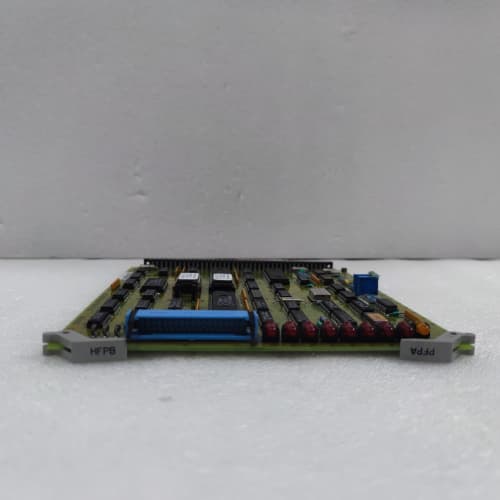
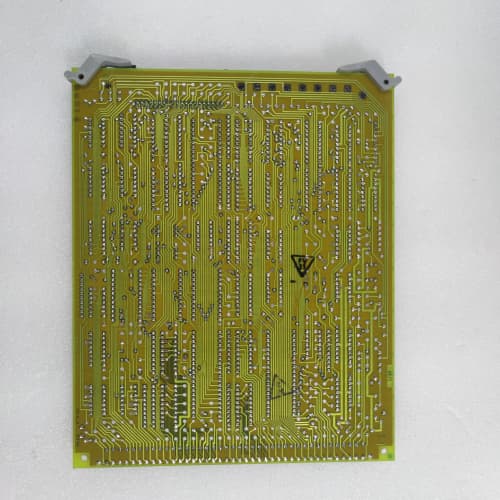
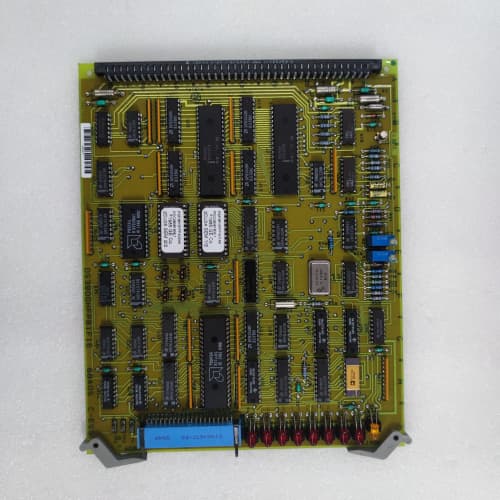
Pressure transmitters, flow meters, position feedback—they all speak 4-20mA. The DS3860HAFA is the interpreter that sits between those field instruments and the Mark VI CPU, converting analog current loops into digital values the controller can use for real-time decisions. It’s the most common analog input board in the Mark VI family, and for good reason: 16 channels per slot, high accuracy, and proven reliability in harsh turbine environments.
Compared to the DS3860HAF (non-A revision), the “A” version adds a significant hardware upgrade: the burden resistor network is now selectable per-channel via software. The older unit had a fixed 250Ω resistor for all channels—you couldn’t run voltage inputs on the same board without external shunt resistors. The -A version lets you assign 4-20mA (250Ω), 0-10V (high impedance >1MΩ), or ±10V on a channel-by-channel basis. This makes the board far more flexible for retrofit applications. That said, the terminal block pinout changed slightly—pin 1 on the old board was common (shared return); on the -A, each channel has its own isolated return.
Key Technical Specifications
| Parameter | Value / Range |
|---|---|
| Number of Inputs | 16 differential, isolated |
| Input Ranges (Software-selectable) | 4-20mA, 0-10V, 0-5V, ±10V, ±5V |
| Input Impedance | 250Ω (current mode) / > 1MΩ (voltage mode) |
| Resolution | 16-bit (0.003% of full scale) |
| Accuracy (Overall) | ±0.05% of reading + ±0.02% of range at 25°C |
| Temperature Drift | ±25 ppm/°C (typical) |
| Common-Mode Rejection | > 100 dB at 50/60 Hz |
| Normal-Mode Rejection | > 60 dB at 50/60 Hz (digital filtering) |
| Sampling Rate | 50 Hz (all channels simultaneously) |
| Isolation Voltage | 1500 VAC (channel-to-backplane) |
| Input Protection | Overvoltage clamp to ±30V; reverse polarity protection |
| Burden Resistor | 250Ω (current mode) with < 0.1% tolerance |
| Diagnostics | Open-loop detection (4mA threshold) per channel |
| Status LEDs | Power (green), Communication (flashing), Fault (red) |
| Termination | 2 x 18-pin spring-clamp terminal blocks |
| Coating | Conformal-coated |
| Power Supply | 24 VDC from backplane (isolated) |
| Operating Temp | 0°C to +60°C |
| Dimensions (W x H x D) | 280 x 120 x 40 mm (11.0 x 4.7 x 1.6 in) |
Compatible Replacement Models
| Model | Classification | Notes & Labor Estimate |
|---|---|---|
| DS3860HAFA | ✅ Drop-in Replacement | Target model. Identical mechanical form factor and backplane connector. No hardware changes. |
| DS3860HAF | ⚠️ Software Compatible | Earlier revision. Fixed 250Ω burden resistor on all channels; channel 9 on the older unit was not isolated. If you’re using voltage inputs, you’ll need external shunt resistors on the terminal block. Also requires a different configuration in the I/O map. Budget 1-2 hours to re-assign channels and verify scaling. |
| DS3860HAFB | ⚠️ Software Compatible | This revision (some plants have reported it) adds an extra 48V DC power input for long cable runs. The hardware fits, but you’ll need to connect the auxiliary power supply. Firmware may need updating. Consult GE’s application note. |
| DS3860HACA | ❌ Hardware Incompatible | This is a high-current analog output module, not an input board. Different pinout and different application. Won’t work. |
| IS420UAIH4A | ❌ Hardware Incompatible | Mark VIe analog input module. Different backplane connector (PCI Express). Requires Mark VIe rack. Not compatible. |
Frequently Asked Questions (FAQ)
Q: How do I wire a 4-20mA 2-wire transmitter to the DS3860HAFA?
This is the most common field wiring question. A 2-wire loop-powered transmitter gets its power from the loop—you need to provide an external 24V DC supply. The wiring scheme is: +24V from the power supply goes to the transmitter’s + terminal. The transmitter’s – terminal goes to the HAFA’s input + (channel positive). The HAFA’s input – (channel negative) goes back to the power supply’s 0V terminal. The HAFA’s built-in 250Ω resistor creates the voltage drop that the ADC measures. Pro tip: use shielded twisted pair and ground the shield at the power supply end only—grounding both ends creates ground loops, and we’ve traced many noisy readings to that mistake. GE’s wiring diagram GEK-108432 has the exact pinout.
Q: Can I mix current and voltage inputs on the same board?
Yes, but you need to configure each channel individually in the I/O map. Channels 1-8 could be 4-20mA, channels 9-12 could be 0-10V, and the rest could be ±5V. However, there’s a hardware caveat: the input impedance changes per mode. If you set a channel to voltage mode, it disconnects the 250Ω burden resistor. You can’t run a 4-20mA transmitter on a channel that’s configured for voltage—the missing burden resistor will saturate the ADC. Always double-check your configuration before powering up, and verify with a multimeter that the correct burden is present. We’ve seen plants fat-finger this and get readings stuck at 20mA (max scale).
Q: The HAFA is showing erratic readings on channel 5. What’s the first thing to check?
Ground loops. In 80% of the cases, erratic analog readings are caused by ground potential differences between the transmitter and the Mark VI rack. Measure the AC voltage between the transmitter’s 0V terminal and the rack’s 0V terminal—if it’s more than 0.5V AC, you have a ground loop. Solutions: use an isolated signal isolator (we recommend the Phoenix Contact MINI MCR series) or ensure the transmitter and the rack share the same earth ground point. Also, check the shield connection—it should be tied to earth ground only at the rack end, not at the transmitter end. If the shield is connected at both ends, it acts as a conductor for ground currents, injecting noise into the loop.
Q: What’s the open-loop detection threshold?
The HAFA detects open-loop conditions when the current drops below 2.0mA (for 4-20mA channels). In a 4-20mA loop, 4mA is the zero scale—anything below 2mA indicates a broken wire or a dead transmitter. The CPU will flag this as an open-loop alarm and you’ll see a diagnostic message in the Toolbox. For voltage inputs, open-loop detection isn’t supported—a disconnected wire will just read 0V, which could be interpreted as a valid signal. If you’re using voltage transmitters, we recommend adding a resistor network or pull-down to differentiate “0V signal” from “disconnected wire” if this is critical for safety.
Q: How often should I calibrate the DS3860HAFA?
GE recommends a 2-year calibration cycle for turbine control applications, and annually for safety-critical signals (e.g., flame detection, overspeed temperature compensation). The HAFA has a factory calibration that’s stable to ±0.05% for about 3 years in typical plant environments. However, if your cabinet runs hot (above 45°C) or you’ve had power surges, the ADC may drift sooner. We’ve seen boards drift 0.15% after 18 months in 55°C cabinets. For calibration, you’ll need a precision current source (e.g., Fluke 789) and the Toolbox software. It’s a 45-minute procedure for all 16 channels.
Q: Can I hot-swap the DS3860HAFA while the turbine is running?
The backplane supports live insertion, but we strongly advise against it. The HAFA has no automatic reconfiguration—the CPU polls the board slot and expects it to be present. If you pull a board and insert a new one, the CPU might see a different serial number and flag it as “unconfigured,” requiring a software reset. In a running turbine, a soft reset can cause a control interrupt. We’ve seen 2-second CPU resets after a hot-swap—that’s enough to trip a critical alarm. Always schedule this during a planned outage. If you absolutely must hot-swap (e.g., in an emergency), do it during a load reduction when the turbine is in a stable idle state.
Q: My readings are all off by exactly 1.5%. What’s causing that?
Check your burden resistor. The HAFA uses a precision 250Ω resistor with 0.1% tolerance for current inputs. If you’re using an external shunt resistor instead, it may have a different tolerance. Also, verify that you’ve selected the correct input range in the I/O map—if you’ve configured a channel for 0-10V but wired a 4-20mA transmitter, the ADC will read a voltage across the burden resistor (0-5V for a 4-20mA loop) and interpret it based on the wrong scaling. That would give you a systematic offset. For example, 12mA generates 3V across the 250Ω resistor. If the board thinks it’s a 0-10V input, it’ll scale 3V to 30% of range, but your transmitter scale might be 0-100% at 4-20mA. The mismatch is exactly the error you’re seeing.
Q: What’s the maximum cable length for analog inputs?
GE specifies 300 meters (985 ft) for 4-20mA loops with 18 AWG wire, and 150 meters for voltage inputs. The longer the cable run, the more susceptible you are to noise pickup. For voltage inputs, the high impedance of the HAFA (1 MΩ) means that even small capacitive coupling from adjacent power cables can induce noise—we’ve seen 50Hz hum on 100-meter runs in cabinets with AC distribution. For long runs, always use 4-20mA—the current loop is much more noise-immune. If you must use voltage for a long run, use shielded twisted pair and a cable with at least 50% coverage braid, and keep the cable at least 12 inches away from any 480V AC power cables.
Q: Does the HAFA support HART communication?
No. The HAFA is a dumb transducer—it reads the analog current or voltage and digitizes it. There’s no HART modem or HART protocol stack on this board. If you need to communicate with HART transmitters, you’ll need to use a separate HART handheld communicator or a HART multiplexer (like the GE HART module, which is a different product). The HAFA will ignore the HART frequency-shift keying (FSK) signal—it’s a 1.2 kHz/2.2 kHz superimposed on the 4-20mA, and the board’s internal filtering will attenuate it, but it won’t affect the analog reading.
Q: What’s the typical lead time if I order today?
We keep 4-6 units in the US warehouse. Domestic: 2-3 business days for ground, overnight if you order by 2 PM EST. International: 5-7 days via DHL Express. Customs delays in countries with restrictive electronics import rules (e.g., Brazil, India, Turkey) can add 2-3 days—we recommend using our customs broker to speed things along. Also, note that this board is not ITAR-controlled, so we can ship to most countries without an export license. However, if you’re shipping to a sanctioned country, we’ll need to verify the end-user certificate.
ABB 3HAB5761-1/06
SST SST-DN3-PCI-2
TEL 1381-645294-12
GE UR8FH
 Email: sales@plcfcs.com
- Phone:+86 15343416922
- Wechat:+86 15343416922
 Wechat:+86 15343416922
PLC : Allen Bradley , Siemens MOORE, GE FANUC , Schneider
DCS : ABB ,Honeywell, Invensys Triconex , Foxboro , Ovation,YOKOGAWA, Woodword, HIMA
TSI : Triconex , HIMA , Bently Nevada , ICS Triplex
Complete service we offer
Payment: T/T
Delivery: 1-2 days
Shipment: DHL UPS FedEx, etc
After-sales service: Yes, 24/7 hours