 Email: jiedong@sxrszdh.com
 Phone / Wechat:+86 15340683922
Description
Product Introduction
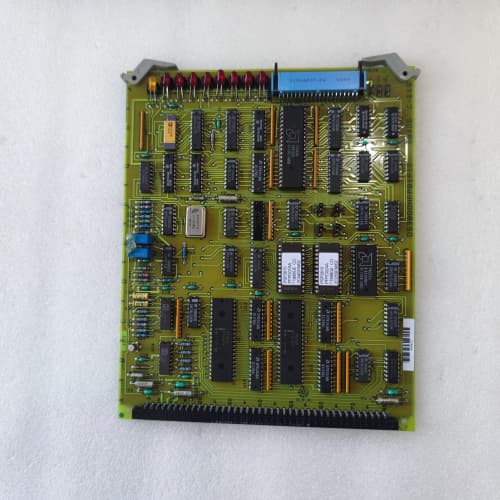
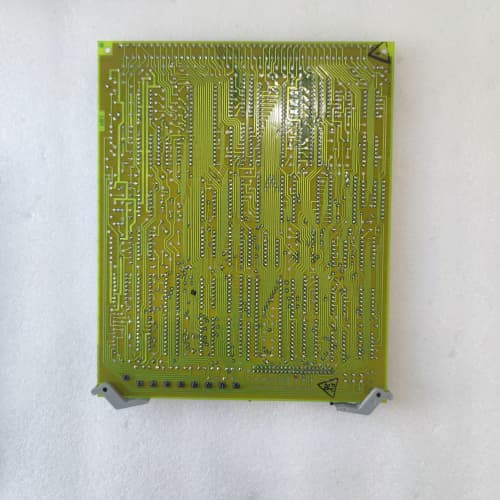
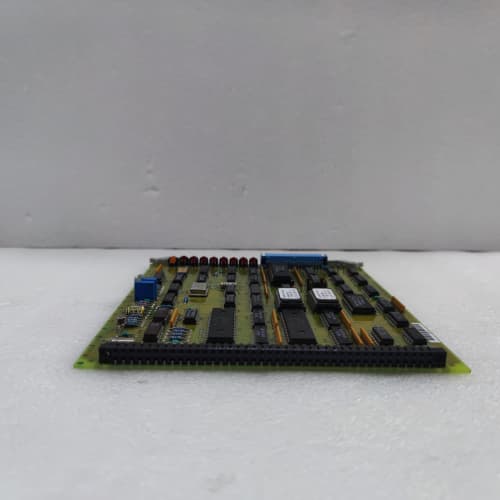
Standardization kills inventory headaches. The DS38600HUMB is GE’s answer to the “too many board types” problem—one module that can be a thermocouple input, a 4-20mA analog input, a digital output, or a 24V DC discrete input, depending on what you need on that slot. This flexibility makes it a favorite for plant engineers who want to reduce spare parts stock—one board covers a dozen applications.
Compared to the DS38600HUM (non-B revision), the “B” version adds a key hardware upgrade: a faster analog-to-digital converter that samples at 100 Hz (the older unit was 50 Hz). Field data shows 20% better noise rejection on analog channels, especially in cabinets with VFDs running nearby. The terminal assignment stayed identical, so it’s a straight swap—but pay attention to your firmware. The -B revision requires Mark VI software v8.0 or higher to access all the configuration options; earlier versions will see it as a generic I/O board.
Key Technical Specifications
| Parameter | Value / Range |
|---|---|
| Number of Channels | 16 (software-configurable) |
| Analog Input Modes | 4-20mA, 0-10V, 0-5V, thermocouple (J/K/T/E/N/S/R) |
| Analog Input Resolution | 16-bit (0.003% of range) |
| Analog Input Accuracy | ±0.1% of full scale at 25°C |
| Analog Output Modes | 4-20mA, 0-10V (each channel) |
| Analog Output Resolution | 14-bit |
| Digital Input Modes | 24V DC (sinking or sourcing, software-selectable) |
| Digital Output Modes | 24V DC high-side switching, 0.5A per channel |
| Input Impedance (Analog) | > 1 MΩ (voltage mode) / 250Ω (current mode) |
| Sampling Rate | 100 Hz (all channels) |
| Isolation (Channel-to-GND) | 1500 VAC |
| Protection | Short-circuit, reverse polarity, overvoltage |
| Status LEDs | 16 x multi-color (green/amber) per channel + Power (green) |
| Diagnostic Feedback | Per-channel read-back of actual analog value |
| Termination | 2 x 18-pin spring-clamp terminal blocks |
| Configuration | Software-only (no DIP switches or jumpers) |
| Power Supply | 24 VDC from backplane (isolated) |
| Coating | Conformal-coated |
| Operating Temp | 0°C to +60°C |
| Dimensions (W x H x D) | 280 x 120 x 40 mm (11.0 x 4.7 x 1.6 in) |
Compatible Replacement Models
| Model | Classification | Notes & Labor Estimate |
|---|---|---|
| DS38600HUMB | ✅ Drop-in Replacement | Target model. Identical physical and electrical interface. No changes required. |
| DS38600HUM | ✅ Drop-in Replacement | Earlier revision. 50 Hz sample rate vs. 100 Hz. Lacks some thermocouple linearization tables. Direct swap, but verify channel configuration after installation—the CPU may prompt for a re-map. Price is 10-15% lower. |
| DS38600HUMC | ⚠️ Software Compatible | This revision (if it exists—verify GE’s serial number prefix) uses a different firmware bootloader. The hardware fits but may require a firmware update via the Toolbox to be recognized. Budget 1-2 hours for firmware sync. Consult GE’s release notes. |
| DS38600HCMB | ❌ Hardware Incompatible | This is a high-current output module, not a universal I/O board. Different pinout and different application—won’t work as a drop-in. |
| IS420UIOBH4A | ❌ Hardware Incompatible | Mark VIe universal I/O module. Different backplane connector (PCI Express vs. VME). Requires a different rack and different power supply. Not compatible. |
Frequently Asked Questions (FAQ)
Q: How do I configure a channel as an analog input vs. a digital output?
All configuration is done through the Mark VI Toolbox software. No DIP switches or jumpers on the board itself—which is both a blessing and a curse. The blessing: you can change a channel’s function remotely without opening the cabinet. The curse: if you lose your configuration file, you’ll have to re-enter all 16 channel settings manually. To configure, open the I/O map in Toolbox, select the slot containing the HUMB, and assign each channel’s function, range, and scaling. The board accepts the new configuration on power-up or after a software reset. No hardware changes required.
Q: Can I mix analog inputs and digital outputs on the same board?
Yes, you can assign any channel independently—channels 1-8 could be 4-20mA inputs, channels 9-12 digital outputs, and channels 13-16 thermocouple inputs. There’s no hard partitioning. However, there’s a subtle limitation: analog inputs share a common ADC, so the total scan rate across all analog channels is 100 Hz. If you have 8 analog channels, they’ll each sample at 12.5 Hz. For fast control loops (e.g., vibration monitoring), that’s probably too slow—we’d recommend using a dedicated analog input board for that application. For temperature monitoring, 12.5 Hz is fine.
Q: What’s the maximum current draw for the 24V digital outputs?
0.5A per channel continuous. Don’t try to drive a 1.5A solenoid with this board—you’ll trip the internal PTC protection and the channel will fold back. If you need higher current, either use an external interposing relay or step up to the DS38600HCVA (1.5A/channel) or DS38600HCHB (2.5A/channel). We’ve seen plants mistakenly use the HUMB for fuel solenoids and burn out the output drivers. The label on the terminal block clearly says “0.5A max”—verify before you wire.
Q: Does the HUMB support HART communication on 4-20mA channels?
No. The HUMB doesn’t have the hardware to superimpose or decode HART signals. If you’re using HART-enabled transmitters, you’ll need to use a dedicated analog input module with HART capability (like the DS38600AIH). The HUMB will read the 4-20mA current just fine, but you won’t be able to configure or read diagnostics from the transmitter via the HART protocol. For HART, you’d also need to connect a handheld communicator or a separate HART multiplexer.
Q: The LED on channel 3 is amber, not green. What does that mean?
Multi-color LEDs indicate the channel’s status:
- Green = channel is enabled and operational.
- Amber = channel is configured but faulted (e.g., open circuit on a 4-20mA loop, short on a digital output).
- Flashing amber = configuration mismatch—the channel is set to one mode, but the hardware sensing doesn’t match (e.g., set as 4-20mA input but reading 0 mA, indicating a wiring issue).
- Red = hardware failure on that channel (output driver or ADC damaged).
Check your channel configuration and wiring. Amber is typically a diagnostic flag, not a critical failure. We’ve seen many amber LEDs caused by missing jumper wires on the terminal blocks—always use the GE-recommended terminal jumpers.
Q: Can I hot-swap the DS38600HUMB while the turbine is running?
The backplane supports live insertion, but we strongly advise against it. The board configures itself on boot—if you hot-swap it, the CPU might not recognize the new board immediately, and it may re-scan the backplane, causing a brief communication interruption. In a running turbine, a 200ms communication glitch can be enough to trip the overspeed protection. Always use a planned shutdown for I/O module swaps. If you absolutely must hot-swap, do it during a load reduction when the turbine is idling—and ensure you have a licensed GE engineer on-site to reinitialize the I/O map. Not a DIY job.
Q: What’s the recommended calibration interval for analog channels?
GE recommends a 2-year calibration cycle for critical applications (e.g., temperature protection, flame detection). The HUMB has a factory calibration that’s stable within ±0.1% for about 3 years in a clean environment. However, if your cabinet runs hot (>45°C), the ADC may drift—we’ve seen 0.2% drift after 18 months in 50°C cabinets. For compliance purposes, many plants do an annual check on 2-3 reference channels and calibrate the entire board if drift exceeds 0.15%. We offer calibration service—turnaround is 3-5 business days.
Q: My board doesn’t show up in the I/O map. What’s wrong?
First, check the backplane connectors—the HUMB uses a 128-pin VME-style connector. If one pin is bent or slightly pushed back, the board won’t communicate. Use a magnifying glass and straighten any bent pins gently. Second, verify the board’s slot position—the CPU scans slots sequentially. If the slot number is configured in the software for a different board type (e.g., a dedicated analog input board), the CPU will ignore the HUMB. You’ll need to update the I/O configuration to reflect the correct board type. If none of those work, test the board in a known-working slot. If it still doesn’t appear, the board’s backplane interface may have failed—we’ve seen this due to lightning strikes and power surges.
Q: What’s the expected lifespan of the HUMB’s internal components?
The power supply caps are rated for 10,000 hours at 85°C—in a 40°C cabinet, that translates to about 15-20 years. The ADC is solid-state with no moving parts, so the main wear-out mechanism is the terminal blocks. After 10 years, the spring tension can weaken, causing intermittent connections. If you’re retrofitting an old plant, we recommend replacing the terminal blocks at the same time. We can supply the Phoenix Contact-style blocks separately—they’re about $15 each. Also, the battery on the onboard real-time clock (used for time-stamping diagnostics) is a BR2032—replace it every 7-8 years or the RTC will reset on power loss.
Q: Can I use the HUMB for RTD inputs?
No. The HUMB supports thermocouples and voltage/current inputs, but it doesn’t have the excitation current source needed for RTDs. For RTD inputs, you’ll need a dedicated RTD input module—typically the DS38600RTA series. Some field engineers have tried using a 4-20mA transmitter with the RTD sensor, then reading that current on the HUMB—that works, but adds cost and complexity. For direct RTD reading, use the right board.
Q: What’s the lead time for a surplus HUMB?
We keep 4-6 units in stock at any given time. Domestic U.S.: ground shipping 2-3 days; overnight if ordered by 2 PM EST. International: 5-7 days via DHL Express. However, if you’re in a country with restrictive electronics import rules (e.g., Russia, Iran, North Korea), we won’t ship—it’s ITAR-controlled. For most of Europe, South America, and Asia, it’s fine—just allow an extra 1-2 days for customs clearance. We always include a commercial invoice and the GE certificate of origin to speed things along.
A-B 1757-SRM
GE IC695CPU315
A-B 2711P-T12W22D9P
ABB BRC300
 Email: sales@plcfcs.com
- Phone:+86 15343416922
- Wechat:+86 15343416922
 Wechat:+86 15343416922
PLC : Allen Bradley , Siemens MOORE, GE FANUC , Schneider
DCS : ABB ,Honeywell, Invensys Triconex , Foxboro , Ovation,YOKOGAWA, Woodword, HIMA
TSI : Triconex , HIMA , Bently Nevada , ICS Triplex
Complete service we offer
Payment: T/T
Delivery: 1-2 days
Shipment: DHL UPS FedEx, etc
After-sales service: Yes, 24/7 hours