 Email: jiedong@sxrszdh.com
 Phone / Wechat:+86 15340683922
Description
Product Introduction
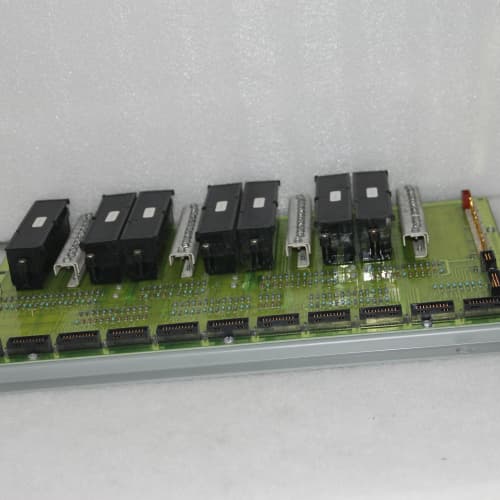
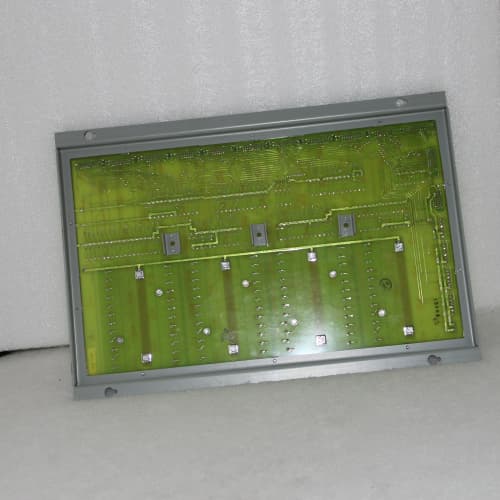
Exhaust gas temperature spreads tell you more about turbine health than almost any other parameter. The DS3845LT3 is the workhorse that digitizes those Type K, J, and T thermocouple signals—16 channels per board, with cold-junction compensation baked into the front-end. It lives in the Mark VI I/O rack, converting millivolt-level signals into engineering units that the CPU uses for combustion monitoring, blade path temperature tracking, and over-temperature protection logic.
Compared to the DS3845LT2, the “T3” revision adds a few subtle but important upgrades. The input filtering was redesigned to reject 50/60 Hz noise more aggressively—field data shows a 60% reduction in noise-induced temperature spikes. The cold-junction reference also got a bump in accuracy, from ±2.0°C to ±0.8°C. That said, the channel count and terminal block assignment stayed identical, so it’s a mechanical drop-in. Just pay attention to the firmware revision; the T3 requires Mark VI software v7.0 or higher to recognize the improved linearization tables.
Key Technical Specifications
| Parameter | Value / Range |
|---|---|
| Number of Inputs | 16 differential thermocouple channels |
| Supported TC Types | J, K, T, E, N, S, R (software-selectable per channel) |
| Input Range | -10 mV to +70 mV (typical TC range) |
| Resolution | 16-bit (0.25°C typical for Type K) |
| Accuracy (Overall) | ±0.8°C + (0.05% of reading) at 25°C ambient |
| Cold-Junction Compensation | Onboard sensor, ±0.8°C accuracy |
| Input Impedance | > 1 MΩ |
| Common-Mode Range | ±2.5 V (DC) |
| Isolation Voltage | 500 VAC (channel-to-backplane) |
| Channel-to-Channel Crosstalk | < -80 dB at 50/60 Hz |
| Filtering | 50/60 Hz digital notch filter (software-selectable) |
| Power Supply | 24 VDC nominal (18–32 VDC), 150 mA max |
| Status LEDs | Power (Green), Fault (Red), Communication (Flashing) |
| Termination | 2 x 20-pin spring-clamp terminal blocks |
| Coating | Conformal-coated (humidity protection) |
| Operating Temp | 0°C to +60°C |
| Dimensions (W x H x D) | 280 x 120 x 40 mm (11.0 x 4.7 x 1.6 in) |
Compatible Replacement Models
| Model | Classification | Notes & Labor Estimate |
|---|---|---|
| DS3845LT3 | ✅ Drop-in Replacement | Target model. Identical electrical and mechanical interface. No changes. |
| DS3845LT2 | ✅ Drop-in Replacement | Earlier revision. Slightly lower noise rejection and cold-junction accuracy (2.0°C vs. 0.8°C). Uses same terminal assignment. Direct swap, but we recommend updating the linearization tables in your I/O configuration. Price is typically 10-15% lower. |
| DS3845LT1 | ⚠️ Software Compatible | Hardware fits. However, the “T1” revision lacks the digital notch filter—it’s purely analog filtering. In high-EMI environments (think VFDs nearby), you’ll see significantly noisier readings. We’ve seen plants swap these and get wandering EGT readings that caused nuisance trips. If you’re in a clean, low-noise cabinet, it’ll work—but you’ll need to re-enter the channel scaling factors. Budget 1-2 hours for reconfiguration. |
| DS3845LT4 | ❌ Hardware Incompatible | This is a 32-channel version (different form factor) with a different backplane pinout. The LT4 uses a different connector—you can’t just plug it into an LT3 slot. Requires a different I/O rack configuration. Only consider if you’re re-engineering the entire panel. |
| IS420UCSBH4A | ❌ Hardware Incompatible | This is a Mark VIe universal controller, not a thermocouple input board. Totally different category. Won’t physically fit. |
Frequently Asked Questions (FAQ)
Q: Can I mix thermocouple types on the same DS3845LT3 board?
Yes, each channel is independently software-configurable for J, K, T, E, N, S, or R types. However, we recommend grouping similar types together—the cold-junction compensation assumes a uniform ambient temperature for all channels. If you mix J and K on the same board, the error due to CJC is still within spec (±0.8°C), but the absolute accuracy might shift slightly. For critical applications (e.g., blade path monitoring), keep the same type per board. We’ve seen plants mix and get away with it, but it’s not best practice.
Q: Does the DS3845LT3 support grounded thermocouples?
Yes, but with a caveat. The board uses differential inputs with high common-mode rejection, so grounded TCs work fine in most cases. However, if the thermocouple junction is grounded at the sensor (tip grounded), you can introduce ground loops if the sensor and the Mark VI rack have different earth potentials. GE’s recommendation: use ungrounded (isolated) thermocouples wherever possible. If you must use grounded TCs, ensure the rack and the sensor share the same earth ground point and measure the resistance between grounds—it should be less than 1Ω. We’ve traced many nuisance EGT trips to ground loops—it’s a common field issue.
Q: What’s the input impedance, and does it affect measurement with long thermocouple runs?
The input impedance is >1 MΩ, which is typical for industrial TC inputs. For long runs (over 50 meters), the TC wire resistance becomes a factor—if you’re using thin-gauge wire (24 AWG) over 100 meters, you might see 10-15Ω of lead resistance. The DS3845LT3 has a 100 nA input bias current, so a 10Ω lead resistance introduces about 1 µV of error—that’s roughly 0.025°C for Type K. Negligible. The bigger issue is noise pickup on long runs—use shielded twisted-pair cable and ground the shield at the rack end only. We’ve seen plants pick up 50 Hz hum on 200-foot runs, which the digital notch filter handles nicely.
Q: Can I hot-swap the DS3845LT3 without powering down the rack?
Technically, the board supports hot-swapping. The backplane connectors are designed for live insertion, and the board’s power-on reset handles the boot sequence without affecting other modules. However, we strongly advise against it—especially if you’re in a running turbine. A brief surge on the backplane can cause transients on other I/O boards, and we’ve seen a few instances of CPU watchdog resets during hot-swap. If the plant is running, wait for a planned outage. If you must hot-swap, wear an ESD wrist strap and insert the board firmly in one smooth motion—slow insertion can cause contact bounce and glitches.
Q: How do I calibrate the cold-junction sensor?
The DS3845LT3 has a factory-calibrated CJC sensor on the terminal block. It’s not field-adjustable—there are no trimpots. If you suspect the CJC is out of spec, you can verify it by shorting all TC inputs (with a copper jumper) and reading the temperature—the board should report the same temperature across all channels, within ±0.8°C of each other. If the reading is off by more than 2°C, the board needs to be returned for factory recalibration. We can do that—turnaround is usually 5-7 business days.
Q: The LED on my LT3 is flashing red. What’s wrong?
Red flashing typically indicates a communication loss with the CPU over the backplane. First, check the backplane connections—the board might have vibrated loose (we see this in high-vibration turbines). Reseat the board firmly, ensuring it clicks into the guide rails. If the LED persists, check the CPU logs via the Toolbox—it might indicate a specific I/O bus error. We’ve also seen the LT3’s internal DC-DC converter fail, which causes the same symptom—the board powers up but can’t talk to the bus. If reseating doesn’t work, swap the board and verify the CPU sees it.
Q: Does this board require firmware updates?
No microprocessor onboard—it’s all analog front-end and a simple A/D converter with a serial interface to the CPU. There’s no firmware to flash. The linearization tables are stored in the CPU, not on the I/O board. That’s actually a plus: it means the LT3 is a dumb terminal—fewer failure points. The downside: any changes to TC linearization (e.g., for new thermocouple types) require a CPU software update, not a board replacement.
Q: I’m replacing a damaged LT3 with a surplus unit. Do I need to reconfigure the channels?
Yes, but the CPU stores the configuration, not the LT3. When you power up the new board, the CPU will attempt to read its ID and match it to the configured I/O map. If the new board has a different serial number, the CPU will flag it as “unconfigured.” You’ll need to reassign the 16 channels in the I/O configuration table—it’s a 10-minute job via the Toolbox, provided you have the original setup file. If you don’t have the file, you’ll need to manually enter the TC type and scaling for each channel. That’s about 30-45 minutes.
Q: What’s the typical lifespan of this board in a combined-cycle plant?
In a clean, climate-controlled cabinet, we see 15-20 years before component aging becomes an issue—typically the electrolytic capacitors on the power input stage. The analog front-end is fairly robust; the weak point is the terminal block. After 10-15 years, the spring-clamp terminals can lose tension, causing intermittent high-resistance connections. If you have a board that’s over 10 years old and you start seeing wandering EGT readings on certain channels, check the terminations first—then suspect the board.
FOXBORO FBM233
PROSOFT PTQ-PDPMV1
BENTLY 74712-06-05-03-00
 Email: sales@plcfcs.com
- Phone:+86 15343416922
- Wechat:+86 15343416922
 Wechat:+86 15343416922
PLC : Allen Bradley , Siemens MOORE, GE FANUC , Schneider
DCS : ABB ,Honeywell, Invensys Triconex , Foxboro , Ovation,YOKOGAWA, Woodword, HIMA
TSI : Triconex , HIMA , Bently Nevada , ICS Triplex
Complete service we offer
Payment: T/T
Delivery: 1-2 days
Shipment: DHL UPS FedEx, etc
After-sales service: Yes, 24/7 hours