 Email: jiedong@sxrszdh.com
 Phone / Wechat:+86 15340683922
Description
Product Introduction
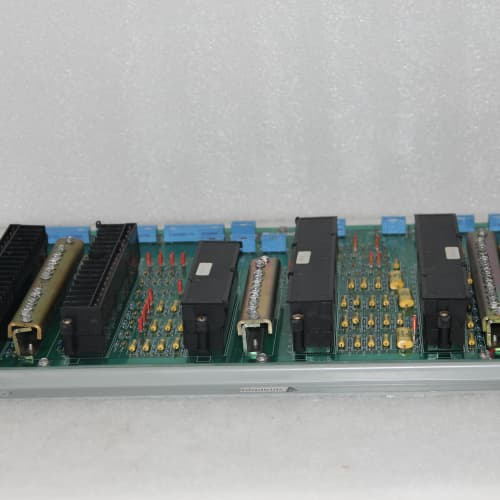
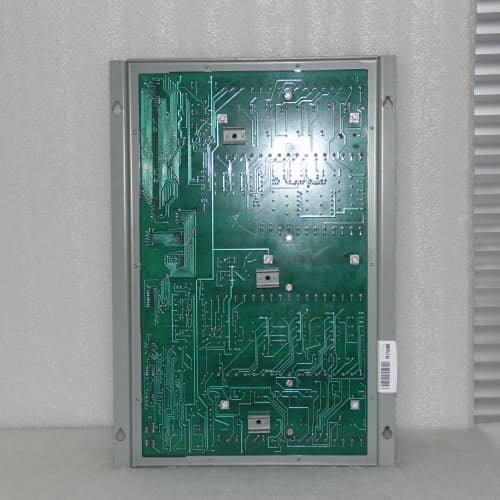
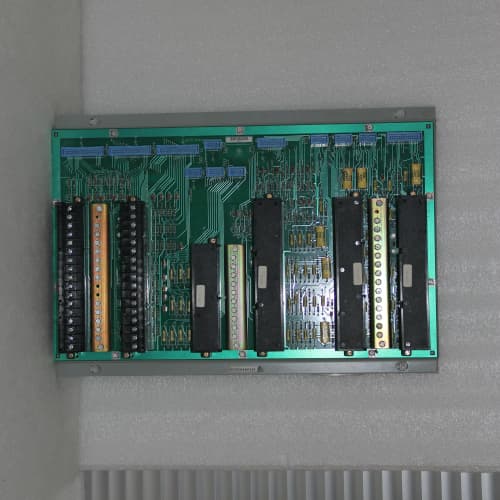
The GE DS3820SMTD is a servo output module for the Speedtronic Mark V turbine control system, providing four isolated, high-resolution analog output channels for precise control of electro-hydraulic and electro-pneumatic actuators. This board mounts directly into the Mark V rack, receiving digital position commands from the CPU and converting them to highly accurate analog signals that drive turbine valve positioners, inlet guide vanes, and other critical actuation devices.
The SMTD integrates both command output generation and position feedback monitoring in a single module. Each channel provides a ±10V or 4-20 mA command signal (user-selectable) to the actuator, while simultaneously reading the actuator’s LVDT or RVDT position feedback through dedicated analog inputs. The board then drives a closed-loop control algorithm that minimizes position error. This eliminates the need for separate servo drivers or external position controllers, simplifying system architecture and reducing cabinet space requirements. The SMTD remains a critical component in GE Mark V systems for fuel valve positioning, steam admission control, and other precision motion applications.
Key Technical Specifications
| Parameter | Value |
|---|---|
| Manufacturer | GE (General Electric) |
| Model Number | DS3820SMTD |
| Series | Speedtronic Mark V |
| Number of Channels | 4 (fully isolated) |
| Output Signal Types | ±10V (10 mA max) or 4-20 mA (selectable per channel) |
| Output Resolution | 16-bit (0.3 mV for ±10V; 0.25 µA for 4-20 mA) |
| Output Accuracy | ±0.1% of full scale at 25°C; ±0.25% over full temperature range |
| Output Load | ±10V: 1 kΩ minimum; 4-20 mA: 0-600Ω load |
| Feedback Inputs | 4 (one per channel, differential) |
| Feedback Input Range | ±10V DC (supports LVDT and RVDT) |
| Feedback Resolution | 14-bit (1.2 mV) |
| Feedback Accuracy | ±0.2% of full scale |
| Feedback Excitation | 2.5 kHz, 3V RMS (integrated oscillator) |
| Control Loop Update Rate | 500 Hz (2 ms per channel) |
| Isolation Voltage | 2500 VDC (field-to-backplane) |
| Status Indicators | 4 green LEDs (channel active), 4 yellow LEDs (position error warning), 1 red LED (system fault) |
| Operating Temperature | 0 to +60°C (ambient, forced air required) |
| Storage Temperature | -40 to +85°C |
| Dimensions | 8.5″ x 4.2″ x 1.5″ (standard Mark V 1-slot width) |
| Connector | 96-pin DIN 41612 (Type C, male) + external terminal block for field wiring |
Key Selling Points & Differentiators
- Integrated command and feedback in one slot. No need for separate analog output and input modules. The SMTD handles both functions, minimizing cabinet space and simplifying the signal chain.
- On-board 2.5 kHz excitation oscillator. Generates the excitation signal for LVDT/RVDT position feedback—no external signal conditioner required. This is a significant cost and integration savings.
- Selectable ±10V or 4-20 mA outputs per channel. Flexibility to drive valve positioners with either analog voltage or current loop signals, depending on the actuator’s requirements. Each channel can be individually configured.
- 16-bit output resolution with 500 Hz update rate. High resolution ensures smooth, precise actuator positioning with no noticeable steps or quantization jitter. The 2 ms update rate provides responsive dynamic response for turbine control applications.
- Closed-loop control engine integrated on the board. The SMTD runs the position control algorithm locally, offloading the CPU and allowing lower processing overhead.
- 48-hour burn-in with position loop performance testing. Every unit is exercised through the full servo loop—command output generated, feedback simulated, and error signal measured. We verify that the integral gain, proportional gain, and derivative gain response are within GE’s factory spec.
- 18-month warranty covering output accuracy and feedback integrity. If any channel fails to meet the ±0.1% output accuracy or ±0.2% feedback accuracy, we replace the board.
Frequently Asked Questions (FAQ)
Q: The SMTD has ±10V and 4-20 mA outputs. How do I select which one to use for each channel?
A: Selection is done through the Mark V software. Each channel has a configuration parameter that chooses between ±10V or 4-20 mA. There are no physical jumpers on the board. Once configured, the board’s output stage adjusts accordingly. If you need to change it later, it’s a simple software setting in the Mark V configuration tool.
Q: My valve positioner only accepts 4-20 mA. Will the SMTD drive it correctly?
A: Yes, with one important limitation: the 4-20 mA output can drive a maximum load of 600Ω. Most modern positioners accept 4-20 mA with 250Ω input impedance, which is well within spec. For older positioners or long cable runs, check the loop resistance (positioner impedance plus cable resistance)—if it exceeds 600Ω, you’ll need a loop-powered isolator or a separate current driver. Most applications are fine.
Q: What is the function of the integrated LVDT excitation oscillator?
A: The SMTD includes a 2.5 kHz, 3V RMS oscillator that provides the excitation signal required for LVDT (Linear Variable Differential Transformer) position feedback sensors. You connect the oscillator output to the LVDT’s primary winding, and the LVDT’s secondary windings return the position-sensing voltage to the board. This eliminates the need for an external oscillator or signal conditioner—everything is integrated on the SMTD. The board also has an internal demodulator to convert the AC feedback signal to a DC position signal for the CPU.
Q: Can I use the SMTD to drive an actuator that does not have position feedback?
A: Not effectively—the SMTD is designed as a closed-loop controller and expects position feedback. Without feedback, the board will not perform its internal position loop correctly. If you have an open-loop actuator, you should use the DS3820AOBA (Analog Output Board) or another analog output module to drive it—the SMTD will continuously try to close the loop and may become unstable without feedback.
Q: What is the yellow position error warning LED indicating?
A: The yellow LED illuminates when the position error (difference between commanded output and actual feedback) exceeds a configured threshold—typically ±1% of full scale. This indicates either a problem with the actuator (sticking, slow response), a wiring issue (broken feedback wire), or a sensor problem (LVDT misalignment). The CPU can also monitor this and generate an alarm. If the yellow LED is on briefly during large position changes, it’s normal. If it stays on continuously, investigate the field device. The threshold is configurable in the Mark V software.
Q: Is the SMTD a drop-in replacement for older DS3820SMTB or DS3820SMTC boards?
A: Yes. The SMTD superseded the SMTB and SMTC variants with improved resolution (16-bit vs. 12-bit) and faster update rate (500 Hz vs. 100 Hz). The form factor, connector pinout, and field wiring are identical. You can replace an SMTB or SMTC directly with an SMTD without any hardware changes. If your control logic expects the older board’s behavior, you may need to adjust the PID gains slightly (because the SMTD’s closed-loop response is faster), but otherwise it’s a direct drop-in.
Q: What is the maximum cable length from the SMTD to the actuator?
A: For the command signal (±10V or 4-20 mA), cable length is typically limited by voltage drop or noise pickup—keep it under 100 meters for ±10V, and under 300 meters for 4-20 mA. For LVDT feedback (2.5 kHz AC), keep cable lengths under 50 meters to avoid signal attenuation and phase shift. GE’s standard practice is to mount the Mark V cabinet as close to the turbine as possible—typically within 25 meters of the actuators. Use shielded twisted-pair cables with the shield grounded at the Mark V cabinet end. Longer runs may require signal conditioners or differential line drivers.
Q: The SMTD has 14-bit feedback resolution. Is that enough for my application?
A: 14-bit resolution on the feedback input provides 1.2 mV resolution on a ±10V signal. For a typical LVDT with a 10V span, this gives approximately 0.012% of full range resolution—or about 12 parts per million. For most turbine applications (valve positions, inlet guide vanes), this is more than sufficient. The limiting factor is usually the mechanical accuracy of the LVDT and actuator. The 16-bit output command has even finer resolution (0.3 mV), ensuring the command is smoother than the feedback—a standard control engineering practice.
Q: What is the update rate of the SMTD’s closed-loop control?
A: The SMTD updates the position loop at 500 Hz (2 ms per iteration). This is the rate at which it reads the feedback, compares it to the command, computes the output from the PID algorithm, and updates the analog output. This is fast enough for most electro-hydraulic servo valves, which have natural frequencies in the 10-50 Hz range. If you need a faster loop, you’d use a high-speed dedicated servo controller—the SMTD is designed for turbine applications with moderate dynamic response.
Q: Can the SMTD drive an electro-hydraulic servo valve directly, or do I need an amplifier?
A: Directly—the ±10V output is intended to drive electro-hydraulic servo valves with a ±10V input. Most servo valves accept ±10V directly with an input impedance of 1 kΩ or higher. The SMTD’s output stage can drive 10 mA maximum, so if the valve’s input impedance is lower than 1 kΩ, you’ll need an external amplifier. Check your valve’s datasheet. If it’s a 4-20 mA valve, use the current output mode. If it’s a ±10V valve, the SMTD can drive it directly.
Q: What are the PID gain settings, and can I adjust them?
A: The SMTD uses a PID (Proportional-Integral-Derivative) control loop. The gains are configurable in the Mark V software and are typically set during initial turbine commissioning. The default values are: P = 100, I = 10, D = 0, but these will vary based on your actuator’s speed and deadband. We recommend using GE’s tuning procedure—or have a controls engineer with Mark V experience tune the gains. Incorrect gains can cause oscillation or slow response. We don’t change these during our testing; we verify that the loop responds according to the factory defaults. You’ll tune them to match your specific installation.
Q: The SMTD has a red LED. What does it mean when it’s lit?
A: The red LED indicates a fault on the board: either an internal oscillator failure (LVDT excitation failed), an ADC or DAC fault, or a backplane communication error. If the red LED is lit, the board is not functioning and needs replacement. In our field experience, red LEDs on SMTD boards are rare—the primary failure mode is output drift (which the yellow LED catches first). If you see a red LED, power-cycle the board. If it persists, replace the board and contact us for warranty or service.
Q: Are these SMTD boards still available new, or are they all refurbished?
A: The DS3820SMTD has been discontinued by GE, like all Mark V modules. What we carry is new surplus—boards that were manufactured by GE before the production line ended, stored in original anti-static packaging, and never installed. These are not refurbished units; they are unused factory-original boards. We have limited stock and replenish only when we find additional surplus or NOS (New Old Stock) from decommissioned projects. The boards pass our QC procedures to verify function, but we do not do any rework—they come as manufactured. Refurbished units would be clearly labeled as such—we don’t offer refurbished SMTD boards due to the precision nature of the servo functions.
ABB PM856AK01
PROSOFT MVI56E-MCMR
GE IC695CPE310
MOTOROLA MVME5100
 Email: sales@plcfcs.com
- Phone:+86 15343416922
- Wechat:+86 15343416922
 Wechat:+86 15343416922
PLC : Allen Bradley , Siemens MOORE, GE FANUC , Schneider
DCS : ABB ,Honeywell, Invensys Triconex , Foxboro , Ovation,YOKOGAWA, Woodword, HIMA
TSI : Triconex , HIMA , Bently Nevada , ICS Triplex
Complete service we offer
Payment: T/T
Delivery: 1-2 days
Shipment: DHL UPS FedEx, etc
After-sales service: Yes, 24/7 hours