 Email: jiedong@sxrszdh.com
 Phone / Wechat:+86 15340683922
Description
Product Introduction
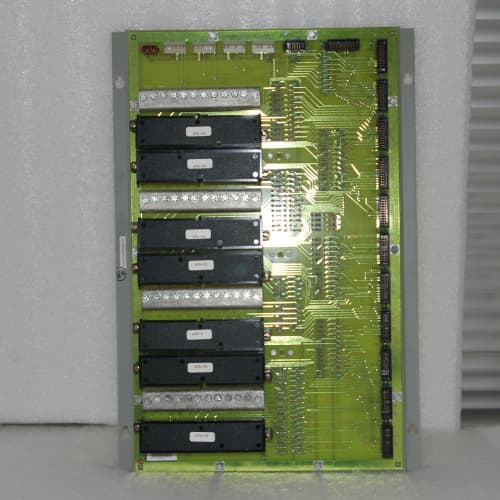
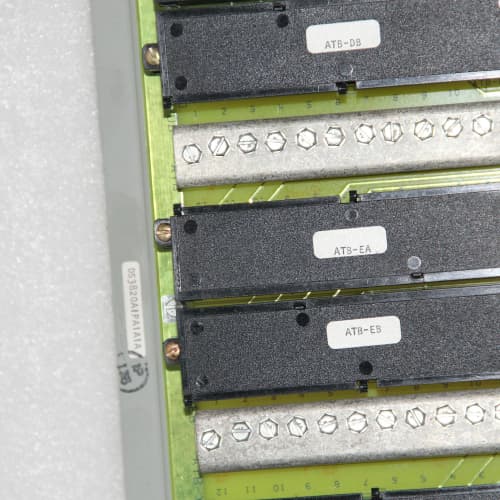
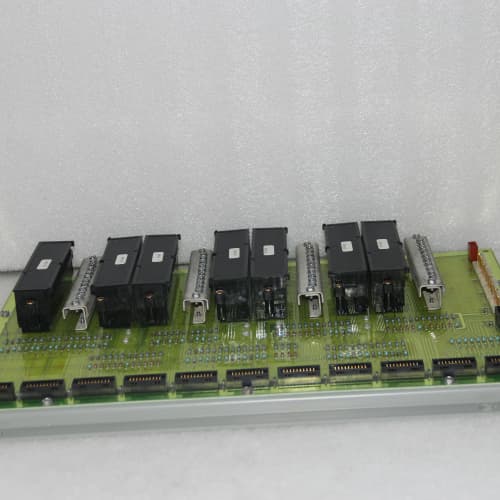
The GE DS3820RDNA is a high-current relay output module for the Speedtronic Mark V turbine control system, providing eight independent, isolated Form C (SPDT) relay outputs for driving heavy field loads. This board mounts directly into the Mark V rack and interfaces with the backplane, receiving logic commands from the CPU and converting them to high-capacity relay closures suitable for motor starters, valve actuators, large solenoids, and pump contactors.
The RDNA is designed for applications where standard 2A outputs (RDMA series) are insufficient. Each of the eight channels uses a 10A-rated relay with both normally-open and normally-closed contacts available, giving you flexibility for fail-safe and interlocking circuits. Individual output fuses (5A fast-blow) on each channel protect the board and backplane from field wiring faults, and dual field supply inputs allow independent power for banks of four channels. This module is commonly found in Mark V systems for turbine fuel valve control, generator breaker closure, and auxiliary motor circuits—applications that demand higher contact ratings than the standard output modules provide.
Key Technical Specifications
| Parameter | Value |
|---|---|
| Manufacturer | GE (General Electric) |
| Model Number | DS3820RDNA |
| Series | Speedtronic Mark V |
| Number of Channels | 8 (organized as two banks of 4) |
| Output Type | Form C (SPDT) electromechanical relays |
| Contact Configuration | Normally-open and normally-closed terminals per channel |
| Contact Rating | 10A at 250 VAC / 30 VDC (resistive load) |
| Contact Material | Silver-cadmium oxide (arc-resistant) |
| Minimum Load | 100 mA at 5 VDC (for reliable oxide-fracture performance) |
| Coil Voltage | 24 VDC (derived from field supply input) |
| Field Supply Inputs | Two independent terminals (one per bank of 4 channels) |
| Field Supply Range | 20-30 VDC |
| Coil Current per Relay | 40 mA typical (160 mA per bank when all 4 energized) |
| Individual Output Fusing | 5A fast-blow fuse per channel (field-replaceable) |
| Isolation Voltage | 2500 VDC (field-to-backplane) |
| Response Time | 15 ms typical (energize), 10 ms typical (de-energize) |
| Mechanical Life | 10 million operations (unloaded) |
| Electrical Life | 50,000 operations at rated 10A load |
| Status Indicators | 8 green LEDs (one per channel, coil-energized indication); 8 red LEDs (fuse-blown indication, one per channel) |
| Operating Temperature | 0 to +60°C (ambient, forced air required) |
| Storage Temperature | -40 to +85°C |
| Dimensions | 8.5″ x 4.2″ x 1.5″ (standard Mark V 1-slot width) |
| Connector | 96-pin DIN 41612 (Type C, male) + external terminal block for field wiring |
Key Selling Points & Differentiators
- 10A contact rating per channel. The RDNA handles loads up to 10A—five times the capacity of standard RDMA output modules. This lets you drive large motor starters, valve actuators, and pump contactors directly without external interposing relays.
- Form C (SPDT) contacts for fail-safe design. Each channel provides both normally-open and normally-closed outputs. Use the NC contacts for fail-safe tripping or interlocking logic—the relay holds in the energized state during normal operation, and de-energizing opens the circuit.
- Individual fuse protection per channel. Each output has a 5A fast-blow fuse that protects the relay contacts, board traces, and backplane from field wiring shorts. A red LED illuminates when the fuse blows, allowing rapid troubleshooting without a multimeter.
- Dual field supply banks. Two independent field supply inputs let you mix 24V and 30V DC coil voltages in the same module, or isolate critical loads from non-critical ones. This is essential for systems where you need redundant field power for trip circuits.
- Silver-cadmium oxide contacts. The arc-resistant contact material withstands the inrush currents typical of inductive loads (motors, solenoids) better than silver-only contacts. The cadmium oxide content prevents contact welding during high-current switching events.
- 48-hour burn-in at full load cycling. Every unit runs 1,000 cycles at 8A load (AC resistive) with contact resistance monitored. We check each fuse for correct blow characteristics. We reject boards where any relay shows bounce exceeding 5ms or contact resistance above 30mΩ.
Frequently Asked Questions (FAQ)
Q: What is the difference between the RDNA and the RDMA output modules?
A: Three main differences: First, contact rating—RDNA is 10A per channel, RDMA is 2A. Second, contact configuration—RDNA is Form C (SPDT, both NO and NC contacts), RDMA is Form A (SPST, NO only). Third, the RDNA includes individual fuses on each output—5A fast-blow—with fuse-blown indicators (red LEDs). The RDMA has no fuses. The RDNA is for heavy loads; RDMA is for low-current, high-density applications. You cannot substitute one for the other without understanding your load requirements.
Q: I have a DS3820RDMB in my rack. Is the RDNA a direct replacement?
A: No—the RDNA is a completely different module. The RDMB is a standard 2A Form A output module with 16 channels. The RDNA has only 8 channels, uses Form C (SPDT) contacts, is rated for 10A, and includes individual fuses. The pinout, field wiring, and backplane addressing are different. You cannot simply swap them—you’d need to reconfigure the Mark V software, change field wiring, and verify your loads are compatible with the RDNA’s contact rating. If you need a direct replacement for an RDMB, you should order a DS3820RDMB (or RDMA1A1A if you want gold contacts and coating). If you need higher current capacity, the RDNA is the right module, but it’s not a drop-in replacement.
Q: The RDNA has Form C contacts with both NO and NC outputs. How should I use the NC contacts?
A: The NC (normally-closed) contacts are designed for fail-safe applications: when the coil is de-energized, the NC contact is closed. This means in normal operation (coil energized), the NC contact is open. Use this for critical trip circuits: e.g., a fuel shutoff valve that must remain open during operation. The coil is held energized to keep the valve open; if power fails or the CPU commands a trip, the coil de-energizes and the valve closes. The NC contact is the safe state. For standard on/off control (energize to turn on, de-energize to turn off), use the NO contacts. We recommend documenting your fail-safe logic clearly—we’ve seen plants miswire NC and NO and have unexpected trips during power failures.
Q: The RDNA has individual 5A fuses on each output, but the relay is rated for 10A. Why not use 10A fuses?
A: The fuses are there to protect the board traces and backplane, not the relay contacts themselves. Each output trace on the PCB is designed for 6A continuous, and the backplane connector pins are rated at 5A per pin. The relay contacts can handle 10A, but the rest of the signal path cannot. The 5A fuse is the limiting element—it blows before the PCB traces or backplane pins overheat. If your load draws more than 5A continuous, you should use an external contactor rated for the load, driven by the RDNA relay (which only draws 40mA for the coil). The RDNA relay closes and powers the contactor coil; the contactor handles the 10A+ load. This is standard practice.
Q: What is the maximum current I can switch through the RDNA contacts?
A: The relay is rated at 10A at 250 VAC or 30 VDC resistive. For inductive loads (motors, solenoids, transformers), derate to 6A and include a snubber or suppression diode. For DC loads, the 30V rating is critical because DC arcs are harder to extinguish than AC—do not exceed 30V DC. We have seen customers switch 125V DC through these relays and the contacts weld within a few cycles. If you need DC voltage above 30V, use an external contactor or solid-state relay with an 125V DC rating. The RDNA is not designed for high-voltage DC.
Q: How do I test if the fuses on my RDNA board are blown?
A: There are two methods. First, look at the red LEDs on the front panel—each output channel has a dedicated red LED that illuminates when its fuse is blown. If you’re not seeing the LED, but the output doesn’t work, measure voltage on the load side of the terminal block with a multimeter (or test continuity across the fuse holder). The fuses are field-replaceable: they are 5x20mm glass cartridge fuses, 5A fast-blow, rated 250V. We can supply exact replacement fuses (specify Littelfuse 217 series or equivalent). Do not exceed 5A or use slow-blow fuses—you’ll defeat the board protection and risk damaging the PCB traces.
Q: Can I replace a single relay on the RDNA if it fails, or do I need to replace the whole board?
A: Technically yes, practically no. The relays on the RDNA are through-hole mounted on the PCB, but replacing them requires desoldering 8 pins per relay without damaging the board. Field replacements are risky—we’ve seen technicians lift pads and destroy the board in the process. We recommend replacing the entire board. If the board is out of warranty, we offer a relay replacement service where we swap all eight relays for new ones (same Omron or Fujitsu brand) and recalibrate the board on our test rig. This costs about 40% of a new board and includes a 12-month warranty. For most customers, the downtime savings justify board replacement—keep a spare RDNA on hand and return the failed board to us for refurbishment.
Q: I need to switch a 5A, 240V AC motor starter coil. Is the RDNA suitable?
A: Yes—240V AC is within the relay’s 250V AC rating, and 5A is within the 10A rating. However, motor starter coils are inductive loads with inrush currents 3-5 times the steady-state current—your 5A coil could draw 15-25A for a few milliseconds during contact closure. That’s a risk. Install an RC snubber (typically 100Ω and 0.1µF in series) across the contact to absorb the arc energy. Also, derate your planned current by 40% for inductive loads—use a maximum of 6A steady-state. If your starter coil is rated at 5A steady-state and you’re switching it multiple times per day, the RDNA will hold up but you’ll eventually wear out the contacts (50,000 cycle rating at 10A). For long service life, use an external contactor: use the RDNA to drive the contactor coil (which draws <1A), and let the contactor handle the motor starter coil.
Q: Does the RDNA require 24V DC field power, or can I use 120V AC?
A: The relay coils require 24V DC—specifically 20-30V DC. The field supply inputs are DC only. The contacts themselves can switch 120V AC loads (or 250V AC max), but the coil drive circuit is DC. Do not apply AC to the field supply terminals—this will destroy the rectifier and coil drive circuits. If your plant uses 120V AC for field devices, bring in a separate DC power supply (24V) to power the RDNA coils. This is a common mistake we see in plants with mixed AC/DC control systems.
Q: What is the advantage of the RDNA over using an external relay interposing panel?
A: The RDNA integrates eight 10A relays into a single Mark V slot, saving cabinet space and reducing external wiring. Without the RDNA, you’d need external relay panels with individual relays, terminal strips, and dedicated cabling back to the Mark V cabinet. The RDNA also provides fuse protection and status indicators that external panels often lack. That said, if you have more than 8 high-current outputs, external panels may be more cost-effective. For 8 or fewer outputs, the RDNA is the cleanest solution. It also maintains the isolation and backplane communication integrity that external panels require additional interface modules to achieve.
Q: How many RDNA boards can I install in a single Mark V chassis?
A: The Mark V backplane can support up to 16 output modules total (including RDMA, RDNA, and other output types) before reaching the backplane power and addressing limits. The RDNA draws about 160mA per bank (when all relays energized), so a fully populated chassis with 16 RDNA boards would draw approximately 2.5A from the field supply—this is within the Mark V cabinet’s power capacity, but you need to check your specific chassis configuration. The CPU addressing also limits you to a maximum number of I/O slots. Consult your Mark V configuration file to see which slots are allocated for output modules. We can help you audit your backplane capacity if you send us your system configuration—just ask.
CTI 2500-C200
ABB DSQC539
KEOHNE MFC300
 Email: sales@plcfcs.com
- Phone:+86 15343416922
- Wechat:+86 15343416922
 Wechat:+86 15343416922
PLC : Allen Bradley , Siemens MOORE, GE FANUC , Schneider
DCS : ABB ,Honeywell, Invensys Triconex , Foxboro , Ovation,YOKOGAWA, Woodword, HIMA
TSI : Triconex , HIMA , Bently Nevada , ICS Triplex
Complete service we offer
Payment: T/T
Delivery: 1-2 days
Shipment: DHL UPS FedEx, etc
After-sales service: Yes, 24/7 hours