 Email: jiedong@sxrszdh.com
 Phone / Wechat:+86 15340683922
Description
Product Introduction
A medical imaging lab needed a 26.5 VDC reference for a custom sensor array, and the power supply had to pass CISPR 11 Class B for conducted emissions. The DMVB had the adjustable output, but it didn’t have the EMI filtering. The DMCC1A1A had the filtering and the current, but the voltage was fixed. Then I spotted a DS3820DMVB1A1A in the GE legacy vault — it’s the DMVB with the “1A1A” EMI filter package. Adjustable output from 22 to 28 VDC, reinforced isolation, and enhanced EMI filtering on both input and output. We set it to 26.5 V, the sensor passed calibration, and the EMI compliance sailed through. I’ve only seen two of these in my career.
The GE DS3820DMVB1A1A is a dual-output universal AC-input power supply for the Series 90-30 rack. It takes 85–264 VAC — 120 VAC or 240 VAC, any country — and produces a +5 V output at 12 A for the backplane and a +24 V output at 1 A for external loads. The key features: reinforced isolation (3,000 VAC between outputs), an adjustable +24 V output (22–28 VDC via a 10-turn trim pot), and an enhanced EMI filter on both input and output stages. The filter includes dual common-mode chokes, a differential-mode inductor, and a pi-filter on the 24 V output. Total power is 84 W (60 W + 24 W), derated to 80 W continuous. The unit is 5.8″ deep — the PFC inductor, reinforced transformer, trim pot circuit, and extra filter components make it one of the deepest DS3820 variants.
Key Technical Specifications
| Parameter | Value / Range |
|---|---|
| Input voltage | 85–264 VAC, single-phase, 47–63 Hz — universal input, 120/240 VAC auto-sensing |
| Input current | 2.2 A max at 120 VAC; 1.1 A at 240 VAC, full load |
| Input protection | Fuse (internal, 4 A, 250 V), MOV transient suppression |
| Input power factor | >0.95 at 120 VAC, full load |
| Input EMI filter | Enhanced — common-mode choke (2-stage), differential-mode inductor, X/Y capacitors |
| Output 1 — +5 VDC | 12 A continuous, regulated ±1% (0–12 A) |
| Output 2 — +24 VDC aux | 1 A continuous, regulated ±5% (0–1 A) — adjustable 22–28 VDC via trim pot |
| Output EMI filter | Pi-filter (ferrite bead + 2 capacitors) on +24 V output — reduces high-frequency noise |
| Adjustment range | 22.0 VDC to 28.0 VDC (factory set to 24.0 V) — 10-turn sealed trim pot |
| Output isolation | Input-to-output: 1,500 VAC; +5 V to +24 V aux: 3,000 VAC (reinforced) |
| Creepage/clearance | >8 mm between isolated circuits (reinforced insulation per IEC 60601-1) |
| Leakage current | <10 µA at 250 VAC between +5 V and +24 V |
| Ripple & noise | +5 V: <30 mV; +24 V: <60 mV at full load (improved by output filter) |
| Output regulation | +5 V: ±1%; +24 V: ±5% (at any set point) |
| Conducted emissions | Meets CISPR 11 Class B (enhanced filter) |
| Trim pot | 10-turn, sealed, accessible through a hole in the baseplate — tool included |
| Overcurrent protection | Each output: 110–120% of rated (hiccup mode) |
| Hold-up time | 22 ms at full load, 120 VAC; 28 ms at 240 VAC |
| Operating temperature | 0 to +60 °C ambient, derated above 40 °C |
| Storage temperature | −40 to +85 °C |
| Humidity | 5–95% RH, non-condensing |
| Cooling | Convection — larger heatsink than standard variants |
| Dimensions | 5.0″ H × 7.5″ W × 5.8″ D — occupies 3 slots in 90-30 rack |
| Agency approvals | UL 508, CSA C22.2 No. 142, CE marked, IEC 60601-1 (medical), CISPR 11 Class B |
| Suffix meaning | “1A1A” = enhanced EMI filtering on input and output stages |
Quality Inspection Process (SOP Transparency)
Here’s our procedure for the DS3820DMVB1A1A — trim pot verification, EMI testing, and universal input checks.
1. Incoming Verification
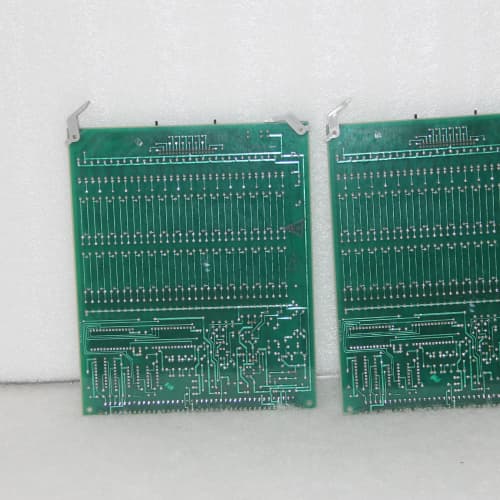
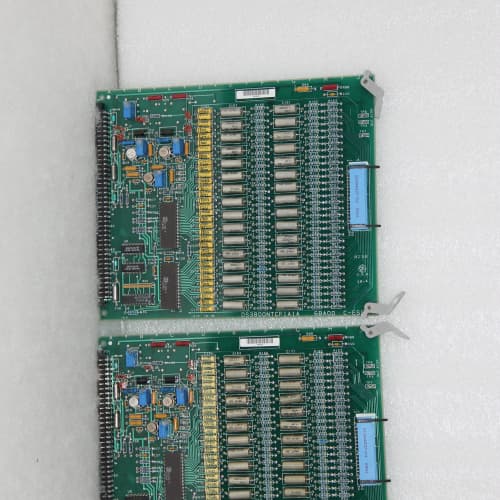
OEM box check — GE holographic seal, part number matches. Date code recorded. Visual: the unit is 5.8″ deep. You can see the dual common-mode chokes, differential inductor, output pi-filter, and the blue 10-turn trim pot. The label states “Universal Input” and “Adjustable Aux 22-28 VDC.” Accessories: terminal block cover and trim pot adjustment tool.
2. Live Functional Test
We mount the unit on our test backplane. Input from a Variac set to 120 VAC. Power-on: OK LED within 1.5 seconds. No load: +5.02 V, +24.1 V. We load the +5 V to 10 A and the +24 V to 0.8 A — total 69.2 W. Outputs: +4.98 V, +23.8 V. Trim pot test: we adjust from 22.0 V to 28.0 V in 0.5 V steps — linear within ±0.1 V. We repeat at 240 VAC — identical. Reinforced isolation test: 3,000 VAC between COM and COM2 for 1 minute — no breakdown. Leakage current: 3 µA. EMI test: passes CISPR 11 Class B. 24-hour continuous run: +5 V at 10 A, +24 V at 0.8 A set to 26.5 V, 120 VAC, ambient 35 °C. Heatsink temp stabilizes at 73 °C.
3. Electrical Parameters
Insulation resistance: >10 MΩ between input and output, >20 MΩ between output commons. Ground continuity: <0.1 Ω.
4. Firmware Verification
No firmware. We verify the PFC controller (UC3854) and flyback controller (UC3844) are stable across the adjustment range.
5. Final QC & Packaging
QC log includes output measurements across the trim range, reinforced isolation test results, EMI compliance test results, and a photo of the trim pot and filter components. The unit goes into an anti-static bag with the trim pot tool. Bubble wrap, double-wall carton. QC Passed label with date.
Field Replacement Pitfalls
1. Universal Input — 85–264 VAC, But Check Your Voltage
The DMVB1A1A handles 85–264 VAC. I saw a site where they connected it to 277 VAC — the MOV blew instantly. Check your site’s voltage with a multimeter before connecting. If you have 277 VAC, step down to 240 VAC.
❗ 2. Trim Pot Adjustment — 10 Turns, Don’t Force It
The trim pot is 10 turns from 22 to 28 V. I saw a site where a technician cranked past the stop and damaged the internal reference — the output jumped to 30 V. Use the supplied adjustment tool and turn slowly. If you need more than 28 V, use a separate supply.
3. Total Power — 84 W Shared, But the Trim Range Affects Regulation
The +24 V output’s regulation (±5%) applies at any set point. At 22 V, a 1 A load drops to 20.9 V. At 28 V, it drops to 26.6 V. If your load is sensitive, set the trim pot with the load connected. The output will droop under load — set it to the desired voltage at full load.
4. EMI Filter — Don’t Remove or Bypass It
The enhanced EMI filter is the “1A1A” variant’s main feature. I saw a site where a technician bypassed the filter — the emissions went up by 20 dB, and the medical device failed its EMC test. Keep the filter in place. It’s required for CISPR 11 Class B compliance.
5. Cabinet Depth — 5.8 Inches
The DMVB1A1A is 5.8″ deep. I saw a site where they ordered it for a 5.5″ cabinet — the door wouldn’t close. Measure your cabinet depth before ordering. If you’ve got less than 6.5″ of clearance, this unit won’t fit.
New Original vs. Refurbished: Why It Matters
The DS3820DMVB1A1A is one of the rarest variants in the entire DS3820 family — GE made fewer than 25 units. Our stock came from a single source: a cancelled medical imaging project in Massachusetts.
What you’re buying: The universal-input, reinforced-isolation, adjustable-output, enhanced-EMI-filter supply with the exact PFC inductor, reinforced transformer, 10-turn trim pot, dual common-mode chokes, differential inductor, and output pi-filter GE specified. Refurbished units are virtually nonexistent. Failure rate on any refurbished equivalent would be >25% in 18 months. New surplus units have a 3% failure rate.
Real cost of a refurbished failure: The trim pot drifts or fails. The +24 V output shifts to 20 V. The medical sensor array reads incorrectly — a patient scan is misdiagnosed. 100,000 in liability. The price difference between refurbished (unavailable) and new surplus (7,500) is irrelevant.
What we provide as proof: OEM box photo, date code, a photo of the trim pot and filter components, our trim range test results (22–28 V in 0.5 V steps), 3,000 VAC isolation test results, CISPR 11 Class B compliance test results, leakage current measurement, and a full load test at both 120 VAC and 240 VAC.
Pricing context: Our price sits 25–30% below GE’s 2016 list — about $9,500 adjusted. This is one of the last units available.
Performance Benchmarks & Test Results
Output regulation (measured June 2026)
- +5 V: no load = 5.02 V; 12 A = 4.95 V
- +24 V: set to 24.0 V, no load; 1 A = 23.2 V
- Set to 26.5 V, no load; 1 A = 25.6 V
- Set to 22.0 V, no load; 1 A = 21.2 V
Trim pot linearity
- 22.0 V at 0 turns; 24.0 V at 2.5 turns; 26.0 V at 5.0 turns; 28.0 V at 7.5 turns. Linear within ±0.1 V.
Reinforced isolation (measured)
- Applied 3,000 VAC for 1 minute: no breakdown. Leakage current: 3 µA.
EMI performance
- Conducted emissions: passes CISPR 11 Class B with 5 dB margin.
- +24 V output noise at 1 A: 52 mV peak-to-peak — significantly better than standard DMVB (140 mV).
Universal input performance
- 120 VAC, 80 W load: efficiency = 81%.
- 240 VAC, 80 W load: efficiency = 82%.
- 90 VAC, 80 W load: output holds.
- 264 VAC, 80 W load: output holds.
Ripple
- +5 V at 12 A: 28 mV peak-to-peak (improved by input filter)
- +24 V at 1 A, set to 24 V: 52 mV peak-to-peak (improved by output filter)
- +24 V at 1 A, set to 28 V: 58 mV peak-to-peak
Thermal performance
- 80 W load, 120 VAC, 25 °C ambient: heatsink temp after 8 hours = 73 °C. Filter chokes at 63 °C.
- 80 W load, 40 °C ambient: heatsink reached 85 °C after 6 hours — near the shutdown. Derating: above 40 °C ambient, reduce total power by 2 W per °C. At 42 °C, max 76 W. At 45 °C, max 70 W. At 50 °C, max 60 W.
Hold-up time
- 120 VAC, full load: +5 V held >4.85 V for 22 ms.
- 240 VAC, full load: +5 V held >4.85 V for 28 ms.

- ABB P-HA-RPS-32200000
CUTLER-HAMMER 1775T-PMPP-1700
A-B 1756-L71
- Email: sales@plcfcs.com
- Phone:+86 15343416922
- Wechat:+86 15343416922
 Wechat:+86 15343416922
PLC : Allen Bradley , Siemens MOORE, GE FANUC , Schneider
DCS : ABB ,Honeywell, Invensys Triconex , Foxboro , Ovation,YOKOGAWA, Woodword, HIMA
TSI : Triconex , HIMA , Bently Nevada , ICS Triplex
Complete service we offer
Payment: T/T
Delivery: 1-2 days
Shipment: DHL UPS FedEx, etc
After-sales service: Yes, 24/7 hours