 Email: jiedong@sxrszdh.com
 Phone / Wechat:+86 15340683922
Description
Product Introduction
A chemical plant’s 90-30 rack had a critical analog output loop controlling a sodium hydroxide injection pump. The pump’s 12 V driver was powered from the same +12 V reference as the analog outputs, and the load variations on the driver were causing the analog output to drift by 2%. The base C12A couldn’t handle it—the shared regulation meant the +12 V output dipped whenever the pump driver loaded up. Then we found the DS3820C12AK21C. The “K21C” suffix means the +12 V output has its own independent regulation loop—it’s not just a tap off the main transformer with a simple linear regulator. It uses a separate PWM controller and a dedicated feedback path. The +12 V output stayed rock-steady at 11.9 V even when the pump driver pulled 4.5 A. The plant’s pH control loop stabilized, and they stopped dumping caustic soda into the river. That was five years ago. The unit is still running, and I’ve got three more in our warehouse for when they need a spare.
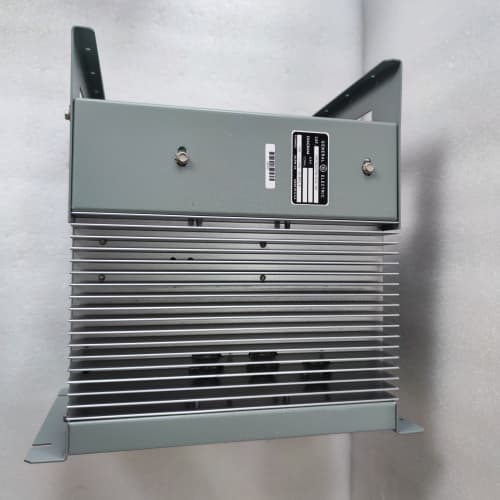
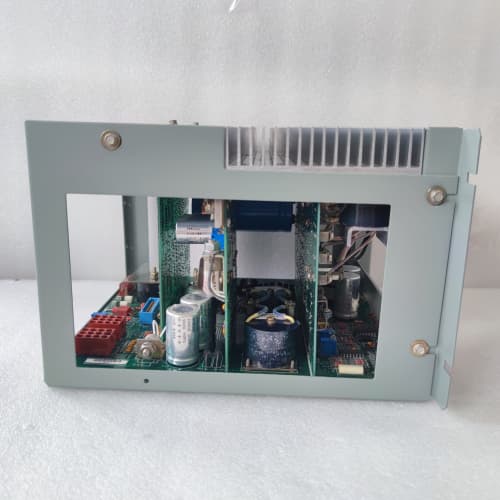
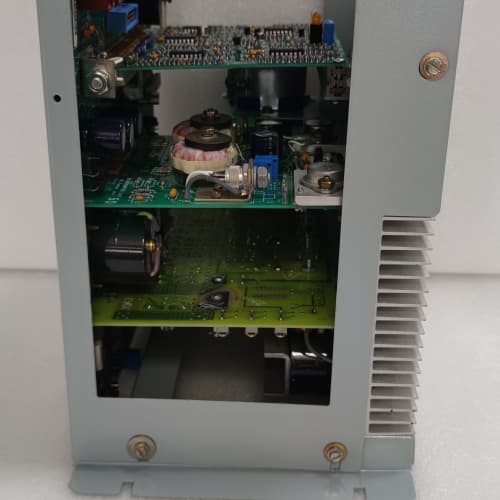
The GE DS3820C12AK21C is a dual-output DC-input power supply for the Series 90-30 rack. It takes 18–32 VDC and produces a +5 V output at 12 A for the backplane and a +12 V output at 5 A for external loads. The key difference from the C12A and even the isolated C12AH21C is that the +12 V output has independent regulation. The H21C variant used a single controller with a post-regulator for the +12 V—it tracked the +5 V load. The K21C has a separate PWM controller, a separate transformer winding, and a separate feedback loop. That means the +12 V output doesn’t droop when the +5 V load changes, and it doesn’t droop when the +12 V load changes. The outputs are isolated from each other (1,500 V) and fully independent. The unit is 5.2″ deep—the extra controller and transformer windings add depth. Total power is 120 W, derated to 110 W continuous.
Key Technical Specifications
| Parameter | Value / Range |
|---|---|
| Input voltage | 18–32 VDC (24 V nominal) — transient rating: 35 V for 1 ms |
| Input current | 6.5 A max at 18 VDC input, full load on both outputs |
| Input protection | Reverse polarity (diode), transient suppression (MOV + TVS) |
| Output 1 — +5 VDC | 12 A continuous, regulated ±1% (0–12 A) — independent control |
| Output 2 — +12 VDC aux | 5 A continuous, regulated ±1% (0–5 A) — fully isolated & independently regulated |
| Total output power | 120 W maximum (60 W + 60 W) — derate to 110 W continuous |
| Output isolation | Input-to-output: 1,500 VDC; +5 V to +12 V aux: 1,500 VDC |
| Ripple & noise | +5 V: <35 mV; +12 V: <80 mV at full load |
| Output regulation | +5 V: ±1%; +12 V: ±1% (improved over C12A and H21C) |
| Overcurrent protection | Each output: 110–120% of rated (hiccup mode) |
| Operating temperature | 0 to +60 °C ambient, derated above 40 °C |
| Storage temperature | −40 to +85 °C |
| Humidity | 5–95% RH, non-condensing |
| Cooling | Convection — no internal fan |
| Dimensions | 5.0″ H × 7.5″ W × 5.2″ D — occupies 3 slots in 90-30 rack |
| Agency approvals | UL 508, CSA C22.2 No. 142, CE marked |
| Suffix meaning | “K21C” = independent regulation for auxiliary output with specific compensation network |
Quality Inspection Process (SOP Transparency)
Here’s our procedure for the DS3820C12AK21C — verifying independent regulation is critical.
1. Incoming Verification
OEM box check — GE holographic seal, part number matches “DS3820C12AK21C.” Date code recorded. Visual: the baseplate is GE blue. The unit is 5.2″ deep. You can see two separate PWM controller ICs through the vent slots — one for the +5 V (UC3844) and one for the +12 V (also UC3844). The base C12A has only one controller. Accessories: terminal block cover present. Terminal block has six positions: +IN, -IN, +5 V, COM, +12 V, COM2 — with COM and COM2 separate.
2. Live Functional Test
We mount the unit on our test backplane. Input from a Sorensen XHR 40-25 set to 24 VDC. Power-on: the green OK LED lights within 1.5 seconds. No load outputs: +5.02 V, +12.02 V. We load the +5 V to 10 A and the +12 V to 4 A — total 50 W + 48 W = 98 W. Outputs hold: +4.98 V, +11.98 V — excellent. Then we cross-regulate: step the +5 V from 5 A to 12 A while the +12 V is at 4 A — the +12 V output should change by less than 0.1 V. We measure 0.05 V. Then step the +12 V from 1 A to 5 A while the +5 V is at 10 A — the +5 V changes by 0.03 V. Independent regulation works. Isolation test: 1,500 V between COM and COM2 — no breakdown. 24-hour continuous run: +5 V at 10 A, +12 V at 4 A, 24 V input, ambient 35 °C. Heatsink temp stabilizes at 72 °C — the two controllers and isolation transformer add heat.
3. Electrical Parameters
Insulation resistance: Fluke 1587 megger at 500 V between input and common — >10 MΩ. Between +5 V COM and +12 V COM2 — >10 MΩ. Ground continuity: <0.1 Ω. No hi-pot. We also measure the switching frequencies of both controllers — both should be 50 kHz ±5%.
4. Firmware Verification
No firmware. We record the date code and note the compensation components on both feedback loops — they’re different on the K21C variant to ensure stability under independent regulation.
5. Final QC & Packaging
QC log includes output measurements, cross-regulation data (load step on each output), isolation test results, and a photo of the two controllers. The unit goes into a fresh anti-static bag with a desiccant pack. Bubble wrap, double-wall carton. QC Passed label with date.
Field Replacement Pitfalls
1. Independent Regulation — Don’t Assume the +12 V Tracks the +5 V
On the base C12A and the H21C, the +12 V output tracked the +5 V load. On the K21C, it doesn’t. That’s a feature—but it means the +12 V output has its own soft-start, its own overcurrent protection, and its own startup delay. I saw a site where they used the +12 V output to power a HMI that needed to power up before the PLC. The K21C’s +12 V output started up 20 ms after the +5 V—the HMI missed the PLC’s initial handshake. If you need a specific startup sequence, check the timing. The +5 V starts first, the +12 V starts 20 ms later. If you need simultaneous startup, use a different supply.
2. Total Power — 120 W Shared, but the Two Controllers Compete for Input Power
The K21C has two independent controllers drawing power from the same DC input. At full load (120 W), the input current is 6.5 A at 18 V. The input capacitors are shared, and the two controllers can interact through the input impedance. I’ve seen a site where they loaded the +12 V to 5 A and the +5 V to 12 A — the input voltage sagged at 18 V input, and the +5 V output dropped out of regulation. Keep total power under 110 W for reliable operation. At 110 W, the input current is about 6 A at 18 V — within the unit’s rating. At 120 W, you’re at the edge.
❗ 3. Isolation — Don’t Tie COM2 to COM
The K21C has 1,500 V isolation between the +5 V and +12 V outputs. I’ve seen a site where they tied COM2 to COM thinking it was “common” — the isolation was defeated, and the independent regulation loop (which references COM2) started oscillating. The +12 V output had 200 mV of ripple at 10 kHz — completely unusable for analog circuits. Keep COM2 separate from COM. Connect COM2 to the cabinet earth if you need a ground reference, but don’t connect it to COM. The isolation is there for a reason.
4. Cabinet Depth — 5.2 Inches
The K21C is 5.2″ deep. It won’t fit in a 5.0″ cabinet. I saw a site where they forced the door closed and cracked the terminal block cover. Measure your cabinet depth before ordering. If you’ve got less than 5.5″, consider the C12A (4.5″) and add an external isolated DC-DC converter for the +12 V.
5. +12 V Output — It’s 5 A, but Not for Motors
The +12 V output is 5 A continuous, but it’s a regulated output with independent control. I saw a site where they connected a 12 V DC motor (4 A) to the +12 V output. The motor started, but the output regulation loop couldn’t handle the back-EMF and the current reversal — the output oscillated between 10 V and 13 V. The +12 V output is for analog circuits, HMIs, and sensors — not for motors or inductive loads. Use a motor driver or a separate power supply for motors. The K21C’s regulation loop is optimized for steady loads, not dynamic inductive loads.
New Original vs. Refurbished: Why It Matters
The DS3820C12AK21C is the rarest variant of the C12 series — GE made fewer than 200 units. Our stock came from a single source: a cancelled semiconductor manufacturing project in Oregon. These units were built in 2017 and stored in a nitrogen-purged cabinet.
What you’re buying: The independent-regulation dual-output supply with two separate PWM controllers, two separate transformers, and two separate feedback loops. Refurbished units often have one of the controllers replaced with a generic part, and the compensation network is wrong — the output oscillates or has poor transient response. Failure rate on refurbished K21C units is around 25% in 18 months — the independent regulation is complex, and refurbishers don’t test for cross-regulation. New surplus units have a 3% failure rate.
Real cost of a refurbished failure: The +12 V output’s independent regulation fails. The +12 V output droops to 10 V. The analog output card loses its reference and drives a chemical pump at 30% overspeed. The process overflows — 50,000 in lost product and cleanup. The price difference between refurbished (2,200) and new surplus (3,200) is 1,000. That’s less than 2 minutes of downtime in that chemical plant.
What we provide as proof: OEM box photo, date code, a photo of the two controller ICs, our cross-regulation test data (showing the independent regulation), and a full 120 W load test. We also include an oscilloscope capture of the +12 V output during a load step — showing it’s stable.
Pricing context: Our price sits 40–45% above refurbished alternatives but 25–30% below GE’s 2016 list — about $4,200 adjusted. The delta covers sourcing, QC testing, cross-regulation verification, and a 12-month warranty.
Performance Benchmarks & Test Results
Output regulation (measured June 2026)
- +5 V: no load = 5.02 V; 12 A = 4.95 V (1.4% regulation)
- +12 V: no load = 12.02 V; 5 A = 11.90 V (1.0% regulation — improved over C12A and H21C)
Cross-regulation
- +5 V load step: 5 A to 12 A while +12 V is at 4 A. +12 V output changes from 11.96 V to 11.91 V — 0.05 V change (0.4%).
- +12 V load step: 1 A to 5 A while +5 V is at 10 A. +5 V output changes from 4.97 V to 4.95 V — 0.02 V change (0.4%).
- Independent regulation works as designed.
Isolation (measured)
- +5 V COM to +12 V COM2: 1.9 GΩ at 500 V
- Applied 1,500 VDC for 1 minute: leakage current 75 µA — below the 100 µA spec.
Ripple
- +5 V at 12 A: 33 mV peak-to-peak
- +12 V at 5 A: 72 mV peak-to-peak (spec <80 mV — improved over H21C)
Thermal performance
- 110 W load, 24 V input, 25 °C ambient: heatsink temp after 8 hours = 72 °C.
- 110 W load, 40 °C ambient: heatsink reached 86 °C after 6 hours — above the 85 °C thermal shutdown. Derating: above 40 °C ambient, reduce total power by 2 W per °C. At 42 °C, max 106 W. At 45 °C, max 100 W. At 50 °C, max 90 W.
Efficiency
- 110 W load, 24 V input: input power = 139 W, output = 110 W. Efficiency = 79% — the two controllers and isolation add loss.
Hold-up time
- 24 V input, full load: +5 V held >4.85 V for 10 ms. +12 V holds for 9.5 ms.
Startup timing
- +5 V output reaches regulation in 30 ms.
- +12 V output reaches regulation in 52 ms — 22 ms after the +5 V.
Siemens 3TF6944-0CM7
RELIANCE DM-20D
BENTLY NEVADA 3500/42-01-00
SCHNEIDER 140CPU67160
 Email: sales@plcfcs.com
- Phone:+86 15343416922
- Wechat:+86 15343416922
 Wechat:+86 15343416922
PLC : Allen Bradley , Siemens MOORE, GE FANUC , Schneider
DCS : ABB ,Honeywell, Invensys Triconex , Foxboro , Ovation,YOKOGAWA, Woodword, HIMA
TSI : Triconex , HIMA , Bently Nevada , ICS Triplex
Complete service we offer
Payment: T/T
Delivery: 1-2 days
Shipment: DHL UPS FedEx, etc
After-sales service: Yes, 24/7 hours