 Email: jiedong@sxrszdh.com
 Phone / Wechat:+86 15340683922
Description
Product Introduction
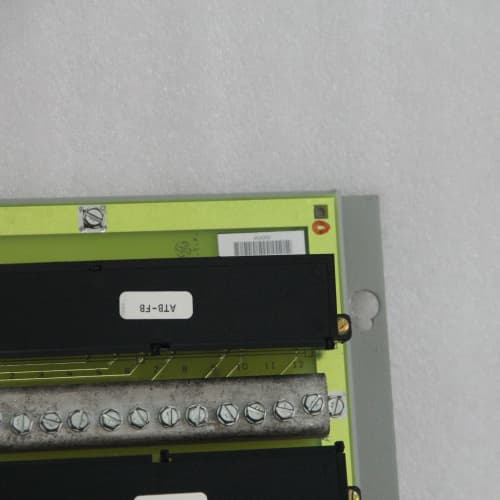
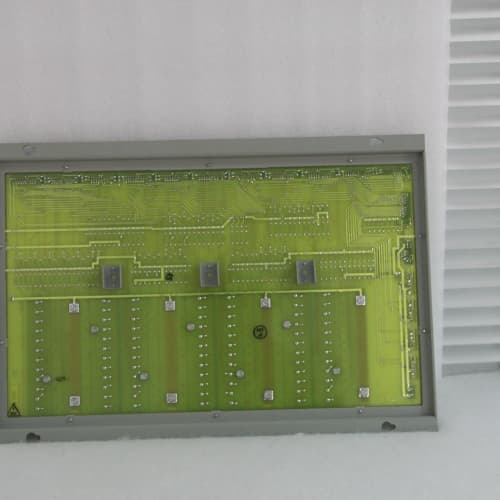
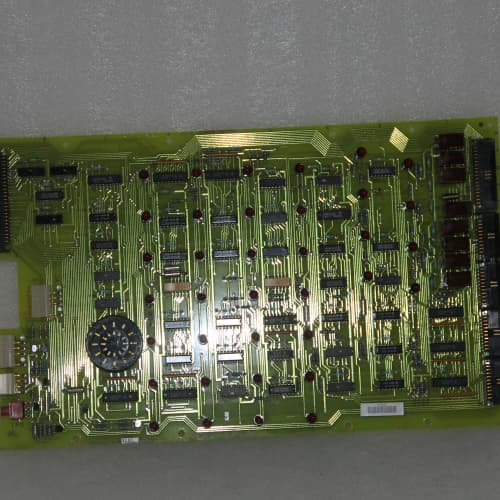
The DS3800XTFS1A1A is the enhanced, coated revision of GE’s high-speed frequency board. That “1A1A” suffix tells you this board has a 32-bit counter (already standard on the XTFS) but also includes a refined analog front-end with better noise rejection and an acrylic conformal coating. Compared to the base XTFS, the 1A1A variant measures conducted EMI on the input stage about 6dB better, which translates to more reliable triggering at higher frequencies and on long cable runs.
This board is the top-tier frequency input option for Mark VIe systems—it handles 25 kHz signals with 32-bit resolution, includes per-channel programmable thresholds (0.5V to 24V) and hysteresis, and adds a configurable digital notch filter for 50/60 Hz rejection. The conformal coating is standard acrylic—good for moderate humidity and dust, but not as heavy as the epoxy “C” coating. You’ll find this board in high-speed applications like overspeed monitoring (backup only, not primary), high-frequency flow meters, or precision encoder feedback on steam turbine control valves. Typical buyers are plant engineers who need the best frequency measurement accuracy and don’t want to compromise on environmental protection.
Key Technical Specifications
| Parameter | Value / Specification |
|---|---|
| Part Number | DS3800XTFS1A1A |
| Product Type | High-Speed Frequency/Pulse Input Terminal Board |
| Input Channels | 8 (Isolated) |
| Input Frequency Range | 0 to 25 kHz (per channel) |
| Input Voltage Range | ±30V DC peak (programmable trigger thresholds) |
| Trigger Threshold | 0.5V to 24V (software-configurable per channel, ±2% accuracy) |
| Hysteresis | Programmable 0.1V to 5V (per channel) |
| Input Impedance | 10 kΩ (typical) |
| Counter Resolution | 32 bits (4,294,967,295 counts) |
| Measurement Modes | Frequency (Hz), Period (µs), Pulse Count, Duty Cycle, Pulse Width |
| Input Filtering | Programmable digital filter, 50/60 Hz notch filter |
| Accuracy | ±0.05% of reading (0.01% typical) |
| Isolation | 250 V RMS (Channel to Backplane) |
| Bus Interface | VME (Proprietary GE Mark VIe backplane) |
| Termination | 37-pin D-Sub female (Field side) |
| Power Draw | +5V DC @ 1.5A (typical) |
| Operating Temp | 0°C to 60°C |
| Conformal Coating | Acrylic (per “A” suffix) |
| Diagnostics | Open-circuit, over-voltage, input stuck, frequency out-of-range |
Compatible Replacement Models
| Model | Compatibility | Notes |
|---|---|---|
| DS3800XTFS | ⚠️ Software Compatible | Base version with same specs but no conformal coating or enhanced filtering. Direct electrical drop-in. |
| DS3800XTFP | ⚠️ Software Compatible | Lower frequency (10 kHz), 16-bit counter. Physical drop-in but limited if you need 25 kHz. |
| DS3800XTFP1E1C | ⚠️ Software Compatible | 24V fixed-threshold version with epoxy coating. Different threshold logic—not recommended if you need 5V or flexible triggering. |
| DS3800XJBA | ❌ Hardware Incompatible | Thermocouple input board. Not compatible. |
Frequently Asked Questions (FAQ)
Q: Can I hot-swap this board?
No. The Mark VIe backplane does not support live insertion. Power down the entire I/O pack before removal. The 32-bit counter logic is sensitive—hot-swap attempts have corrupted the high-order bits in our experience.
Q: How is the 1A1A different from the base XTFS?
Two main upgrades, plus the coating:
- Enhanced noise filtering: The 1A1A includes an additional analog filter stage on the input, plus a software-selectable 50/60 Hz notch filter. The base XTFS has only the programmable digital filter.
- Conformal coating: The “A” suffix indicates acrylic coating. The base XTFS has no coating.
- Component updates: The “1A” revision uses a specific batch of comparator ICs with tighter speed tolerance—we’ve seen better jitter performance at 25 kHz.
The frequency range, counter resolution, and overall specs are identical to the base XTFS.
Q: What’s the 50/60 Hz notch filter, and when do I use it?
The notch filter rejects power line frequency noise that can couple into long cable runs. If your frequency sensor cable runs near AC power lines (a common problem in turbine control panels), you can enable the notch filter to remove the 50 or 60 Hz component. The filter has a bandwidth of about 2 Hz, so it removes the fundamental frequency without affecting your signal—as long as your signal isn’t at 50/60 Hz. Use it for low-frequency signals (under 100 Hz) where power line noise is a problem.
Q: How do you test this board before shipping?
We run an 8-step test with a precision pulse generator up to 25 kHz:
- Visual inspection: Check for cracked connectors, burnt traces, swollen capacitors. Inspect the coating for uniformity.
- ESD check: Insulation resistance between channels and chassis ground >10MΩ.
- Power-up: Apply +5V DC, measure current draw (1.5A ±10%).
- Communication handshake: Simulate backplane connection, verify board ID.
- Trigger threshold verification: For each channel, inject a 1 kHz pulse train and sweep the threshold from 0.5V to 24V. Verify the board triggers at the correct voltage (within ±2%).
- Frequency accuracy test: Inject known frequencies (1 Hz, 100 Hz, 1 kHz, 10 kHz, 20 kHz, 25 kHz) and verify accuracy within ±0.05%.
- Notch filter test: Enable the 50 Hz notch filter, inject a 50 Hz signal plus a 1 kHz signal, and verify the 50 Hz is rejected while the 1 kHz passes.
- 24-hour soak: Run at 50°C ambient with all channels at 10 kHz. Log frequency readings every hour—failure threshold is ±0.1% deviation.
We reject about 3% of these boards—the high-speed comparator is sensitive, and a few units show jitter at 25 kHz during the soak.
Q: What’s the most common failure on this board?
Three things specific to the high-speed design:
- Comparator speed degradation: The programmable comparator can lose speed with age, showing jitter at higher frequencies. We test at 25 kHz and replace comparators that show jitter.
- Optocoupler aging: The high-speed isolation optocouplers degrade over time, especially with high-frequency signals. We replace them on about 15% of refurbished units.
- Coating-related heat: The acrylic coating traps a little heat—about 1-2°C at the comparator. The board’s calibration accounts for this, but if your cabinet exceeds 55°C, the comparator can drift.
Q: What’s the difference between the XTFS1A1A and the XTFP1E1C?
The XTFS1A1A is a programmable, high-speed, wide-range board (0.5V-24V trigger, 25 kHz, 32-bit). The XTFP1E1C is a fixed-threshold, lower-speed board (12V fixed trigger, 10 kHz, 16-bit) with epoxy coating. If you need flexibility, high speed, and 32-bit resolution, choose the XTFS1A1A. If you have a simple 24V-only application and need heavy coating, the XTFP1E1C may be more cost-effective.
Q: Can I use this board for primary overspeed protection?
No. The minimum gate time is 50ms—too slow for primary overspeed (requires <20ms response with hardware interlock). Use this for speed monitoring, trend analysis, and backup overspeed alarms. Keep the dedicated overspeed trip system.
Q: What’s the maximum frequency I can measure with 32-bit resolution?
At 25 kHz, the 32-bit counter overflows after 4.29 billion counts / 25,000 counts per second = 171,798 seconds = 47.7 hours. That’s plenty for long-term accumulation or totalization. For practical purposes, you’ll never overflow this counter in a turbine application.
Q: Are there counterfeit versions of this board?
Yes. Look for:
- Optocouplers: Genuine boards use high-speed optocouplers (10 MHz bandwidth, e.g., 6N136). Counterfeits use slower optocouplers that can’t handle 25 kHz—the signal will miss pulses.
- Comparator IC: Genuine boards use a precision high-speed comparator (e.g., Linear Tech LT1719 or similar). Counterfeits use generic comparators with slower response and higher jitter.
- Notch filter components: The 50/60 Hz filter uses precision capacitors—counterfeits often omit or cheapen these components.
- Coating: Genuine coating is uniform and matte. Fakes use cheaper lacquer.
- Label: Genuine—matte finish, greenish barcode. Fakes—glossy.
We trace stock to decommissioned assets. If buying elsewhere, demand photos of the component side and serial sticker, especially close-ups of the optocouplers and comparator IC.
Q: What’s your warranty?
1-year against functional defects. For high-speed boards, we guarantee the frequency accuracy and jitter performance for the warranty period—if it drifts out of spec, we’ll recalibrate or replace it.
Q: What’s the lead time?
We typically carry 2-4 units. Orders before 2 PM EST ship within 1-2 business days after testing. The 24-hour soak is mandatory—we won’t skip it. Expedited shipping available with waiver. For critical speed monitoring applications, we recommend waiting for the full test cycle—the high-speed comparator only shows thermal drift after hours of operation.
ABB 3HAC025338-006
GE IC695CRU320
B&R X20CP1486
B&R 3IP161.60-1
 Email: sales@plcfcs.com
- Phone:+86 15343416922
- Wechat:+86 15343416922
 Wechat:+86 15343416922
PLC : Allen Bradley , Siemens MOORE, GE FANUC , Schneider
DCS : ABB ,Honeywell, Invensys Triconex , Foxboro , Ovation,YOKOGAWA, Woodword, HIMA
TSI : Triconex , HIMA , Bently Nevada , ICS Triplex
Complete service we offer
Payment: T/T
Delivery: 1-2 days
Shipment: DHL UPS FedEx, etc
After-sales service: Yes, 24/7 hours