 Email: jiedong@sxrszdh.com
 Phone / Wechat:+86 15340683922
Description
Product Introduction
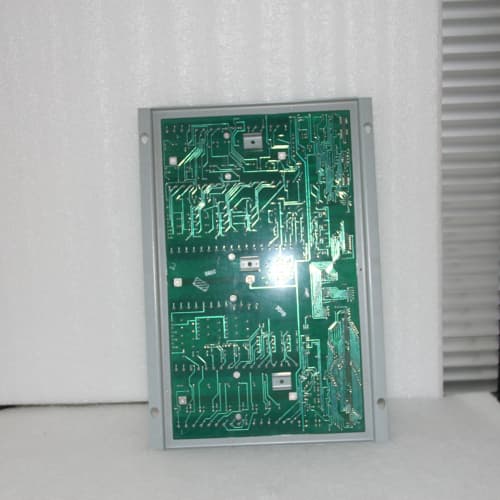
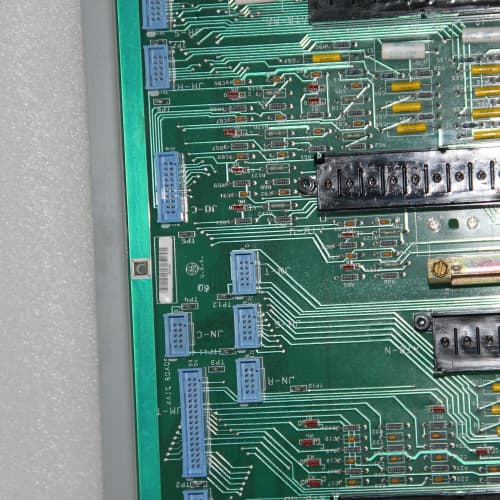
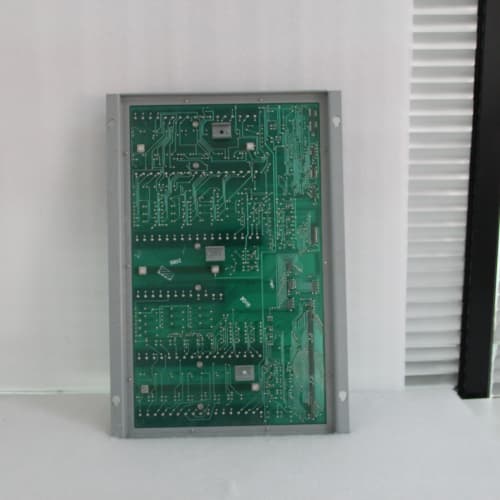
The DS3800XTFP1E1C is a specialized variant of GE’s frequency input board—factory-configured for 24V DC logic-level signals and coated with a thick epoxy layer for corrosion resistance. The “E” in the suffix tells you this board expects 24V inputs (rather than the wide-range 0.5-24V of the base XTFP), and the “C” at the end indicates heavy conformal coating, similar to what you’d see on offshore or chemical plant equipment.
The “E” configuration means the trigger threshold is fixed at about 12V with 4V of hysteresis—ideal for 24V proximity sensors, encoder outputs, or pulse generators that output a clean 24V logic signal. This is in contrast to the wide-range XTFP which has programmable thresholds per channel. The fixed threshold eliminates configuration overhead and ensures consistent triggering, but you lose the ability to mix 5V and 24V signals on the same board. If your plant runs all 24V, this version simplifies installation. The epoxy coating protects against salt spray and chemical exposure, making it suitable for coastal or industrial facilities. Typical buyers are plant engineers in harsh environments looking to eliminate configuration variables on critical speed and flow inputs.
Key Technical Specifications
| Parameter | Value / Specification |
|---|---|
| Part Number | DS3800XTFP1E1C |
| Product Type | Frequency/Pulse Input Terminal Board |
| Input Channels | 8 (Isolated) |
| Input Frequency Range | 0 to 10 kHz (per channel) |
| Input Voltage Range | 10-30V DC (24V nominal) |
| Trigger Threshold | 12V ±1V (factory-fixed) |
| Hysteresis | 4V ±0.5V (factory-fixed) |
| Input Impedance | 4.7 kΩ (typical for 24V logic) |
| Counter Resolution | 16 bits (65,535 counts) |
| Measurement Modes | Frequency (Hz), Period (µs), Pulse Count |
| Isolation | 250 V RMS (Channel to Backplane) |
| Bus Interface | VME (Proprietary GE Mark VIe backplane) |
| Termination | 37-pin D-Sub female (Field side) |
| Power Draw | +5V DC @ 1.4A (typical) |
| Operating Temp | 0°C to 60°C |
| Conformal Coating | Thick epoxy (salt spray resistant, per “C” suffix) |
| Diagnostics | Open-circuit detection, over-voltage detection, input stuck detection |
Compatible Replacement Models
| Model | Compatibility | Notes |
|---|---|---|
| DS3800XTFP | ⚠️ Software Compatible | Wide-range version with programmable thresholds. Direct drop-in for 24V signals, but offers more flexibility and costs more. |
| DS3800XTFP1E1A | ⚠️ Software Compatible | Same 24V logic but with acrylic coating (lighter). Direct electrical swap for less corrosive environments. |
| DS3800XTF | ⚠️ Software Compatible | Earlier fixed-threshold version without coating. Electrical drop-in but lacks environmental protection. |
| DS3800XDIO | ❌ Hardware Incompatible | Digital I/O board. No frequency counting capability. |
Frequently Asked Questions (FAQ)
Q: Can I hot-swap this board?
No. The Mark VIe backplane does not support live insertion for frequency input boards. Power down the entire I/O pack before removal. The fixed-threshold logic is robust, but the counter registers can still corrupt if you hot-plug.
Q: What does the “E” configuration mean?
The “E” in DS3800XTFP1E1C indicates a factory-fixed 24V logic input. The trigger threshold is set to 12V ±1V with 4V hysteresis. This is ideal for:
- 24V proximity sensors (PNP output, 24V logic level)
- 24V pulse generators (square wave, 24V amplitude)
- Encoder outputs (24V open-collector or push-pull)
It is not suitable for 5V logic (TTL) or low-level magnetic pickup signals. If you have those, use the wide-range XTFP and set the thresholds in software.
Q: How is the “E” version different from the standard XTFP?
The standard XTFP has programmable thresholds (0.5V to 24V) per channel. The 1E1C version has fixed thresholds set at 12V. The trade-offs:
- Simplicity: No configuration needed. Plug it in and it works with 24V signals.
- Reliability: Fixed thresholds are less prone to configuration errors.
- Cost: Lower cost than the programmable version.
The downside is you lose flexibility—all channels are locked to 24V logic. Mixing 5V and 24V signals is not possible on this board.
Q: What’s the difference between the “C” coating and the “A” coating?
On GE’s conformal coating scale:
- “A”: Acrylic coating (25-35µm). Good for moderate humidity, dust protection.
- “C”: Thick epoxy coating (75-100µm). Salt spray resistant, better for coastal, offshore, or chemical environments.
The “C” coating is more durable but traps more heat—the board runs about 2-3°C warmer at full load. If your cabinet is already warm, account for this.
Q: How do you test this board before shipping?
We run a 7-step test with a precision pulse generator and 24V logic levels:
- Visual inspection: Check for cracked connectors, burnt traces, swollen capacitors. Verify the epoxy coating is uniform and covers all components.
- ESD check: Insulation resistance between channels and chassis ground >10MΩ.
- Power-up: Apply +5V DC, measure current draw (1.4A ±10%).
- Communication handshake: Simulate backplane connection, verify board ID.
- Trigger threshold verification: For each channel, inject a 1 kHz pulse train and sweep the input voltage from 0V to 30V. Verify the board triggers at 12V ±1V and has 4V hysteresis.
- Frequency accuracy test: Inject known frequencies (1 Hz, 100 Hz, 1 kHz, 5 kHz, 10 kHz) at 24V amplitude. Verify accuracy within ±0.1%.
- 24-hour soak: Run at 50°C ambient with all channels at 1 kHz. Log frequency readings every hour—failure threshold is ±0.2% deviation.
We reject about 4% of these boards—the fixed-threshold comparators are less complex, so failure rates are slightly lower than the programmable version.
Q: What’s the most common failure on this board?
Three things specific to the fixed-logic design:
- Optocoupler burnout: The input optocouplers are rated for 30V continuous. If you feed 48V or higher (common on some sensors), they’ll fail. We replace these on about 10% of refurbished units.
- Input resistor drift: The 4.7kΩ input resistors can drift with temperature, shifting the trigger threshold. We replace them if they’re out of spec.
- Coating-related heat: The epoxy coating traps heat, which can stress the optocouplers over time. We monitor temperature closely during the 24-hour soak.
Q: What input signals can I use with this board?
24V logic signals only. Acceptable sources:
- PNP proximity sensors (24V output)
- 24V pulse generators (square wave)
- 24V open-collector outputs with pull-up resistors
- 24V differential encoder outputs (use single-ended, ground the negative side)
Do not connect:
- 5V TTL signals (won’t trigger)
- Magnetic pickups (voltage is too low and AC)
- 48V or higher signals (will damage optocouplers)
Q: Can I use this board for overspeed protection?
The board measures frequency, and the 100ms minimum gate time is too slow for primary overspeed protection. Use it for monitoring and speed indication only. Keep the dedicated overspeed trip system (hardwired relays or dedicated frequency modules).
Q: What’s the maximum frequency I can measure?
10 kHz per channel. For a turbine with a 60-tooth speed gear, that’s:
- 60 Hz at 60 RPM? (actually 10,000 Hz / 60 teeth = 166.7 rotations per second = 10,000 RPM)
- So 10 kHz covers you up to 10,000 RPM on a 60-tooth gear—well beyond typical overspeed.
Q: Are there counterfeit versions of this board?
Yes. Look for:
- Optocouplers: Genuine boards use high-speed optocouplers (6N136 or equivalent). Counterfeits use slower optocouplers that miss high-frequency pulses.
- Coating: Genuine epoxy coating is thick, uniform, and slightly yellowish. Fakes use thinner or uneven coatings.
- Resistors: Genuine trigger resistors are precision 1% tolerance. Counterfeits use 5% resistors—the threshold will drift.
- Label: Genuine—matte finish, greenish barcode. Fakes—glossy.
We trace stock to decommissioned assets. If buying elsewhere, demand photos of the component side, serial sticker, and close-ups of the optocoupler and resistors.
Q: What’s your warranty?
1-year against functional defects. For frequency boards, we guarantee the trigger threshold accuracy for the warranty period—if it drifts out of spec, we’ll recalibrate or replace it.
Q: What’s the lead time?
We typically carry 2-3 units. Orders before 2 PM EST ship within 1-2 business days after testing. The 24-hour soak is mandatory—we won’t skip it. Expedited shipping available with waiver. For speed monitoring applications, we recommend waiting for the full test cycle—the optocouplers only show thermal drift after hours of operation.
EPRO PR6423/018-110
Siemens 6AV6 643-0BA01-1AX0
LUST VF1406M,C9
A-B 1398-DDM-030
 Email: sales@plcfcs.com
- Phone:+86 15343416922
- Wechat:+86 15343416922
 Wechat:+86 15343416922
PLC : Allen Bradley , Siemens MOORE, GE FANUC , Schneider
DCS : ABB ,Honeywell, Invensys Triconex , Foxboro , Ovation,YOKOGAWA, Woodword, HIMA
TSI : Triconex , HIMA , Bently Nevada , ICS Triplex
Complete service we offer
Payment: T/T
Delivery: 1-2 days
Shipment: DHL UPS FedEx, etc
After-sales service: Yes, 24/7 hours