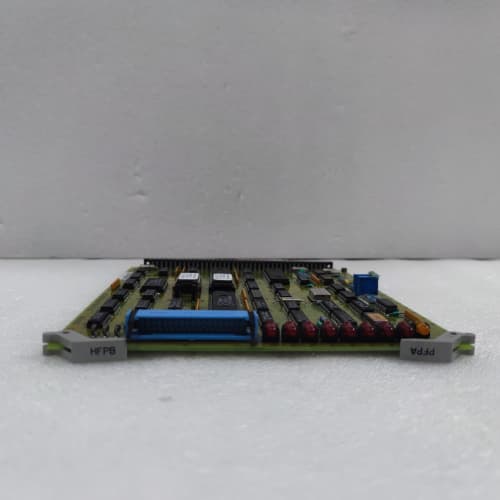
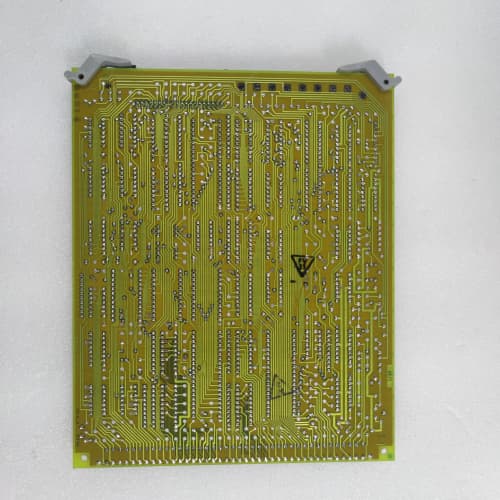
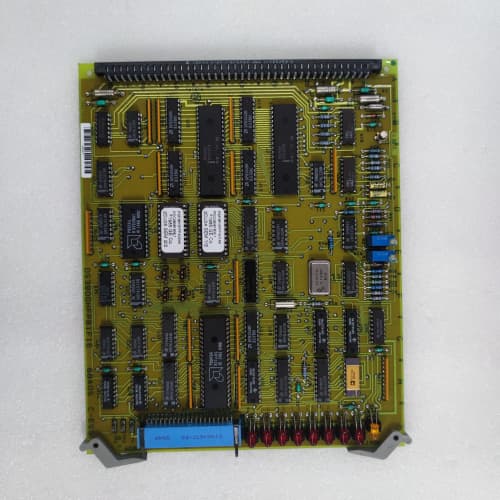
 Email: jiedong@sxrszdh.com
 Phone / Wechat:+86 15340683922
Description
Product Introduction
The DS3800XPTN is the diagnostic variant of GE’s Mark VIe power module line—same 15A capacity as the XPEN, but with a more sophisticated status monitoring and indication system. The “PT” designation likely stands for Power with Diagnostics, and the “N” indicates a specific revision with refined fault detection logic. Unlike the XPEN or XPEX, which just give you an OK/fault LED, the XPTN provides a multi-segment LED array and a dedicated diagnostic backplane interface that reports detailed fault conditions to the controller.
You’ll find this board in applications where power supply health is critical—think units with limited redundancy or installations where monitoring and predictive maintenance are priorities. The board’s diagnostic circuitry tracks input voltage sag, output overcurrent conditions, and internal temperature, feeding that data to the controller via the backplane. For plants running 24/7 operations, this early warning capability is valuable. The physical footprint is identical to the XPEM/XPEN/XPEX series, so it’s a direct drop-in replacement. Typical buyers are plant engineers implementing condition-based monitoring or replacing older power modules with more diagnostic-capable versions.
Key Technical Specifications
| Parameter | Value / Specification |
|---|---|
| Part Number | DS3800XPTN |
| Product Type | Diagnostic Power Entry Module |
| Input Voltage | 24V DC nominal (18-32V DC range) |
| Input Current | 9A maximum (steady state at full load) |
| Output Voltage | 5V DC (Backplane) |
| Output Current | 15A maximum (shared across backplane) |
| Diagnostic Features | Input voltage monitoring, output current monitoring, temperature sensing, fault logging |
| Status Indication | Multi-segment LED array (Input OK, Output OK, Overcurrent, Overtemperature, Fault) |
| Inrush Limiting | Yes, soft-start on power-up |
| Transient Protection | TVS array on input, reverse polarity protection |
| EMI Filtering | Built-in differential and common-mode filters |
| Redundant Inputs | Single input (no internal OR-ing; use external diodes if needed) |
| Bus Interface | VME backplane (proprietary GE Mark VIe) |
| Termination | Screw terminals (Input), Backplane connector (Output) |
| Power Draw | Self-consumption: <18W (including diagnostics) |
| Operating Temp | 0°C to 60°C |
| LED Indicators | Multi-color LED array with diagnostic codes |
Compatible Replacement Models
| Model | Compatibility | Notes |
|---|---|---|
| DS3800XPEN | ⚠️ Software Compatible | Standard 15A version without advanced diagnostics. Electrical drop-in but lacks detailed fault reporting. |
| DS3800XPEX | ⚠️ Software Compatible | 20A version without diagnostics. Physical drop-in but lower capacity—check your rack draw. |
| DS3800XPER | ❌ Hardware Incompatible | Redundant version with internal OR-ing. Different architecture; not recommended as a direct swap. |
| DS3800XPTN1A1A | ⚠️ Software Compatible | Enhanced revision of the XPTN with conformal coating and improved filtering. Direct electrical drop-in with additional features. |
Frequently Asked Questions (FAQ)
Q: Can I hot-swap this power module?
No. The Mark VIe backplane requires power removal before installation or removal. Pulling this live risks arcing and voltage transients that can damage downstream boards. The diagnostic circuitry is sensitive—we’ve seen a hot-swap attempt corrupt the fault memory. Power down the entire I/O pack.
Q: How is the XPTN different from the XPEN?
Three differences:
- Diagnostics: The XPTN has a more sophisticated monitoring system—it tracks input voltage, output current, and temperature, and reports these values to the controller via the backplane. The XPEN only has an OK/fault LED.
- LED array: The XPTN has a multi-segment LED array (4-5 LEDs) that provides detailed status at a glance—you can see whether the fault is overcurrent, overtemperature, or input loss without going to the HMI.
- Fault logging: The XPTN stores fault events in onboard memory, which can be read by the controller. If the board trips, you can query the log to see what happened—useful for diagnosing intermittent issues.
The output capacity (15A) and physical footprint are identical to the XPEN.
Q: What diagnostic information does the board provide?
The XPTN monitors and reports:
- Input voltage: Reports actual voltage level to the controller (not just OK/fail). Alarms at 20V and 18V thresholds.
- Output current: Measures current draw on the 5V rail. Alarms when load exceeds 80% of capacity (12A), and trips at 15A.
- Internal temperature: Thermistor reading of the board’s temperature near the FETs. Alarms at 65°C, trips at 75°C.
- Fault history: Stores the last 8 fault events (time-stamped, with fault type) in non-volatile memory.
This data is accessible via the backplane and can be displayed in ToolboxST or your HMI.
Q: How do you test this board before shipping?
We run a 7-step test with extra attention to the diagnostic features:
- Visual inspection: Check for swollen capacitors, burnt FETs, cracked screw terminals. Inspect the LED array—if any LEDs are dim or missing, the board fails.
- ESD check: Insulation resistance between input terminals and chassis ground must exceed 10MΩ.
- Initial power-up: Apply 24V DC and verify soft-start limits inrush to <20A. Check that the LED array sequences correctly on power-up (self-test).
- No-load output: Measure the 5V DC rail unloaded. Must be within ±2% (4.9-5.1V).
- Diagnostic verification: Simulate faults: drop the input voltage to 20V and verify the alarm is reported. Overload the output to 12.5A and verify the 80% alarm triggers. Apply a heat gun to the board and verify the temperature alarm triggers at the correct threshold.
- Load test: Apply a 15A load to the 5V rail. Monitor voltage regulation, ripple, and temperature. Verify the output current measurement matches the actual load within ±5%.
- 24-hour soak: Run at 15A load at 50°C ambient. Log all diagnostic parameters every hour. If any alarm trips or the board reports erroneous values, it fails.
We reject about 10% of these boards at the soak step—the diagnostic circuitry is sensitive, and we’ve seen false temperature alarms develop over time.
Q: What’s the most common failure on this board?
Three things, with the diagnostics adding a fourth:
- Diagnostic IC burnout: The monitoring IC is sensitive to transients on the input. If your 24V bus is noisy, the IC can fail—the board still runs, but you lose the diagnostic reporting. We replace these ICs on about 15% of the boards we refurbish.
- LED array failure: The multi-segment LEDs can dim or fail over time. We replace any dim LEDs on refurbished boards.
- FET burnout: Same as other 15A power modules—FETs degrade over time.
- Fault memory corruption: If the board is powered off while writing to the fault log, the memory can corrupt. We test the fault logging by inducing faults and verifying they’re stored correctly.
Q: What does the “PTN” designation mean?
On GE’s naming:
- PT: Likely stands for Power with Diagnostics (or Power Toolkit)
- N: Specific revision with the diagnostic feature set
The XPTN is a distinct product line from the XPEM/XPEN/XPEX/XPER series—it focuses on diagnostic capability rather than just capacity or redundancy.
Q: Can I use this board in a redundant configuration?
The XPTN has a single input. For redundancy, you need external OR-ing diodes between your two 24V sources and the board’s input. The diagnostic circuitry will monitor the single input voltage—it will see the voltage drop if one source fails, but it won’t switch automatically without the external diodes. The diagnostic log will record the fault, which is useful for troubleshooting.
Q: How accurate is the diagnostic monitoring?
From our bench testing:
- Input voltage: ±1% accuracy (typical)
- Output current: ±3% accuracy at 15A
- Temperature: ±2°C accuracy
These are GE’s published specs, and we verify them during our test protocol. The current measurement is a hall-effect sensor, so it’s non-invasive and doesn’t add loss to the output.
Q: Can I run a 12-slot rack with this board?
The XPTN has 15A output capacity, same as the XPEN. At 15A:
- Up to 12 analog input boards (1.2A each = 14.4A)
- Up to 10 analog output boards (1.5A each = 15A)
- Up to 11-12 mixed boards, depending on their draw
We recommend leaving 20% margin—so 12A continuous load target. If you have a fully populated rack with heavy boards, you might exceed this. Check your specific board specs.
Q: Are there counterfeit versions of this board?
Yes, and the diagnostic IC is the giveaway. Here’s what we look for:
- Diagnostic IC: Genuine boards use a specific monitoring IC (typically a Texas Instruments or Analog Devices part). Counterfeits often omit the IC entirely or use a generic component that doesn’t communicate with the backplane.
- LED array: Genuine boards have a multi-color, multi-segment LED array with specific brightness. Fakes use cheaper single-color LEDs or arrays with inconsistent brightness.
- FET brands: Same as other power modules—counterfeits use off-brand FETs.
- Label: Genuine labels have a matte finish with a greenish barcode area. Fakes are glossy.
We trace our stock to decommissioned assets. If you’re buying elsewhere, demand photos of the component side, the serial sticker, and close-ups of the diagnostic IC and LED array.
Q: What’s your warranty on this board?
We offer a 1-year warranty against functional defects. If the board fails to meet published specs within that period and hasn’t been damaged or miswired, we’ll replace or refund. For boards with diagnostic features, we also guarantee the diagnostic accuracy for the warranty period—if the monitoring drifts out of spec, we’ll replace it.
Q: What’s the lead time?
We typically carry 2-4 units of the XPTN in stock. If you order before 2 PM EST, we ship within 1-2 business days after testing. The 24-hour soak is non-negotiable—we won’t skip it. If you need expedited shipping, we can rush the initial testing and ship next-day, but you sign a waiver acknowledging the long-term soak was skipped. For critical systems, we recommend waiting for the full test cycle—the diagnostic circuitry can develop intermittent errors after hours of operation, and a short test won’t catch that.
MOOG T200-410J-0AA1
GE HYDRAN M2
ABB 3HAC025338-006
NI PXI-7852R
 Email: sales@plcfcs.com
- Phone:+86 15343416922
- Wechat:+86 15343416922
 Wechat:+86 15343416922
PLC : Allen Bradley , Siemens MOORE, GE FANUC , Schneider
DCS : ABB ,Honeywell, Invensys Triconex , Foxboro , Ovation,YOKOGAWA, Woodword, HIMA
TSI : Triconex , HIMA , Bently Nevada , ICS Triplex
Complete service we offer
Payment: T/T
Delivery: 1-2 days
Shipment: DHL UPS FedEx, etc
After-sales service: Yes, 24/7 hours