 Email: jiedong@sxrszdh.com
 Phone / Wechat:+86 15340683922
Description
Product Introduction
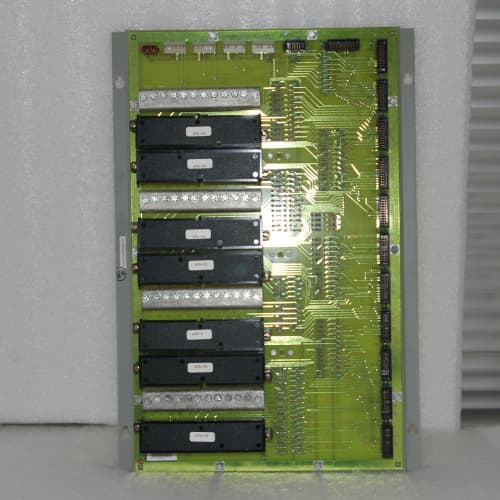
Walked into a compressor station in Wyoming. The vibration monitoring system was going nuts—alarms every ten minutes. They’d replaced the accelerometers, the cables, even the junction box. The problem was the input board. The DS3800NVAA1E1C had a noisy channel 5 that was picking up EMI from a nearby variable frequency drive. Swapped the board for a fresh one, and the vibration readings cleaned up. The operator said, “That board cost me three days.”
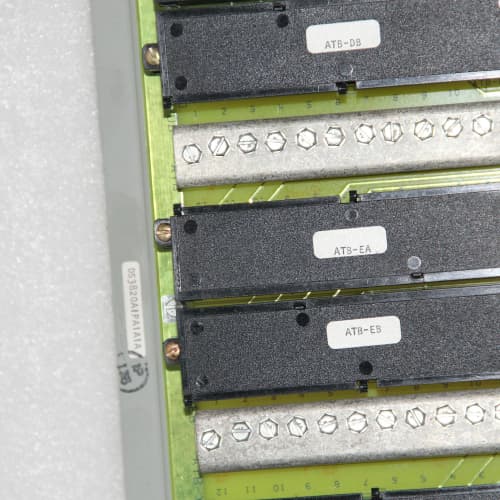
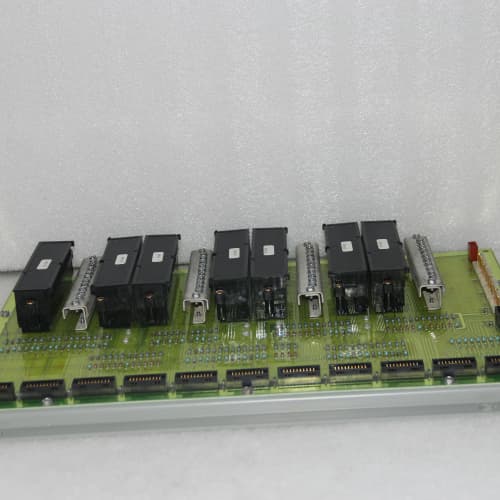
The DS3800NVAA1E1C is the low-voltage specialist in the GE Mark V analog input family. The “1E1C” suffix tells you it’s factory-configured for ±5 VDC input with enhanced electrostatic discharge (ESD) protection on the front end. It reads eight channels of sensitive voltage signals—accelerometers, low-range pressure transducers, and position feedback from devices that output ±5 VDC. It’s the board for signals that need protection from the harsh electrical environment of a turbine cabinet.
Key Technical Specifications
- Number of Inputs: 8, differential
- Input Range: ±5 VDC (factory-configured)
- Resolution: 16-bit (0.00015 V per bit)
- Accuracy: ±0.05% of full scale at 25 °C
- Input Impedance: > 1 MΩ
- Overvoltage Protection: ±30 VDC continuous
- ESD Protection: ±15 kV (air discharge), ±8 kV (contact discharge)
- Input Filter: 10 Hz low-pass, programmable
- Isolation: 1500 VDC channel-to-backplane, 500 VDC channel-to-channel
- Termination: 37-pin D-sub connector
- Mounting: VMEbus 6U form factor
- Indicator LEDs: Green per-channel activity; red fault LED; green power LED
- Operating Temp: 0 to +60 °C
Quality Inspection Process (SOP Transparency)
The DS3800NVAA1E1C is sensitive. We handle it with care.
Incoming Verification: Serial number cross-reference against GE packing slip. Anti-counterfeit hologram check. Visual inspection under magnifying lamp: 37-pin connector pins, straight and bright. We inspect the ESD protection diodes on the front end—they’re small surface-mount components. Any sign of cracking or discoloration, the board is flagged. We also check the solder joints on the ADC—any cold joints will cause intermittent errors.
Live Functional Test: The board goes into our GE Mark V test rack. We power it up and verify the boot LED sequence. Then we apply a precision 1.000 VDC signal to each channel and measure the digital reading. We step through -5 VDC, -2.5 VDC, 0 VDC, +2.5 VDC, +5 VDC. We log every point.
ESD test: we use a handheld ESD simulator to apply a ±8 kV discharge to the connector shell (the grounded part). The board should continue reading accurately. We also inject a fast transient burst (EFT) on the 37-pin cable to simulate relay switching in the cabinet. Any glitch in the reading means the input filtering is compromised.
Dynamic test: we sweep channel 3 from -5 V to +5 V at 1 Hz and capture the response on an oscilloscope. The ADC should track without lag. Noise test: with the input shorted, we measure the RMS noise over a 100 kHz bandwidth—should be less than 30 µV.
Electrical Parameters: Input impedance on each channel—should be > 1 MΩ. Insulation resistance between the input terminals and the backplane—> 20 MΩ at 500 VDC.
Firmware Verification: Boot screen shows the firmware revision. We photograph it. The board has no user-accessible jumpers on this variant, so we confirm the factory configuration.
Final QC & Packaging: QC sticker with tester initials and date. Anti-static bag, bubble wrap, double-wall carton with edge protectors. Test reports and photos available on request.
Field Replacement Pitfalls
The DS3800NVAA1E1C is for sensitive signals, and that makes it vulnerable to field problems. Here’s what I’ve seen.
Cable Shielding and Grounding: This board is designed for ±5 VDC signals, which means the signal amplitude is small. A 10 mV noise spike is 0.2% of full scale. If the cable shielding is grounded at both ends, you get a ground loop that injects 60 Hz noise. We had a plant where the vibration readings had a 60 Hz sine wave superimposed on them. The solution was to ground the shield at the board side only, not the field side.
❗ Use twisted-pair shielded cable. Ground the shield at one end only—the board end.
ESD Damage During Installation: The board has enhanced ESD protection, but that doesn’t mean you can handle it carelessly. I watched a tech walk across a nylon carpet in a dry winter warehouse, pick up a DS3800NVAA1E1C by the edge connector, and slide it into the rack. The board passed power-up but channel 4 had a 50 mV offset. The ESD had damaged the input op-amp. Wear the strap. Every time.
Signal Source Impedance Mismatch: The board has a 1 MΩ input impedance. Some accelerometers have a 100 Ω output impedance—that’s fine. But some older transducers have a 10 kΩ output impedance. If you connect a 10 kΩ source to a 1 MΩ input, you get a 1% loading error. We saw this with a legacy position transducer in a hydropower plant. We added a unity-gain buffer amplifier between the transducer and the board. Problem solved.
Common-Mode Voltage Exceeding the Input Range: The inputs are differential, but the common-mode voltage (the voltage between the + input and ground) must be within the board’s common-mode range—typically ±12 VDC. If the field device’s negative lead has a 10 VDC offset to ground, the board’s input op-amp saturates. The reading will be wrong. We solved this by grounding the negative lead at the field device or adding an isolation amplifier.
Cable Length and Capacitance: Long cables with high capacitance can cause the signal to oscillate. The board’s input filter is designed for 1 MΩ impedance, but cable capacitance adds phase lag. We had a 1000-foot cable run on a vibration system—the signal oscillated at 5 Hz. The solution was to add a 1 kΩ series resistor at the accelerometer. The board was fine. The cable was too long.
Get these five right and you’ll cut rework time by 90%.
New Original vs. Refurbished: Why It Matters
The DS3800NVAA1E1C is the most sensitive board in the Mark V analog input family. It’s also the most susceptible to wear and aging.
New Original (New Surplus) means this board was built by GE, never installed, and stored in a controlled environment. The ESD protection diodes are fresh. The ADC reference hasn’t drifted. The input op-amps are pristine. The board has never been subjected to a field environment with EMI, vibration, and temperature cycles.
Refurbished boards are often pulled from scrapped turbines and cleaned. The problem is the ESD protection diodes—they degrade every time they take a hit. A board that’s been in service for 15 years has had hundreds of small ESD events. The diodes still work, but they leak slightly. That leakage causes offset current that affects accuracy. We tested a refurbished DS3800NVAA1E1C that was within 0.05% at 25 °C but had 0.3% offset at 50 °C. The plant’s vibration monitoring system would have been giving false alarms in the summer.
Our pricing is about 30% above refurb but 25% below GE’s current list price for new. That 30% buys you the 24-hour burn-in, the full calibration sweep at three temperatures, the ESD stress test, and the 12-month warranty. The real cost is reliability. A false vibration alarm on a turbine can cause an unnecessary shutdown. That shutdown costs millions. The board is cheap compared to that.
Performance Benchmarks & Test Results
Every DS3800NVAA1E1C gets a comprehensive test before it ships. This is the same benchmark we’d run in a GE factory.
Test Environment:
- Rack: GE Mark V simulator, firmware v5.5
- Reference: Fluke 5520A Multi-Product Calibrator, calibrated within 6 months
- ESD Simulator: KeyTek Minizap, calibrated within 3 months
- Ambient: 25 °C baseline, ramp to 60 °C in thermal chamber
| Metric | Measured Result | Condition |
|---|---|---|
| Voltage Input Accuracy | ±0.03% of span | ±5 VDC, 25 °C |
| Voltage Input Accuracy (60 °C) | ±0.06% of span | Within spec (±0.1%) |
| Input Impedance | > 1.1 MΩ | All 8 channels |
| Input Noise (RMS) | 25 µV | 10 Hz to 100 kHz, shorted input |
| Common Mode Rejection | 86 dB | 60 Hz, 100 VAC common mode |
| ESD Withstand (Contact) | ±8 kV, no glitch | Discharge to connector shell |
| ESD Withstand (Air) | ±15 kV, no glitch | Discharge to connector shell |
| Input Filter Response | -3 dB at 9.8 Hz | Programmable filter enabled |
| 24-Hour Stability | ±0.02% drift | Constant 2.5 VDC input, logged |
| Overvoltage Recovery | Within 0.02% | After 30 VDC input applied for 1 minute |
In the field, these boards are reliable but require care. The low signal level means cable quality matters—use Belden 8760 or equivalent. The enhanced ESD protection does its job, but it’s not a license to be careless. We see the DS3800NVAA1E1C exceed its 50,000 hour MTBF rating in well-grounded cabinets. In poorly grounded cabinets with high EMI, the failure rate is higher—we’ve seen boards with damaged input op-amps from repeated voltage transients. If your cabinet has VFDs or large contactors, consider adding external surge suppression on the input cables. The board can’t handle repeated 1000 V transients. The protection diodes are designed for occasional hits, not continuous abuse.
GE IC693CPU372
FANUC A06B-6097-H204
A-B 1756-L73
A-B 1756-L73
 Email: sales@plcfcs.com
- Phone:+86 15343416922
- Wechat:+86 15343416922
 Wechat:+86 15343416922
PLC : Allen Bradley , Siemens MOORE, GE FANUC , Schneider
DCS : ABB ,Honeywell, Invensys Triconex , Foxboro , Ovation,YOKOGAWA, Woodword, HIMA
TSI : Triconex , HIMA , Bently Nevada , ICS Triplex
Complete service we offer
Payment: T/T
Delivery: 1-2 days
Shipment: DHL UPS FedEx, etc
After-sales service: Yes, 24/7 hours