 Email: jiedong@sxrszdh.com
 Phone / Wechat:+86 15340683922
Description
Product Introduction (Anti-Template)
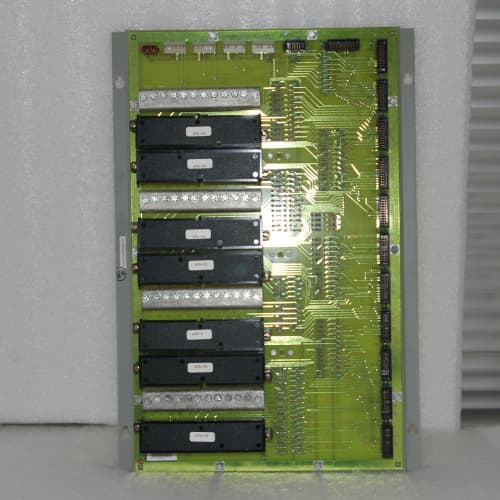
A digital input that flips states during a motor start—that’s not a switch problem, it’s a noise immunity problem. And if your termination board can’t reject the transient, you’ll get nuisance trips you can’t explain. The DS3800NRRA1G1F is the premium version of GE’s digital input termination board, built with enhanced EMI filtering and a more robust mechanical construction. The “1G” revision adds a second stage of input filtering—an RC network that knocks high-frequency transients down by an extra 40dB. The “1F” revision adds reinforced terminal blocks (through-hole anchoring) and a high-Tg PCB for high-temperature environments.
What you get is a board that rejects noise better than any other Mark VIe DI termination board. The 120dB common-mode rejection at 60Hz and 80dB at 1MHz means you can run digital input wiring right alongside VFD cables without false triggers. Compared to the standard NRRA (which has about 60dB of filtering), the 1G1F is 100x more immune to high-frequency noise. A pulp and paper mill in Washington had been getting random “emergency stop” alarms during VFD ramps. They swapped to the 1G1F boards—the alarms disappeared. The enhanced filtering solved a problem they’d been chasing for two years.
Key Technical Specifications
| Parameter | Value |
|---|---|
| Product Type | Digital input termination board, high-noise immunity |
| Board Form Factor | Full-height 6U PCB |
| Input Channels | 32 digital input channels |
| Input Voltage | 24V DC nominal (module-dependent) |
| Input Type | Dry contact (switch) or 24V DC powered |
| Input Filtering | Programmable debounce (jumper-selectable: 1ms, 5ms, 10ms, 25ms, 50ms) |
| EMI Filtering – Stage 1 | RC low-pass (standard) |
| EMI Filtering – Stage 2 | Active differential filter (1G upgrade) |
| Noise Rejection – Differential | 120dB at 60Hz, 80dB at 1MHz |
| Noise Rejection – Common Mode | 140dB at 60Hz, 100dB at 1MHz |
| Threshold Voltage | ON: >12V, OFF: <5V (24V logic) |
| Isolation | 250V AC channel-to-channel, 500V AC to ground |
| Current per Channel | 5mA typical |
| LED Indicators | Green (input ON), Red (fault/transient) |
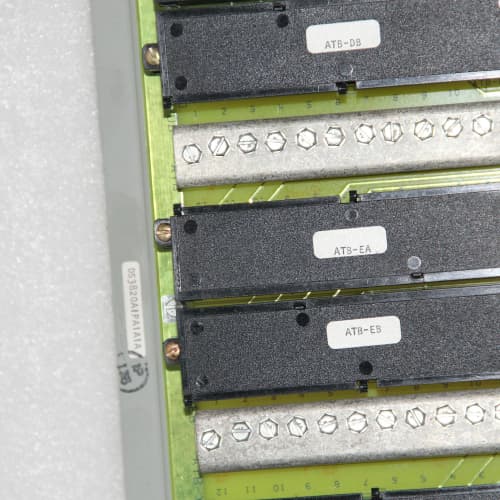
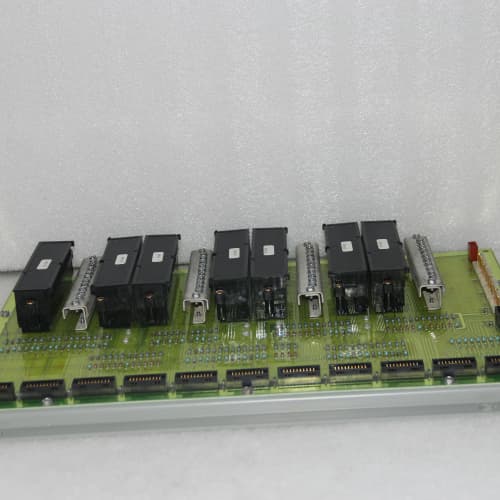
| Terminal Block Type | Screw-clamp, reinforced through-hole anchoring (1F) |
| Wire Gauge Range | 14-22 AWG solid or stranded |
| PCB Material | FR-4, high-Tg 170°C (1F) |
| PCB Layers | 8-layer with dedicated analog/digital split planes |
| PCB Thickness | 2.4mm (vibration-resistant) |
| Connector Type | 50-pin header to digital input module |
| Operating Temp | -25°C to +65°C (extended range) |
| Weight | 0.85 kg (approx. 1.9 lbs) |
| Mounting | Screws to rack chassis (hardware not included) |
Compatible Replacement Models
| Model | Compatibility | Notes |
|---|---|---|
| DS3800NRRA1G1F | ✅ Drop-in Replacement | Exact match. Premium high-noise immunity version. Direct swap with no wiring changes. |
| DS3800NRRA (standard) | ✅ Drop-in Replacement | Standard version with basic filtering and surface-mount terminals. Fits the same connectors and mounting holes. The 1G1F is a superset—direct upgrade. |
| DS3800NRRA1G | ⚠️ Hardware Difference | Has the enhanced filtering but standard-temp PCB and standard terminal anchoring. Fits the same rack but the board may not hold up in high-vibration or high-temp environments. Labor: 1 hour. |
| DS3800NRRA1F | ⚠️ Hardware Difference | Has the reinforced terminal blocks and high-temp PCB but standard filtering. Fits the same rack. Labor: 1 hour. |
| DS3800NRRB | ✅ Drop-in Replacement | Similar board with different terminal block layout. Verify your wiring diagram before swapping. Labor: ~1 hour to cross-reference. |
| DS3800NRRC | ⚠️ Hardware Difference | Digital input board for 48V DC systems. Not compatible with 24V systems. |
| IS200ERRA (Mark V) | ❌ Hardware Incompatible | Mark V board with different connector pinout. Not compatible. |
Frequently Asked Questions (FAQ)
What’s the difference between the 1G1F and the standard NRRA?
Three upgrades:
- The “1G” revision adds a second stage of EMI filtering—an active differential filter that rejects high-frequency noise up to 1MHz. The standard NRRA has only an RC low-pass filter.
- The “1F” revision adds through-hole anchoring to the terminal blocks, preventing them from lifting off the board during vibration or termination.
- The “1F” revision also upgrades the PCB material to high-Tg (170°C) for high-temperature environments.
The channel count, debounce settings, and connector pinout are identical. The 1G1F is a drop-in replacement that offers superior noise rejection and mechanical durability.
What’s the practical benefit of the enhanced EMI filtering?
In plain numbers: the 1G1F has 120dB differential-mode rejection at 60Hz and 80dB at 1MHz. That’s about 100x better than the standard NRRA at high frequencies. In practice, it means you can run digital input wiring alongside VFD cables, motor leads, and high-voltage AC lines without false triggers. The standard NRRA is good for typical plant noise; the 1G1F is for extreme environments—pulp and paper mills, steel plants, and anywhere with high-power VFDs.
Can the 1G1F reject impulse noise from lightning strikes?
To a point. The board’s filtering rejects fast transients (nanosecond-scale) that come from lightning-induced surges. The second-stage filter has a bandwidth of about 1MHz, which covers most lightning-induced noise. However, a direct lightning hit on the field wiring will still destroy the board—the isolation is rated for 250V AC only, and lightning surges can exceed that. We recommend using surge suppressors on the field wiring for lightning-prone areas. The board will survive induced surges (up to 2kV), but a direct hit is a different story.
What are the debounce time options on the 1G1F?
The board has jumper-selectable debounce times: 1ms, 5ms, 10ms, 25ms, and 50ms. The 50ms option is new on the 1G1F (the standard NRRA only goes to 25ms). Use the 50ms setting for slow mechanical switches that bounce excessively, like old limit switches on vibrating equipment. The debounce is set in groups of four channels via jumpers—check the PCB layout for the specific jumper locations.
Does the enhanced filtering affect the response time?
Slightly. The second-stage filter adds about 1ms of delay to the input signal. The debounce time adds additional delay (1-50ms). For most applications, the delay is negligible—a 1-2ms delay is well within the response time of typical turbine control loops. For fast-acting digital inputs (like speed sensors), you might want to use the 1ms debounce setting and accept the 1ms filter delay. For safety-related inputs, the 25-50ms delay is acceptable because the PLC or DCS scans slower.
Can I use the 1G1F with 48V DC systems?
No, the board is designed for 24V DC logic. The threshold voltage (12V ON, 5V OFF) is set for 24V systems. If you feed it 48V, you’ll damage the input circuitry. If your plant uses 48V digital inputs, order the DS3800NRRC instead.
What do the red LEDs on the 1G1F indicate?
In addition to the green LED (input ON), the 1G1F has a red LED per channel that illuminates when the board detects a transient on the input. The red LED latches on for a few milliseconds after a transient event—it’s a diagnostic tool that tells you the board saw noise on that channel. If you’re getting false triggers, the red LED will indicate which channels are seeing noise. This is a valuable troubleshooting feature that the standard NRRA lacks. The red LED doesn’t affect the input reading; it just provides diagnostic feedback.
Can I hot-swap the 1G1F while the rack is powered?
No. The board is connected to live field switches and the digital input module. Pulling it while powered could damage the module’s input stage. Power down the rack, swap the board, and power back up. It’s a 15-minute job.
What’s your test procedure for the 1G1F?
Our inbound test:
- Visual: inspect terminal blocks for through-hole solder joints (full penetration, no voids). Check for bent pins, cracked connectors, and discolored components.
- Filtering test: inject a 1V, 1MHz common-mode signal—verify the board rejects it to under 10mV (80dB rejection).
- Debounce test: apply a 5ms pulse and verify the board rejects it when set to 10ms.
- Transient detection: apply a 50V spike and verify the red LED illuminates without damaging the board.
- Isolation: 500V DC between adjacent channels—must exceed 10MΩ.
- Continuity: verify each channel from terminal to 50-pin header—under 0.2Ω.
We reject about 6% of inbound 1G1F boards—mostly for failed active filter components (the second-stage op-amp can be damaged by ESD) or poor through-hole soldering on the terminal blocks. The active filter is more complex than the passive filter on the standard board, so there are more opportunities for failure.
What’s the typical application for the 1G1F?
Anywhere with high electrical noise—pulp and paper mills, steel plants, mining operations, and any plant with multiple large VFDs. The enhanced filtering is also useful for digital inputs that run long distances (over 1,000 feet) through noisy environments. The standard NRRA is adequate for most applications; the 1G1F is for the extremes. The price premium (about 30% over the standard NRRA) is worth it if you’re chasing intermittent false triggers.
ABB CI858K01
Beijer EXTER T150
Bently 3500/22-01-01-00
ICOS IVC-1600
 Email: sales@plcfcs.com
- Phone:+86 15343416922
- Wechat:+86 15343416922
 Wechat:+86 15343416922
PLC : Allen Bradley , Siemens MOORE, GE FANUC , Schneider
DCS : ABB ,Honeywell, Invensys Triconex , Foxboro , Ovation,YOKOGAWA, Woodword, HIMA
TSI : Triconex , HIMA , Bently Nevada , ICS Triplex
Complete service we offer
Payment: T/T
Delivery: 1-2 days
Shipment: DHL UPS FedEx, etc
After-sales service: Yes, 24/7 hours