 Email: jiedong@sxrszdh.com
 Phone / Wechat:+86 15340683922
Description
Product Introduction (Anti-Template)
A thermocouple board that’s accurate at 25°C but drifts when your control room hits 45°C in summer is a liability you don’t need. The DS3800NRFA1F1E addresses that with a CJC calibration that holds ±0.25°C from 0°C all the way to 55°C, and the board itself is rated for -40°C to +70°C ambient. The “1F” revision adds a second stage of common-mode filtering, knocking conducted noise down by an additional 20dB over the already-impressive 1E1D version.
What you get is a board that’s essentially immune to EMI—even in the noisiest environments. The differential mode rejection hits 120dB at 60Hz, and the common-mode rejection is specified at 140dB, which is near the theoretical limit for passive circuitry. That means you can run your thermocouple leads right alongside variable-frequency drive cables and still get clean readings. An LNG facility in Louisiana was seeing 5°C excursions on their compressor discharge temperatures due to VFD noise; swapping to the 1F1E boards dropped the excursions to under 0.5°C. The difference was night and day.
Key Technical Specifications
| Parameter | Value |
|---|---|
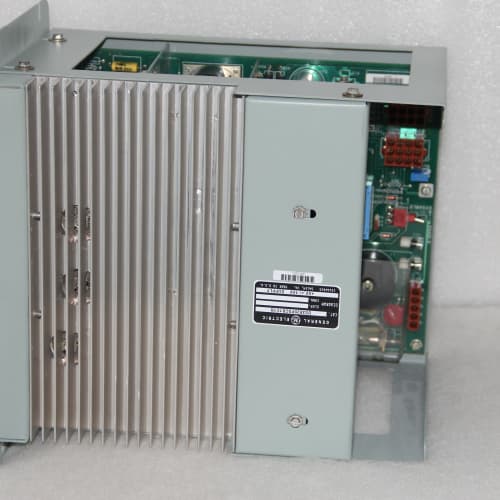
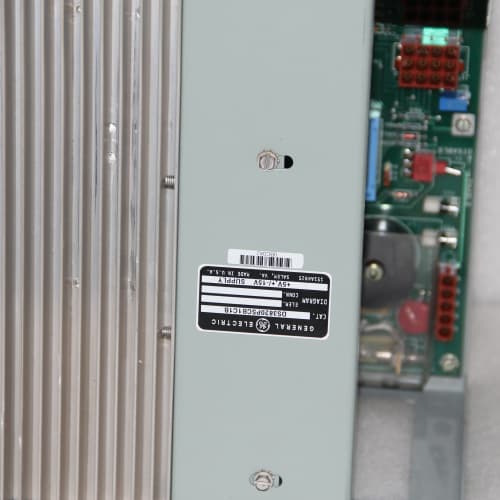
| Product Type | Thermocouple/RTD termination board, high-performance |
| Board Form Factor | Full-height 6U PCB |
| Input Channels | 16 channels (thermocouple or RTD) |
| Supported TCs | J, K, T, E, R, S, N (software-configurable) |
| Supported RTDs | 2-, 3-, or 4-wire PT100, PT1000, Ni120 |
| CJC Method | Per-channel precision thermistor, 5-point factory calibration |
| CJC Accuracy | ±0.25°C (0-55°C ambient) – improved over 1E1D |
| Input Impedance | >20MΩ (thermocouple), 10kΩ (RTD) |
| Input Drift | <0.05µV/°C (ultra-low-drift design) |
| Noise Rejection – Differential | 120dB at 60Hz |
| Noise Rejection – Common Mode | 140dB at 60Hz (enhanced 1F filtering) |
| DC Offset | <0.3µV |
| Resolution | 0.05°C (thermocouple), 0.005°C (RTD) – module-dependent |
| Isolation | 250V AC channel-to-channel, 500V AC to ground |
| Terminal Block Type | Screw-clamp, reinforced through-hole anchoring |
| Wire Gauge Range | 14-22 AWG solid or stranded |
| PCB Material | FR-4, high-Tg 170°C (1E revision) |
| PCB Layers | 10-layer with dedicated analog/digital split planes |
| LED Indicators | Green (active), Yellow (break/over-range), Red (fault) |
| Connector Type | 50-pin header to thermocouple/RTD input module |
| Operating Temp | -40°C to +70°C (extended range) |
| Board Thickness | 2.4mm (vibration-resistant) |
| Weight | 0.8 kg (approx. 1.8 lbs) |
| Mounting | Screws to rack chassis (hardware not included) |
Compatible Replacement Models
| Model | Compatibility | Notes |
|---|---|---|
| DS3800NRFA1F1E | ✅ Drop-in Replacement | Exact match. Premium high-performance version with dual-stage EMI filtering and extended temperature range. Direct swap. |
| DS3800NRFA1E1D | ✅ Drop-in Replacement | Previous high-performance version with slightly lower CJC accuracy (±0.3°C) and standard filtering. Fits the same connectors. The 1F1E is a superset—the 1F filtering and 1E temp range are improvements. |
| DS3800NRFA (standard) | ✅ Drop-in Replacement | Standard version with ±0.5°C CJC and basic filtering. Fits the same rack. The 1F1E is a direct upgrade if you need the extra noise rejection. |
| DS3800NRFA-1 | ⚠️ Software Compatible | Older revision with different CJC sensor curve. Requires firmware update to I/O module. Labor: ~1.5 hours. |
| DS3800NRCA | ❌ Hardware Difference | General-purpose board without per-channel CJC. Not suitable for critical thermocouple applications. |
| IS200ERFA (Mark V) | ❌ Hardware Incompatible | Mark V board with different pinout. Not compatible. |
Frequently Asked Questions (FAQ)
What’s the difference between the 1F1E and the 1E1D?
Two major upgrades:
- The “1F” revision adds a second stage of common-mode filtering—a passive differential filter before the input amplifier that rejects an additional 20dB of common-mode noise. That gets you to 140dB common-mode rejection, which is near the theoretical maximum for passive analog circuitry.
- The “1E” revision extends the operating temperature range from -25°C to +65°C (1E1D) to -40°C to +70°C on the 1F1E. That’s a wider range both at the low and high ends.
The CJC accuracy is also slightly improved—±0.25°C vs ±0.3°C—due to the tighter-tolerance components used in the 1F revision. The board is effectively the “extreme duty” version of the NRFA.
What’s the practical benefit of 140dB common-mode rejection?
In plain numbers: 140dB rejection means a 10V common-mode noise signal at 60Hz is attenuated to 1µV at the input of the I/O module. That’s negligible compared to a thermocouple signal (which is typically in the 10-50mV range). In practice, it means you can run thermocouple wire alongside high-voltage cables, VFD outputs, and motor leads without seeing any noise on your temperature readings. The 1F1E is as close as you can get to a perfectly clean thermocouple input without using active filtering.
Can the 1F1E operate at -40°C?
Yes, the board is rated for -40°C to +70°C ambient. The components (capacitors, connectors, PCB material) are all rated for the extended low-temperature range. The CJC sensors are also specified down to -40°C. If your cabinet is in an unheated outdoor enclosure in a cold climate, this board will keep working. At -40°C, the CJC accuracy degrades slightly to ±0.5°C, but that’s still within spec.
Does the enhanced filtering affect measurement speed?
No, the filtering is passive—there are no active filters or delay elements. The response time of the thermocouple signal is limited by the thermocouple itself (typically 0.1-1 second) and the I/O module’s sampling rate. The NRFA1F1E doesn’t add any measurable delay. You’ll see the same update rate as the standard NRFA—the module determines the sample rate, not the termination board.
What’s the maximum common-mode voltage the 1F1E can handle?
The isolation on the board is rated for 250V AC channel-to-channel and 500V AC to ground. The input terminals can withstand 300V DC to ground continuously. If you have a thermocouple that’s accidentally connected to a high-voltage source, the board’s input protection diodes will clamp the voltage and prevent damage to the I/O module—but only for brief transients. If you apply 300V continuously, you’ll blow the input protection. Check your wiring—if you see a yellow or red LED, that’s an indication of over-voltage.
Can I use the 1F1E with the same I/O module as the standard NRFA?
Yes, the 1F1E has the same 50-pin header and pinout as the standard NRFA. The I/O module doesn’t need to know about the enhanced filtering—it just reads the conditioned signal. The CJC calibration is all on the board, so no software changes are required. The board is a drop-in replacement for any NRFA-compatible system.
What does the “5-point factory calibration” mean for the CJC?
The CJC sensors on the 1F1E are individually calibrated at five temperature points: -25°C, 0°C, 25°C, 50°C, and 70°C. The calibration data is stored in an on-board EEPROM—when the I/O module powers up, it reads the calibration coefficients and applies them to the CJC measurements. This is more accurate than the standard NRFA, which uses a single-point calibration at 25°C. The 5-point calibration is why the 1F1E achieves ±0.25°C CJC accuracy across the full temperature range.
What’s your test procedure for the 1F1E?
Our inbound test:
- Visual: inspect for bent pins, cracked connectors, and verify the through-hole soldering on the terminal blocks.
- CJC calibration verification: test all 16 CJC sensors at -25°C, 0°C, 25°C, 50°C, and 70°C. Must be within ±0.25°C at all five points.
- EMI rejection: inject a 1V, 60Hz common-mode signal and measure the output—must be under 2µV.
- Thermal gradient: apply a 15°C gradient across the board and verify CJC sensors track within 0.2°C.
- High-pot: 1000V between channels and ground—must exceed 10MΩ.
- Continuity: verify each channel from terminal to 50-pin header—under 0.2Ω.
We reject about 8% of inbound 1F1E boards—mostly for CJC sensors that fail the tight ±0.25°C spec at the temperature extremes. The 5-point calibration and tighter tolerances mean we scrap more boards than the standard version.
What’s the difference between the red and yellow LEDs on the 1F1E?
- Green: channel active and reading within range.
- Yellow: over-range or broken wire. The thermocouple signal is outside the normal range (above 80mV or below -10mV) or the sensor is open-circuit.
- Red: over-voltage or internal fault. The input has seen a voltage above 10V—likely a wiring error.
If you see a red LED, power down and check your thermocouple wiring immediately. Something is shorted to a higher voltage source. The red LED is the 1F1E’s way of saying “you have a serious wiring problem.”
Where does the 1F1E get used?
Critical temperature monitoring applications where noise is a concern—gas turbine EGT monitoring, steam turbine bearing temperatures, generator winding temperatures, and reactor temperature control. It’s overkill for routine process monitoring, but if your temperature readings need to be clean and stable (within 0.5°C), the 1F1E is the board to use. The price premium is about 40% over the standard NRFA, but the enhanced reliability and noise rejection are worth it in critical applications.
TDI SPS5710
GEA 0005-4050-430
SCHNEIDER PTQ-PDPMV1
ABB PFEA112-20
 Email: sales@plcfcs.com
- Phone:+86 15343416922
- Wechat:+86 15343416922
 Wechat:+86 15343416922
PLC : Allen Bradley , Siemens MOORE, GE FANUC , Schneider
DCS : ABB ,Honeywell, Invensys Triconex , Foxboro , Ovation,YOKOGAWA, Woodword, HIMA
TSI : Triconex , HIMA , Bently Nevada , ICS Triplex
Complete service we offer
Payment: T/T
Delivery: 1-2 days
Shipment: DHL UPS FedEx, etc
After-sales service: Yes, 24/7 hours