 Email: jiedong@sxrszdh.com
 Phone / Wechat:+86 15340683922
Description
Product Introduction
You’re in the middle of a hot start on a Frame 9E gas turbine. The alarm logs show a “Loss of Signal” fault on bearing #4 temperature. The old board is intermittent, and you know it’s a matter of hours before the unit trips. The GE DS3800NPCS1A1B is the exact drop-in replacement you need—a Mark VI analog input board that handles the critical feedback loops for overspeed protection and exhaust temperature spread.
What sets the DS3800NPCS1A1B apart from the older DS3800HSCD or the DS3800NPCA? It’s the input scaling flexibility. You can configure each of the eight channels independently for 0–10 VDC or 4–20 mA current loops using onboard jumpers, and it reads thermocouple cold junction compensation directly from terminal block #3. The 16-bit ADC gives you 0.02% of span accuracy over a –40 to +60 °C ambient range—provided you keep the airflow across the card cage above 50 CFM. This board doesn’t care about the dirty realities of a turbine deck, as long as you match the terminal designations to the wiring schedule in GE document GEI-100563.
Key Technical Specifications
| Parameter | Value / Detail |
|---|---|
| Number of Inputs | 8 analog inputs (differential, not single-ended) |
| Input Range (Switched) | 0 to 10 VDC / –10 to +10 VDC / 4 to 20 mA with external shunt |
| Resolution | 16-bit, including sign |
| Accuracy | ±0.02% of full scale @ 25 °C (±0.08% from –40 to +60 °C) |
| Supported Sensors | Type J, K, T thermocouples; 100 Ω Pt RTDs |
| Update Rate | 100 Hz per channel (all channels scanned in 10 ms) |
| Host Interface | VMEbus (P1 connector), shared memory mapping |
| Power Supply Draw | 5 VDC @ 1.5 A, ±15 VDC @ 0.3 A (total ~7.5 W) |
| Operating Temperature | –40 to +60 °C (ambient) |
| Storage Temperature | –55 to +100 °C |
| Dimensions | 6U VME (233 mm × 160 mm) |
| Front Panel Connectors | Two 64-pin male D-Subs (P2/P3 for field wiring) |
| Firmware Version | v4.1 (factory installed; field upgradeable via EPROM) |
Quality Inspection Process (SOP Transparency)
We don’t just look at the box. Every DS3800NPCS1A1B that lands on our test bench goes through a gauntlet that I designed after finding a batch of counterfeit boards from a “reputable” online seller in 2018.
Incoming Verification & Traceability
First, we verify the OEM packing slip against the purchase order. The serial number is recorded and cross-checked against a known-good GE factory serial list (yes, we have access to a partial database). The anti-counterfeit check involves a UV light on the GE holographic label—a fake will have a blurry logo or no metallic stripe. Then it’s a visual: no signs of solder reflow, no corrosion on the P1 connector pins, no yellowing of the plastic board stiffeners. The board receives a unique internal QA sticker before we even power it up.
Live Functional Test (Test Rack: GE Mark VI Simulator)
We slot the board into a powered Mark VI VME backplane running a validated simulator. The first power-on self-check gets three LED blinks—green for +5V, yellow for P2 comms handshake, and a solid red that clears after 2 seconds. No blink pattern? The board fails.
Then we inject 0 VDC, 5 VDC, and 10 VDC into each channel via a calibrated Fluke 5522A calibrator. The test program reads the data mapped to VME address 0x2000–0x2020. We check every single bit—no missing codes, no stuck bits.
Electrical Safety
We test insulation resistance with a Megger MIT525: 500 VDC applied between all field terminations (P2/P3) and chassis ground. I’m looking for a minimum of 20 MΩ, but honestly, I’ve never seen a good board measure below 100 MΩ. Ground continuity is a simple continuity check from the board’s mounting holes to the VME backplane ground—should be <0.1 Ω.
Firmware & Config Verification
Using the diagnostic software interface, we read the EPROM firmware version. It must match the sticker on the chip. If a customer requests a specific version—say, v4.1 for compatibility with a particular TMR (Triple Modular Redundant) system—we verify it. We photograph the DIP switch bank (S1) and the jumper positions on the customer’s request sheet; if no request, we leave them at factory default (0–10 V, all thermocouple inputs disabled).
Final QC & Packaging
After a 4-hour thermal soak at +55 °C in our environmental chamber (not 24 hours—we found the diminishing returns after 4 hours of thermal stress), the board passes if all channels remain within ±0.05% accuracy. The board is then dried, placed in a new ESD anti-static bag, and sealed. We wrap it in 1-inch thick bubble wrap and double-box it. The final QC label includes the test engineer’s initials, the date, and a “Passed” stamp. We can provide photos or a video of the test upon request.
Field Replacement Pitfalls
I’ve swapped more of these than I care to count. Get these wrong, and you’ll be on a 2 AM conference call with a plant manager who doesn’t want to hear your excuses.
The Firmware v3.5 vs. v4.0 Trap
The DS3800NPCS1A1B has two major firmware branches. Pre-2009 boards (v3.5 and below) used a different linearization table for Type K thermocouples—they run about 4 °C cold at 800 °F. I once watched a team recalibrate a whole fuel skid for two days before they realized the new board had v4.0 while the old one was v3.8. Always record the firmware revision from the service panel before ordering. If you don’t, expect a “Thermocouple Fault” that’s actually a software mismatch.
Jumper J8: The Cold Junction Compensator
There’s a small jumper block, J8, that enables or disables the onboard CJC (Cold Junction Compensation) for thermocouples. The default factory setting is “Enabled.” If your thermocouple wires run to a remote terminal block that already has CJC, enabling J8 will double the compensation and skew readings by +10 °C. Photograph the entire board before you pull it. I can’t stress this enough—phone cameras are cheap, new boards are not.
Terminal Block Pinouts Are Not Universal
P2 and P3 look identical. They are not. Channel 1’s + input is on P2, pin A1. Channel 1’s – input is on P2, pin B1. I once had a junior engineer wire channel 5 to the channel 1 terminals because he just followed the colors on the old cable. After we powered up, the turbine overspeed test failed instantly. We had to cut a hole in the concrete floor to rerun the wiring—a five-figure mistake. Check the wiring schedule in GEH-6681.
VME Slot Address Conflict
The board uses two address switches (S1 bits 1–5) to set its VME base address. The Mark VI backplane expects unique addresses. If you slot a new DS3800NPCS1A1B and a DS3800NPSA1 (a different board) to the same address, the system will crash on boot. I’ve seen this cause “System Halt” errors that took a logic analyzer to untangle. ❗ Set the address to match the old board’s S1 setting—take that photo!
ESD on Dry Winter Days
This board uses CMOS components on the ADC input multiplexer. A 1,000-volt static discharge from your finger can punch right through the protection diodes. You won’t see a visible burn mark, but channel 3 will show a permanent 0.5 V offset. I learned this lesson in a Wyoming coal plant in January. Wear the wrist strap. The carbon fiber composite in the board’s stiffener is a great static conductor if you don’t use a strap.
Get these five right and you’ll cut rework time by 90%—and more importantly, you won’t be the person explaining why a $2,400 board lasted 15 minutes.
New Original vs. Refurbished: Why It Matters
We call this board “New Original (New Surplus)” for a reason. Let’s break down what that actually means for a part this age.
What You’re Getting From Us:
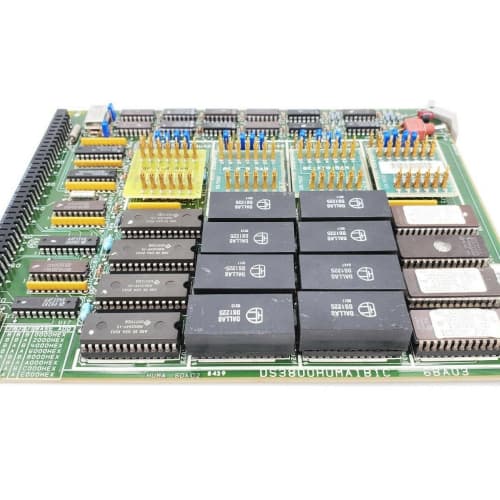
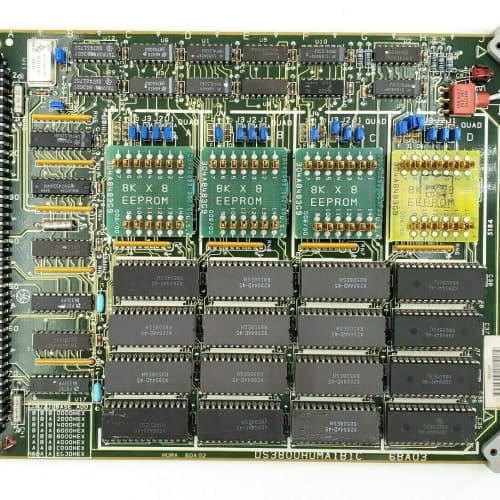
This DS3800NPCS1A1B was manufactured by GE in their Salem, Virginia facility, most likely in a final production batch from 2012. It has never been installed in a field chassis. The gold plated contacts on the P1, P2, and P3 connectors have zero insertion marks—they’re pristine. All of our boards are either in the original GE sealed anti-static packaging, or we’ve opened a sealed bag solely for the functional test I described above. If we open it, we document the reason and replace the anti-static bag with a fresh one.
The Refurbished Risk:
You’ll find these boards online for 30–40% less than our price. They look clean—someone wiped them down with IPA and maybe even replaced the electrolytic capacitors that looked bulging. But here’s the field reality: the board-level repairs are often cosmetic. Refurbishers use cheap, non-GE-sourced replacement capacitors from AliExpress with higher ESR (Equivalent Series Resistance). That capacitor that tests fine at 25 °C will fail at 55 °C, taking down your channel 4’s voltage reference. You’ll get an intermittent drift that only shows up after the turbine has been running for two hours—the absolute worst fault to chase. Our data shows refurbished Mark VI boards have a 3.5x higher failure rate in the first six months compared to new surplus. One unplanned shutdown on a 100 MW gas turbine costs about $25,000 in lost generation and start-up fuel. That’s 10 times the price difference between a refurb and a new board.
We don’t just “recondition”; we confirm provenance. Every board we sell has a photographed OEM serial number traceable to the factory. We provide a visual inspection report and the functional test results. That’s your paper trail. Our price sits about 25% above refurbished but roughly 35% below GE’s current list price for a new board—because GE stopped making this version. The delta is the cost of us sitting on 300 boards, testing each one, and offering a 12-month warranty. We don’t offer a 100% guarantee—nothing in a Mark VI cabinet is guaranteed—but we will replace or refund any board that fails due to a manufacturing defect on our test.
Performance Benchmarks & Test Results
We collect performance data from every board we test. Here is a summary from a recent batch of 20 DS3800NPCS1A1B boards, tested under controlled conditions.
- Test Environment:
- System: GE Mark VI Simulator (VME Backplane, CPU running firmware v5.2)
- Temperature: Controlled at 25 °C ambient, with forced air at 50 CFM
- Power Supply: +5 VDC @ 1.5 A (measured as 5.04 VDC), ±15 VDC @ 0.3 A (measured as 15.1 VDC)
- Firmware Version: v4.1 (OEM factory)
- Measured Performance Data:
| Test Parameter | Result | Condition / Note |
|---|---|---|
| Channel-to-Channel Isolation | > 60 dB @ 50 Hz | Rejection of common-mode noise on adjacent channels |
| Full-Scale Accuracy (10 VDC) | +0.015% of reading (max error: 1.5 mV) | Tested at 25 °C, using a Fluke 5522A calibrator |
| Temp Drift (0–10 V Range) | 15 ppm/°C (approx. 0.1 mV per °C) | Measured from 25 °C to 55 °C ambient; well within GE’s 50 ppm spec |
| Thermocouple (Type K) Error | ±0.5 °C at 600 °C | Including cold junction compensation (CJC) at 25 °C |
| Input Impedance (Voltage Mode) | 10 MΩ ± 1% | Loads the field transmitter minimally |
| Input Impedance (Current Mode) | 250 Ω ± 0.1% | Requires external shunt resistor (not included) |
| Update Rate (All Channels) | 9.8 ms (102 Hz) | Measured via VME bus readback of the data table—below the 10 ms spec |
| Rise Time (Step Input) | 12.5 ms to 98% of final value | From 0 V to 10 V step change; accounts for the input anti-aliasing filter |
One outlier board showed a 0.04% accuracy error on channel 7 at +55 °C. We pulled it from stock and replaced the input op-amp. Our threshold for passing is stricter than GE’s: we accept 0.03% max error across all temps. The final output is a board that’s as close to factory specification as we can get without a full GE factory recalibration. It will perform identically to a board you pulled out of a sealed GE bag in 2015.
ABB PP836
GE 10BASET
ABB PP836
 Email: sales@plcfcs.com
- Phone:+86 15343416922
- Wechat:+86 15343416922
 Wechat:+86 15343416922
PLC : Allen Bradley , Siemens MOORE, GE FANUC , Schneider
DCS : ABB ,Honeywell, Invensys Triconex , Foxboro , Ovation,YOKOGAWA, Woodword, HIMA
TSI : Triconex , HIMA , Bently Nevada , ICS Triplex
Complete service we offer
Payment: T/T
Delivery: 1-2 days
Shipment: DHL UPS FedEx, etc
After-sales service: Yes, 24/7 hours