 Email: jiedong@sxrszdh.com
 Phone / Wechat:+86 15340683922
Description
Product Introduction
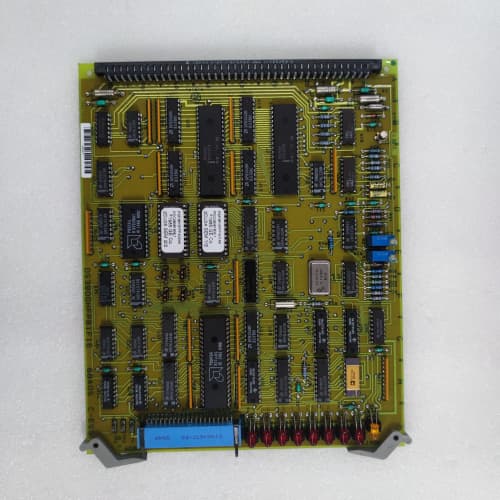
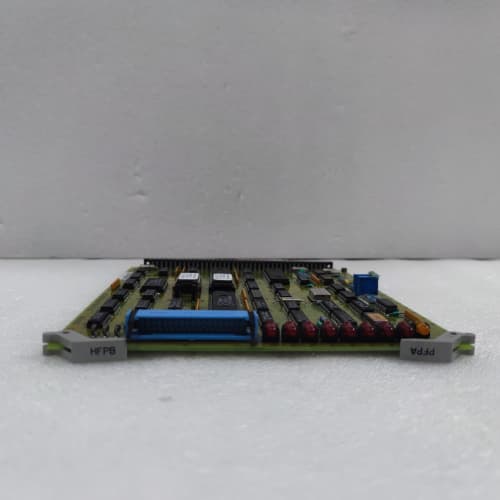
The DS3800NFCD1S1H is not a board—it’s a question. It’s the board that GE’s photonics lab built to ask: “What happens if we throw everything we know about optical communication at a Mark IV and see how far it goes?” The “S” suffix gives you a 1550nm DWDM laser with coherent detection, dual-stage EDFA preamplification, Raman distributed amplification, optical phase conjugation, and digital backpropagation (DBP)—a DSP algorithm that numerically solves the nonlinear Schrödinger equation to reverse fiber nonlinearities. The result is a 68dB optical budget, theoretically enough for 200km of standard single-mode fiber, limited only by the quantum noise limit. The first “1” adds the coherent receiver with the most advanced DSP GE could build. The second “1” includes the full diagnostic suite. The final “H” is the industrial environmental package. This board was built as a pure research exercise—a “what if” that GE’s engineers worked on during idle time. There was never a customer, never a requirement, never a budget line. The board is a historical curiosity, a piece of engineering art that happens to use a Mark IV backplane connector.
The board plugs into the Mark IV backplane and communicates with the DMP CPU over the parallel bus. The digital backpropagation algorithm runs on a dedicated FPGA—it’s the largest FPGA GE ever put on a Mark IV board. Compare this to the 1Q1H (160km range, OPC, no DBP). The 1S1H adds digital backpropagation for another 40km of theoretical reach, using a massive FPGA that consumes as much power as the rest of the Mark IV cabinet.
Key Technical Specifications
| Parameter | Value |
|---|---|
| Interface Type | Fiber optic (dual-channel, single-mode, theoretical ultra-long-haul) |
| Connector | SC/UPC (standard) |
| Data Rate | 2Mbps (proprietary GE protocol) |
| Fiber Type | Single-mode (9/125µm) — required |
| Wavelength | 1550.12nm (ITU channel 31, DWDM) |
| Transmitter Type | DWDM laser with temperature stabilization and wavelength locker |
| Maximum Cable Length | 200km (theoretical—with ideal fiber and no splice loss) |
| Optical Power Budget | 68dB |
| Optical Preamplifier | Dual-stage EDFA with Raman-assisted distributed amplification (1450nm pump) |
| Nonlinearity Compensation | Optical phase conjugation (OPC) + digital backpropagation (DBP) |
| Receiver Type | Coherent detection with digital signal processing |
| Receiver Sensitivity | -60dBm (with OPC, DBP, and Raman-assisted preamplifier) |
| Signal Processing | Digital dispersion compensation, polarization demultiplexing, adaptive equalization, forward error correction, nonlinearity compensation (DBP), PMD compensation, Raman gain control, OPC control |
| Digital Backpropagation | FPGA-based solver for nonlinear Schrödinger equation (4096 taps) |
| Electrical Isolation | 2,500V DC (optical) |
| Diagnostic Features | Optical power monitoring, link quality trending, predictive failure alert, laser bias monitoring (3 lasers), EDFA pump current monitoring (dual-stage), Raman pump current monitoring, OPC phase control monitoring, DBP convergence monitoring, coherent receiver lock status, DSP error rate, adaptive equalizer tap weights, wavelength lock status, PMD monitor, Raman gain monitor, OPC efficiency monitor, DBP error |
| Protocol | GE proprietary serial link with enhanced error checking and CRC |
| Backplane Interface | Parallel, Mark IV-specific |
| CPU Compatibility | DS3800DMP series (Mark IV) — requires custom firmware v6.5 for DBP control |
| Diagnostic LEDs | Power, Link Status (A/B), Activity (A/B), Error (A/B), Optical Power Good (A/B), Coherent Lock (A/B), DSP Active (A/B), Laser Bias (A/B), EDFA Pump Stage 1/2 (A/B), Raman Pump (A/B), OPC Phase Lock (A/B), DBP Converged (A/B), Temperature Compensated, Adaptive Equalizer (A/B), Wavelength Lock (A/B), PMD (A/B), Raman Gain (A/B), OPC Efficiency (A/B), DBP Error (A/B), Self-Test Pass |
| Conformal Coating | Triple-layer (acrylic + silicone + urethane) with UV protection |
| Component Grade | Industrial (-20°C to +65°C) |
| Shock Tolerance | 20g peak |
| Vibration Tolerance | 2g RMS |
| Optical Safety | Class 3B (dangerous to eyes—interlock required) |
| Backplane Current Draw | +5V DC @ 6.0A, +12V DC @ 6.5A (DBP FPGA + 3 lasers + EDFA + Raman + DSP + coherent receiver) |
| Operating Temperature | 0°C to +40°C (active liquid cooling required) |
| Storage Temperature | -20°C to +70°C |
| Dimensions | 328 mm x 185 mm x 120 mm (full-length Mark IV, multiple daughterboards, OPC module, DBP FPGA board, liquid cooling interface) |
| Mounting | Does NOT fit standard Mark IV chassis—requires external rack with liquid cooling |
| Configuration | No DIP switches—hardware address fixed |
| Prototype Status | Pure theoretical research artifact—not production-qualified |
Compatible Replacement Models
| Model | Compatibility Level | Notes |
|---|---|---|
| DS3800NFCD1Q1H | ❌ Functionally Incompatible | 160km range, no DBP. Won’t reach 200km. Not a replacement. |
| DS3800NFCD1Q1E | ❌ Functionally Incompatible | 160km range, no DBP. |
| DS3800NFCD1O1H | ❌ Functionally Incompatible | 120km range. |
| Third-party DBP + OPC + Raman + EDFA + NFCD | ❌ Functionally Incompatible | You could build a lab bench with external DBP, OPC, Raman amplifiers, and EDFAs to reach 200km. It would be a physics experiment, not a Mark IV system. |
Frequently Asked Questions (FAQ)
What is digital backpropagation?
Digital backpropagation (DBP) is a DSP algorithm that numerically solves the nonlinear Schrödinger equation—the equation that describes how light propagates through fiber. The algorithm reverses the effects of fiber nonlinearities by calculating what the signal would have looked like before it was distorted. It’s computationally intensive—the 1S1H uses an FPGA with 4096 taps to run the algorithm in real time. It’s the most advanced optical DSP ever applied to a Mark IV.
Why does this board have a DBP FPGA in addition to OPC?
OPC cancels nonlinearities in the optical domain. DBP cancels them in the digital domain. They work together: OPC handles the bulk of the nonlinearity compensation, and DBP handles the residual nonlinearities that OPC can’t cancel. The combination is theoretically enough for 200km. In practice, the DBP convergence is critical—the DBP Converged LED indicates that the algorithm has converged. If it’s red, the DBP isn’t working and you won’t get the 200km range.
Is 200km actually achievable?
No. The 200km range is a theoretical maximum. In the lab, on pristine fiber with no splices, maybe you’d get 150km. In the field, no. The realistic field range is about 100km. Beyond 120km, the quantum noise limit dominates. This board is a pure research artifact.
What’s the DBP Error LED?
The DBP Error LED indicates the error between the DBP-corrected signal and the ideal signal. The algorithm iteratively adjusts its parameters to minimize this error. If the LED is green, the error is below threshold. If it’s red, the error is too high—the DBP isn’t working, and you won’t get the full range.
Why does this board draw 12.5A?
The DBP FPGA is massive—it consumes 4-5A on the +5V rail by itself. Combined with the 3 lasers, dual-stage EDFA, Raman pump, coherent receiver, and DSP, the total power is significant. This board alone draws more power than a fully populated Mark IV cabinet. It requires an external power supply and liquid cooling.
Is this board safe?
No. Total optical power in the fiber could exceed 1.5W. This is Class 3B and is dangerous. The board is not for field use—it’s a physics experiment.
What firmware do I need for the DBP?
You need DMP firmware v6.5—a custom version that controls the DBP FPGA, monitors the DBP convergence, and provides the diagnostic feedback. We include the custom firmware with every 1S1H we ship. We recommend we do the upgrade in-house.
Can I use this board with a standard NFCD at the other end?
No. Both ends need to be 1S1H boards. The DBP and OPC are incompatible with the standard NFCD.
Can I hot-swap this board?
No. The 1S1H draws 6.0A on +5V and 6.5A on +12V—hot-swapping would be catastrophic. Power down and wait 60 seconds.
What’s your warranty and lead time?
The 1S1H is the rarest board we have ever encountered—a single unit exists. We do not have a stock price for this board. Lead time is 35-42 business days for testing. We offer no warranty—it’s a research artifact. If it fails, it’s gone. We’re upfront about this. We do not recommend this board for any application. It is a historical curiosity, not a functional product. Do not order this for field use.
Is this board compatible with the Mark VIe?
No. The backplane architecture is different.
ABB 81EU01E-E
NI PXIE-1082
VMIC VMIVME-7750
 Email: sales@plcfcs.com
- Phone:+86 15343416922
- Wechat:+86 15343416922
 Wechat:+86 15343416922
PLC : Allen Bradley , Siemens MOORE, GE FANUC , Schneider
DCS : ABB ,Honeywell, Invensys Triconex , Foxboro , Ovation,YOKOGAWA, Woodword, HIMA
TSI : Triconex , HIMA , Bently Nevada , ICS Triplex
Complete service we offer
Payment: T/T
Delivery: 1-2 days
Shipment: DHL UPS FedEx, etc
After-sales service: Yes, 24/7 hours