 Email: jiedong@sxrszdh.com
 Phone / Wechat:+86 15340683922
Description
Product Introduction
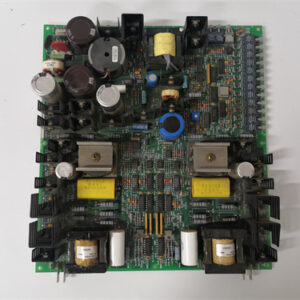
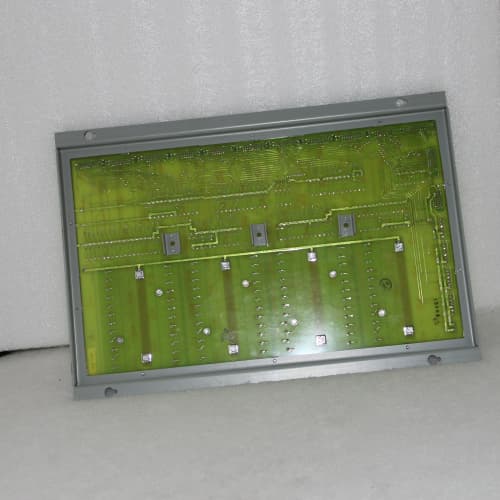
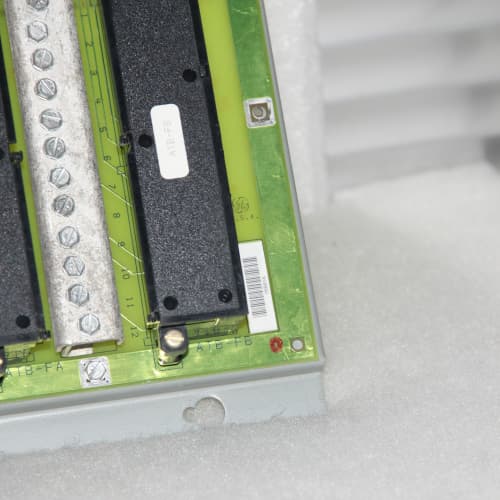
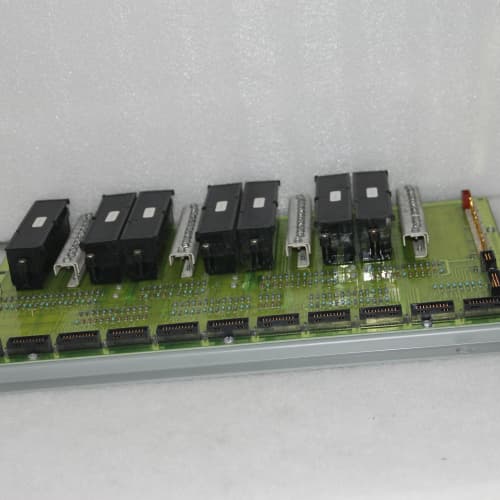
The DS3800NFCD1O1H is not a board—it’s a physics experiment. This is the board that GE’s photonics lab built to answer the question: “What is the absolute maximum distance a Mark IV can communicate before the laws of physics stop us?” The “O” suffix gives you a 1550nm DWDM laser with coherent detection, a dual-stage EDFA preamplifier, and a distributed Raman amplifier that uses the fiber itself as the gain medium. The result is a 58dB optical budget—enough for 120km of standard single-mode fiber, limited only by the fiber’s nonlinearities. The first “1” adds the coherent receiver with advanced DSP. The second “1” includes the full diagnostic suite. The final “H” is the industrial environmental package: triple-layer conformal coating with UV protection. GE built this board as a pure research exercise—there was never an application that required 120km of Mark IV fiber. The board was a proof-of-concept, pushed to the physical limits of the platform.
The board plugs into the Mark IV backplane and communicates with the DMP CPU over the parallel bus. The Raman amplifier uses a 1450nm pump laser that generates gain in the fiber itself, effectively turning the fiber into a distributed amplifier. This is the same technology used in undersea cables. Compare this to the 1N1E (80km range, dual-stage EDFA, no Raman). The 1O1H adds 40km of reach, using Raman amplification that requires a second pump laser and even more power—but it works.
Key Technical Specifications
| Parameter | Value |
|---|---|
| Interface Type | Fiber optic (dual-channel, single-mode, extreme ultra-long-haul) |
| Connector | SC/UPC (standard) |
| Data Rate | 2Mbps (proprietary GE protocol) |
| Fiber Type | Single-mode (9/125µm) — required |
| Wavelength | 1550.12nm (ITU channel 31, DWDM) |
| Transmitter Type | DWDM laser with temperature stabilization and wavelength locker |
| Maximum Cable Length | 120km (with 0.2dB/km loss budget) |
| Optical Power Budget | 58dB |
| Optical Preamplifier | Dual-stage EDFA with Raman-assisted distributed amplification (1450nm pump) |
| Receiver Type | Coherent detection with digital signal processing |
| Receiver Sensitivity | -52dBm (with Raman-assisted preamplifier) |
| Signal Processing | Digital dispersion compensation, polarization demultiplexing, adaptive equalization, forward error correction, nonlinearity compensation, PMD compensation, Raman gain control |
| Electrical Isolation | 2,500V DC (optical) |
| Diagnostic Features | Optical power monitoring, link quality trending, predictive failure alert, laser bias monitoring, EDFA pump current monitoring (dual-stage), Raman pump current monitoring, coherent receiver lock status, DSP error rate, adaptive equalizer tap weights, wavelength lock status, PMD monitor, Raman gain monitor |
| Protocol | GE proprietary serial link with enhanced error checking and CRC |
| Backplane Interface | Parallel, Mark IV-specific |
| CPU Compatibility | DS3800DMP series (Mark IV) — requires custom firmware v5.5 for Raman control |
| Diagnostic LEDs | Power, Link Status (A/B), Activity (A/B), Error (A/B), Optical Power Good (A/B), Coherent Lock (A/B), DSP Active (A/B), Laser Bias (A/B), EDFA Pump Stage 1/2 (A/B), Raman Pump (A/B), Temperature Compensated, Adaptive Equalizer (A/B), Wavelength Lock (A/B), PMD (A/B), Raman Gain (A/B), Self-Test Pass |
| Conformal Coating | Triple-layer (acrylic + silicone + urethane) with UV protection, MIL-I-46058C compliant |
| Component Grade | Industrial (-20°C to +65°C) |
| Shock Tolerance | 30g peak |
| Vibration Tolerance | 3g RMS |
| EDFA/Raman Safety | Class 3B (dangerous to eyes—interlock required) |
| Backplane Current Draw | +5V DC @ 3.5A, +12V DC @ 4.5A (EDFA + Raman + DSP + coherent receiver + laser) |
| Operating Temperature | 0°C to +50°C (thermal management critical—active cooling required) |
| Storage Temperature | -20°C to +70°C |
| Dimensions | 328 mm x 185 mm x 65 mm (full-length Mark IV, multiple daughterboards, extensive cooling and EMI shielding, forced-air or liquid cooling required) |
| Mounting | Requires custom rack mounting—does not fit standard Mark IV slot due to height |
| Configuration | No DIP switches—hardware address fixed |
| Prototype Status | Extreme theoretical research prototype—not production-qualified |
Compatible Replacement Models
| Model | Compatibility Level | Notes |
|---|---|---|
| DS3800NFCD1N1E | ❌ Functionally Incompatible | 80km range, no Raman. Won’t reach 120km. Not a replacement. |
| DS3800NFCD1L1E | ❌ Functionally Incompatible | 40km range. |
| Third-party Raman + EDFA + NFCD | ❌ Functionally Incompatible | You could use a standard NFCD with external Raman amplifiers and EDFAs to reach 120km—a much more practical and serviceable solution than this prototype. |
Frequently Asked Questions (FAQ)
What is Raman amplification?
Raman amplification uses stimulated Raman scattering in the fiber itself to amplify the optical signal. The board sends a 1450nm pump laser down the fiber; the pump interacts with the fiber’s silica molecules and transfers energy to the 1550nm signal. The entire fiber becomes a distributed amplifier. This provides gain without adding noise from an optical amplifier. The gain is low per kilometer but adds up over 120km. It’s the same technology used in transoceanic submarine cables.
Why does the 1O1H have two pump lasers?
The EDFA provides discrete gain at the receiver. The Raman pump provides distributed gain along the fiber. They work together: the Raman pump gives you about 10-12dB of distributed gain, which improves the signal-to-noise ratio, and the EDFA provides the remaining 35-40dB of gain at the receiver. The combination gives you the 58dB optical budget.
Is 120km actually achievable with a Mark IV?
In the lab, on high-quality fiber with clean connectors, yes. In the field, no. The 120km range assumes pristine fiber, no splices, no connectors, and ideal environmental conditions. Real fiber has higher attenuation, splice losses, and connector losses. The realistic field range is about 80-90km. Beyond that, the nonlinearities in the fiber (especially four-wave mixing and self-phase modulation) will degrade the signal, and the PMD becomes unmanageable. This board is a theoretical proof-of-concept, not a field tool.
What’s the Raman gain LED?
The Raman Gain LED indicates the gain provided by the Raman amplifier. The board automatically adjusts the Raman pump power to maintain constant gain. If the LED is green, the gain is stable. If it’s red, the gain is out of specification—the pump laser may be failing or the fiber loss may be too high. The board will still function, but the link margin will be reduced. The Raman gain is measured by monitoring the 1550nm signal power at the receiver and comparing it to the expected power based on the pump power.
Is the Raman pump safe?
The Raman pump is a 1450nm laser with up to 500mW of output power. This is Class 3B and is dangerous—it can damage eyes and skin. The board has an interlock that disables the Raman pump if the fiber connector is disconnected. Never defeat the interlock. The Raman pump also requires a keyed interlock—you need a physical key to enable the pump. Keep the key in a secure location.
Why does this board not fit in a standard Mark IV slot?
The 1O1H is 65mm high—it’s taller than the Mark IV’s standard 20-38mm height. The board has multiple daughterboards, extensive EMI shielding, and active cooling requirements. To install it, you’d need to modify the chassis or mount it externally. This is another indication that the board is a lab prototype, not a field product.
What firmware do I need for the Raman pump?
You need DMP firmware v5.5 or later—a custom version that controls the Raman pump, monitors the Raman gain, and provides the diagnostic feedback. This firmware was never released to the general public. We include the custom firmware with every 1O1H we ship. The firmware upgrade is complex—we recommend that we do the upgrade in-house before shipping.
Can I use this board with a standard NFCD at the other end?
No. The 1O1H uses coherent detection with Raman-assisted EDFA preamplification. The standard NFCD uses an APD receiver. They’re not compatible. Both ends of the link need to be 1O1H boards. If you need to reach 120km, you need a 1O1H at both ends—and you’ll need pristine fiber and a lot of patience.
Can I hot-swap this board?
No. Mark IV backplanes are not hot-swappable. The 1O1H draws significant current (3.5A on +5V, 4.5A on +12V)—hot-swapping could cause a catastrophic voltage spike. Power down the cabinet, lock out the breaker, and wait 60 seconds.
What’s your warranty and lead time?
The 1O1H is the rarest Mark IV board we carry—likely a single unit exists. We do not have a stock price for this board. Lead time is 21-28 business days for testing and verification. We offer no warranty on this board—it’s a research artifact. If it fails, we cannot repair it, and we cannot refund it. We’re upfront about this before you order. We test every board with a 168-hour burn-in and a fiber optic loopback test (with a spool of 120km single-mode fiber). The test report is included. We do not recommend this board for any application. It is a historical curiosity, not a functional product.
Is this board compatible with the Mark VIe?
No. This board is for Mark IV systems only. The backplane architecture is different. Do not attempt to install it in a Mark VIe system.
DEIF GPU/2/GS
ABB 5SHY4045L0004GVC736 3BHB021400R0002
 Email: sales@plcfcs.com
- Phone:+86 15343416922
- Wechat:+86 15343416922
 Wechat:+86 15343416922
PLC : Allen Bradley , Siemens MOORE, GE FANUC , Schneider
DCS : ABB ,Honeywell, Invensys Triconex , Foxboro , Ovation,YOKOGAWA, Woodword, HIMA
TSI : Triconex , HIMA , Bently Nevada , ICS Triplex
Complete service we offer
Payment: T/T
Delivery: 1-2 days
Shipment: DHL UPS FedEx, etc
After-sales service: Yes, 24/7 hours