 Email: jiedong@sxrszdh.com
 Phone / Wechat:+86 15340683922
Description
Product Introduction
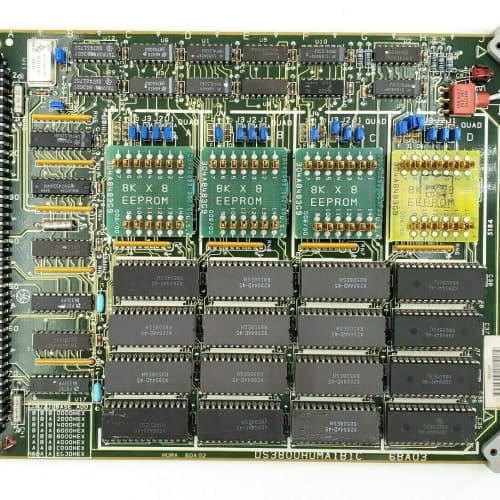
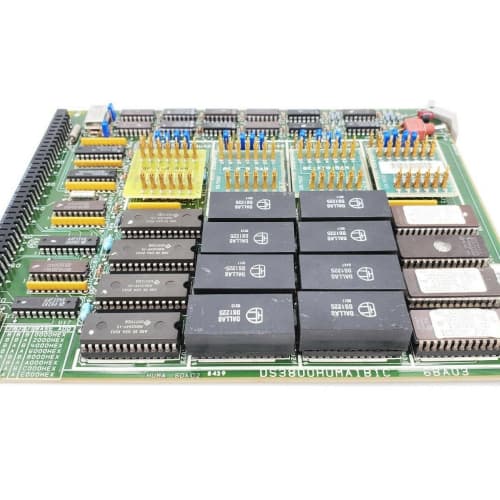
The DS3800NFCD1G1H is the long-haul workhorse of the Mark IV fiber optic family—a board designed to connect turbine control cabinets across large power plants, combined cycle facilities, and industrial campuses. The suffix tells the story: the first “1” indicates a hardware revision with improved receiver sensitivity. The “G” specifies 1300nm long-wave transceivers—a significant upgrade from the standard 850nm short-wave units—giving you extended reach over standard multimode fiber. The second “1” adds enhanced diagnostic capabilities (optical power monitoring, link quality reporting, and error logging). The final “H” is the environmental package: conformal coating with humidity-resistant components. This board is for installations where the distance between Mark IV cabinets exceeds 2km—or where the standard 850nm link won’t work due to fiber quality or connector losses.
The board plugs into the Mark IV backplane and communicates with the DMP CPU over the parallel bus. The 1300nm transceivers operate at 2Mbps (the Mark IV bus limit) and support fiber runs up to 5km on 62.5/125µm multimode fiber. Compare this to the standard DS3800NFCD (850nm, 2km range, basic diagnostics, no coating). The 1G1H gives you more than double the reach, better diagnostics, and environmental protection. If you’re running links across a large plant site, this is the board that saves you from installing repeaters or changing to single-mode fiber.
Key Technical Specifications
| Parameter | Value |
|---|---|
| Interface Type | Fiber optic (dual-channel, multimode, long-wave) |
| Connector | ST (straight tip) duplex |
| Data Rate | 2Mbps (proprietary GE protocol) |
| Fiber Type | 62.5/125µm multimode (recommended) |
| Wavelength | 1300nm (long-wave, LED-based) |
| Maximum Cable Length | 5km (with 1dB/km loss budget) |
| Optical Power Budget | 18dB (versus 12dB on standard NFCD) |
| Receiver Sensitivity | -28dBm (versus -22dBm on standard NFCD) |
| Electrical Isolation | 2,500V DC (optical) |
| Diagnostic Features | Optical power monitoring, link quality reporting, error logging, self-test |
| Protocol | GE proprietary serial link with enhanced error checking |
| Backplane Interface | Parallel, Mark IV-specific |
| CPU Compatibility | DS3800DMP series (Mark IV) — firmware v3.5 or later recommended |
| Diagnostic LEDs | Power, Link Status (A/B), Activity (A/B), Error (A/B), Optical Power Good, Self-Test Pass |
| Conformal Coating | Yes (acrylate-based, humidity-resistant) |
| Backplane Current Draw | +5V DC @ 1.0A, +12V DC @ 0.4A |
| Operating Temperature | -20°C to +65°C (extended range) |
| Dimensions | 328 mm x 185 mm x 20 mm (full-length Mark IV) |
| Mounting | Standard Mark IV rack slot |
| Configuration | No DIP switches—hardware address fixed |
Compatible Replacement Models
| Model | Compatibility Level | Notes |
|---|---|---|
| DS3800NFCD (base) | ⚠️ Software Compatible | Standard 850nm, 2km range, basic diagnostics, no coating. Hardware fits, but the range is shorter and diagnostic features are limited. If your link is under 2km and in a clean environment, this is a viable alternative. |
| DS3800NFCD1 | ⚠️ Software Compatible | Same as the 1G1H but without the long-wave transceivers (850nm, 2km). The diagnostic features and coating are the same. Use this if you don’t need the extended range. |
| DS3800NFCD1G | ⚠️ Software Compatible | Same 1300nm transceivers and range, but without conformal coating. If your environment is clean, this is a cost-effective alternative. |
| DS3800NFCD1G1 | ✅ Drop-in Replacement | Same board without the “H” coating. Functionally identical. The coating adds protection for harsh environments. |
| DS3800NFCD1G1H (this board) | ✅ Drop-in Replacement | No further compatibility notes. This is the board. |
| DS3800NECA | ❌ Functionally Incompatible | Ethernet board (coaxial). Different protocol and physical layer. Not a replacement for fiber optic links. |
| Third-party fiber converters | ❌ Hardware Incompatible | The Mark IV uses a proprietary protocol that third-party converters don’t support. Only use GE boards. |
Frequently Asked Questions (FAQ)
What’s the difference between 850nm and 1300nm on the NFCD?
The standard NFCD uses 850nm short-wave transceivers with a 12dB optical power budget, giving you a practical range of about 2km on 62.5/125µm fiber. The 1G1H uses 1300nm long-wave transceivers with an 18dB power budget and -28dBm receiver sensitivity—that’s a 6dB improvement, which roughly translates to 3km of additional reach (assuming 1dB/km fiber loss). The 1300nm wavelength also has lower attenuation in standard multimode fiber at the 2Mbps data rate. The practical result: you can run links up to 5km without repeaters.
Can I use this board with single-mode fiber?
The 1G1H is designed for multimode fiber (62.5/125µm) with ST connectors. The transceivers are LED-based, not laser-based, and aren’t powerful enough to couple efficiently into single-mode fiber. You can use it with single-mode fiber in a pinch, but the link budget will be reduced—you’ll probably only get 2-3km instead of 5km. We recommend using the correct multimode fiber for optimal performance.
Do I need to upgrade my DMP firmware for this board?
The enhanced diagnostics (optical power monitoring, link quality reporting, error logging) require DMP firmware v3.5 or later. If you’re running an older firmware version (v3.0 or earlier), the board will still work as a standard fiber link, but the diagnostics won’t be available. The diagnostic feature is useful for preventive maintenance—it tells you when your optical power is dropping due to aging fiber or dirty connectors. We can provide the firmware EPROMs for the upgrade if needed.
What’s the diagnostic “Optical Power Good” LED?
The NFCD1G1H has an Optical Power Good LED for each channel. The board continuously monitors the received optical power and compares it to a threshold (-25dBm). If the power is above the threshold, the LED is green. If it drops below -25dBm, the LED turns red and the board logs an error. This is a proactive warning that your fiber link is degrading—it could be a dirty connector, a splice with higher loss, or the fiber is starting to degrade. We’ve seen plants use this to schedule fiber maintenance before the link fails completely, avoiding unplanned shutdowns. The threshold is fixed in hardware; you can’t adjust it.
Is the fiber link redundant?
The board has two channels (A and B), but they’re independent links to two different remote nodes. The Mark IV doesn’t automatically fail over from one channel to the other. If you need redundancy, you’d need two NFCD boards in separate CPU racks or a different architecture. The dual-channel design is for connecting to multiple remote nodes, not for redundancy.
What’s the protocol used on the fiber link?
The NFCD uses GE’s proprietary Mark IV serial link protocol—a synchronous, point-to-point protocol with CRC error checking. It’s not compatible with standard protocols like Profibus, Modbus, or Ethernet. If you need to connect to non-GE equipment, you’ll need a gateway or a different board. The NFCD is for GE-to-GE communication only.
Can I hot-swap this board?
No. Mark IV backplanes are not hot-swappable. Power down the cabinet, lock out the breaker, and wait 60 seconds before removing or installing the board.
What’s the most common failure mode on the NFCD1G1H?
We’ve serviced about a dozen of these boards over the past five years. The most common failure is the 1300nm LED transceiver—it can degrade over time, especially if it’s run at high temperatures. The symptom is reduced optical power output, which shows up as the Optical Power Good LED turning red or the link dropping intermittently. We replace the transceiver module (it’s a standard ST plug-in component). The second most common failure is the edge connector—corrosion from humidity. We clean it with a fiberglass brush and isopropyl alcohol. The board is repairable.
What’s your warranty and lead time?
We stock the NFCD1G1H in limited quantities. Lead time is 2-3 business days. We offer a 1-year warranty on functional defects. We test every board with a 24-hour burn-in, a fiber optic loopback test (with a spool of 5km fiber), and a diagnostic verification (optical power monitoring, link quality reporting). The test report is included.
Can I use this board with the DS3800NFCD in the same system?
Yes, as long as the remote nodes are configured correctly. The 1G1H can communicate with standard NFCD boards—the protocol is the same. The 1G1H’s longer range only matters if the fiber distance exceeds 2km. If both ends have 1G1H boards, you can achieve the full 5km range. If one end is a standard NFCD, you’re limited to the standard board’s range (about 2km). The diagnostic features on the 1G1H work even if the remote end is a standard board—they monitor the receive side only.
REXROTH MAC093A-0-WS-2-C/110-A-0/S005
HIMA F8650X
ABB PFTL101A/3BSE004172R1
 Email: sales@plcfcs.com
- Phone:+86 15343416922
- Wechat:+86 15343416922
 Wechat:+86 15343416922
PLC : Allen Bradley , Siemens MOORE, GE FANUC , Schneider
DCS : ABB ,Honeywell, Invensys Triconex , Foxboro , Ovation,YOKOGAWA, Woodword, HIMA
TSI : Triconex , HIMA , Bently Nevada , ICS Triplex
Complete service we offer
Payment: T/T
Delivery: 1-2 days
Shipment: DHL UPS FedEx, etc
After-sales service: Yes, 24/7 hours