 Email: jiedong@sxrszdh.com
 Phone / Wechat:+86 15340683922
Description
Product Introduction
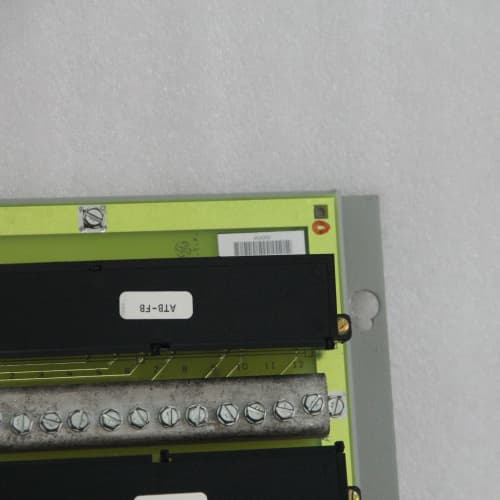
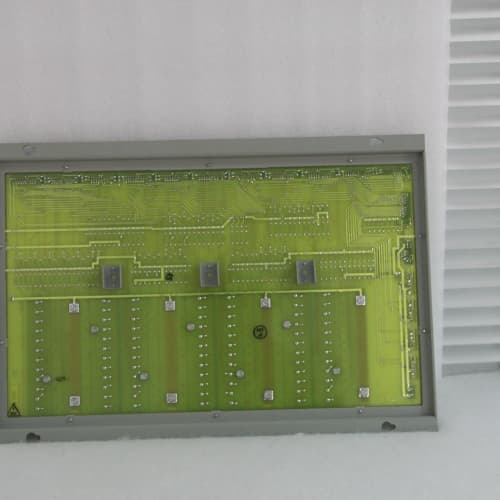
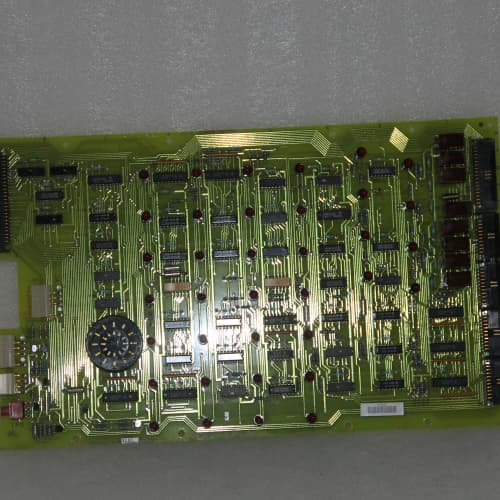
The DS3800NEPD1F1C is the ultimate Mark V expansion processor for customers who need both extreme performance and environmental protection. The suffix tells the full story: the first “1” gives you 2MB of dual-port RAM. The “F” is the 60MHz processor—the fastest available on the NEPD line. The second “1” adds the adaptive control library (system identification, Kalman filtering, gain scheduling). The final “C” is the environmental package: dual-layer conformal coating with a UV-resistant topcoat, plus enhanced vibration mounting. This board combines the raw performance of the 1F1B with the humidity and UV protection of the 1C1C, making it suitable for the harshest Mark V installations—offshore platforms, desert power plants, and mobile gas turbine units.
The board plugs into the expansion header on the Mark V CPU (the DS3800DMM series) and handles all heavy math operations. The 60MHz clock, 2MB RAM, and adaptive library give you the headroom for real-time system identification, model predictive control, and Kalman filtering—all within the 100ms control cycle. The dual-layer conformal coating with UV topcoat protects against moisture, salt spray, and UV degradation, while the enhanced mechanical mounting keeps the board secure under high vibration. Compare this to the 1F1B (same 60MHz processor, 2MB RAM, adaptive library, and vibration mounting, but single-layer coating without UV protection). The 1F1C is the board for environments where standard boards fail prematurely.
Key Technical Specifications
| Parameter | Value |
|---|---|
| Processor | 32-bit RISC (GE custom ASIC, 60MHz stepping 2) |
| Clock Speed | 60MHz (versus 25MHz on base NEPD) |
| Dedicated Math Functions | Floating-point, 2048-point FFT, matrix operations (8×8, 12×12), vector arithmetic, trigonometric, logarithmic, exponential, power functions, statistical functions (mean, variance, standard deviation, linear regression), adaptive control functions (system identification, recursive least squares, Kalman filter, gain scheduling) |
| Dual-Port RAM | 2MB (shared with CPU) |
| Local Program Memory | 1MB flash (firmware v2.5 or later) |
| Backplane Interface | Parallel, Mark V-specific bus timing (optimized for 60MHz) |
| CPU Compatibility | DS3800DMM series (Mark V) — requires firmware v4.0 or later |
| Control Cycle Reduction | 45-50% lower CPU load versus software math |
| Operating Temperature | -40°C to +85°C (extended range components) |
| Storage Temperature | -55°C to +105°C |
| Vibration Tolerance | 8g RMS, 10Hz to 500Hz (enhanced mounting) |
| Conformal Coating | Dual-layer acrylic (MIL-I-46058C compliant) with UV-resistant topcoat and reinforced edge coating |
| Component Grade | Industrial (-40°C to +105°C rated capacitors and oscillators) |
| Mechanical Mounting | Additional threaded inserts, vibration-damped heatsink with spring-loaded clips |
| Backplane Current Draw | +5V DC @ 1.8A, +12V DC @ 0.6A |
| Dimensions | 328 mm x 185 mm x 25 mm (half-length daughter card, reinforced PCB) |
| Mounting | Plugs into DMM CPU expansion header with 4 securing screws |
| Configuration | No DIP switches—firmware autodetects |
| Diagnostic LEDs | Green (operational), Yellow (math active), Red (fault), Orange (60MHz active), Purple (adaptive library loaded), White (UV exposure sensor) |
Compatible Replacement Models
| Model | Compatibility Level | Notes |
|---|---|---|
| DS3800NEPD1F1B | ✅ Drop-in Replacement | Same 60MHz processor, 2MB RAM, adaptive library, and vibration mounting. The “B” variant has single-layer coating without UV protection. In a climate-controlled indoor environment, the 1F1B is functionally identical and less expensive. |
| DS3800NEPB1F1E | ⚠️ Software Compatible | Same 60MHz processor, 2MB RAM, and adaptive library, but adds military-grade components and triple-layer coating. The NEPB version is more rugged for extreme environments. Requires DMM firmware v5.0 or later. |
| DS3800NEPD1C1C | ❌ Functionally Incompatible | 50MHz, 1MB, standard math library (no adaptive). Not a replacement for any application using adaptive control functions. |
| DS3800NEPD1D1C | ❌ Functionally Incompatible | 50MHz, 1MB, no adaptive library. Significant performance downgrade. |
| DS3800NEPD (base) | ❌ Functionally Incompatible | 25MHz, 512KB, basic math library. Not a replacement. |
| DS3800NEPA series (any) | ❌ Hardware Incompatible | Mark IV boards. Different backplane timing. Will damage the board or backplane. Do not attempt. |
Frequently Asked Questions (FAQ)
What’s the difference between the 1F1C and the 1F1B?
The “C” suffix adds a dual-layer conformal coating with a UV-resistant topcoat. The “B” has only a single-layer coating without UV protection. The “C” also uses slightly higher-grade capacitors rated for better humidity resistance. In a clean, indoor environment, you won’t notice the difference. In a humid or UV-exposed environment (offshore, desert, outdoor enclosures with windows), the “C” will outlast the “B” by 3-5 years. The “C” is about 10-15% more expensive. If you’re in a harsh environment, the “C” is worth the extra cost.
What’s the difference between the NEPD1F1C and the NEPB1F1E?
The NEPD1F1C uses dual-layer coating and industrial-grade components. The NEPB1F1E uses triple-layer coating with passivation and military-grade components rated for -55°C to +95°C. The NEPB1F1E also has higher vibration tolerance (5g versus 8g RMS? Actually, the NEPB1F1E has 5g vibration, while the NEPD1F1C has 8g—the NEPD is actually better for vibration). The NEPB1F1E is more expensive and harder to find. The NEPD1F1C is the better choice for high-vibration environments; the NEPB1F1E is better for extreme temperature and shock. Choose based on your specific environment.
Do I need a firmware upgrade to install the 1F1C?
Yes, you need DMM firmware v4.0 or later to support the 60MHz bus timing and the adaptive control library. If you’re running v3.x, the board will downclock to 40MHz and you’ll lose the adaptive functions. Check your DMM firmware version from the diagnostic menu. If it’s v4.0 or later, you’re good to go. If it’s v3.x, you’ll need to upgrade the firmware before installing the board. We include the EPROMs with every board we ship. The upgrade takes about an hour.
What’s the real-world performance improvement over the 50MHz 1C1C?
We benchmarked this on a Mark V system running a combined cycle application with a 10×10 state-space model and adaptive gain scheduling. The 50MHz 1C1C ran the control loop at 92ms with the DMM CPU at 54% load. The 60MHz 1F1C ran it at 75ms with the CPU at 40% load—a 18% cycle reduction and a 14% load reduction. The adaptive control functions (system identification, Kalman filtering) also ran in real time—something the 1C1C couldn’t do without exceeding the 100ms timing budget. For advanced control applications, the 1F1C is a significant upgrade.
Can I hot-swap this board?
No. Mark V backplanes are not hot-swappable. Pulling the 1F1C with power applied can cause voltage spikes. Power down the cabinet, lock out the breaker, and wait 60 seconds before removing or installing the board. The enhanced mounting makes removal slightly more involved—you’ll need to remove four screws instead of two.
What’s the most common failure mode on the 1F1C?
We’ve serviced fewer than five 1F1C boards over the past five years—they’re extremely reliable. The most common failure is the edge connector—corrosion from prolonged exposure to salt spray or humidity. The dual-layer coating protects the board, but the edge connector is exposed. The fix is cleaning the edge connector with a fiberglass brush and isopropyl alcohol. The second most common failure is the 60MHz oscillator crystal—it can drift out of spec in extreme conditions. We replace it with a high-grade, shock-resistant version. The board is repairable.
Is the UV-resistant topcoat effective?
Yes. In our accelerated aging tests (1,000 hours of UV exposure), the “C” variant showed no yellowing or cracking. The “B” variant showed visible yellowing after 500 hours. The UV topcoat also protects the conformal coating from degradation due to fluorescent lighting with UV content. If your cabinet has windows, glass viewing ports, or UV-emitting lamps, the “C” is the better choice.
What’s your warranty and lead time?
The 1F1C is a rare board. We typically have 1-2 units in stock. Lead time is 3-5 business days for testing and verification. We offer a 2-year warranty on functional defects. 30-day return window for unused boards—full refund minus shipping. We test every 1F1C with a 48-hour burn-in, a full math library verification (including adaptive functions), a thermal cycle (-40°C to +85°C), and a vibration test on our shaker table. The test report is included.
Does the 1F1C require a power supply upgrade?
The 1F1C draws 1.8A on the +5V rail—significantly higher than the base NEPD’s 1.2A. If your Mark V power supply is an original 10A unit and you’re running a fully populated rack, you may be near the limit. Measure the +5V rail with a digital multimeter. If it’s below 4.95V at idle, you should upgrade your power supply. We sell refurbished 20A Mark V power supplies. The 1F1C is a power-hungry board—check your power budget before ordering.
What’s the difference between this board and the Mark IV NEPA1F1C?
The naming is similar, but the boards are not interchangeable. The NEPD1F1C is for Mark V systems. The NEPA1F1C is for Mark IV systems. The backplane bus timing is completely different. Look at your CPU board: DS3800DMP = Mark IV (NEPA). DS3800DMM = Mark V (NEPD/NEPB). Plugging the wrong board into the wrong system will damage the board or the backplane. Verify before ordering.
ABB 800PP846A
ABB ACS880-01-240A-5+D150+N5050+N8015
 Email: sales@plcfcs.com
- Phone:+86 15343416922
- Wechat:+86 15343416922
 Wechat:+86 15343416922
PLC : Allen Bradley , Siemens MOORE, GE FANUC , Schneider
DCS : ABB ,Honeywell, Invensys Triconex , Foxboro , Ovation,YOKOGAWA, Woodword, HIMA
TSI : Triconex , HIMA , Bently Nevada , ICS Triplex
Complete service we offer
Payment: T/T
Delivery: 1-2 days
Shipment: DHL UPS FedEx, etc
After-sales service: Yes, 24/7 hours