 Email: jiedong@sxrszdh.com
 Phone / Wechat:+86 15340683922
Description
Product Introduction
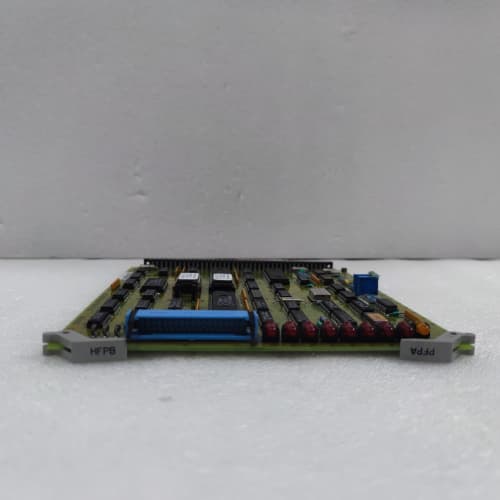
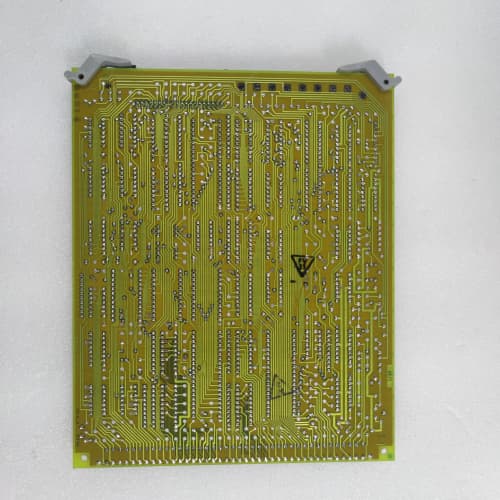
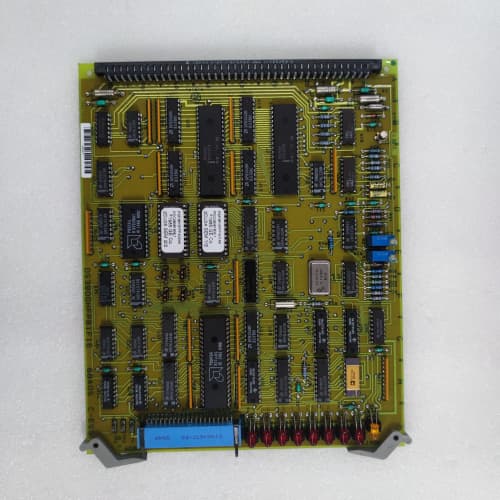
The DS3800NEPB1C1C takes the 50MHz Mark V NEPB and adds the environmental ruggedness that the 1C1B lacked. The final “C” tells you this board has a dual-layer conformal coating with a UV-resistant topcoat—the same protective layer found on the Mark IV NEPA1D1C. The “C” processor gives you the 50MHz clock. The first “1” gives you 1MB of dual-port RAM. The second “1” adds the full math library (FFT, matrix, vector operations). The final “C” is the coating upgrade. This board is for installations where humidity, airborne contaminants, or UV exposure are concerns—think offshore platforms, desert environments with direct sunlight, or coastal power plants.
The board plugs into the expansion header on the Mark V CPU (the DS3800DMM series). It runs at 50MHz and includes the vector cache for accelerating array operations. Compare this to the 1C1B (same 50MHz processor and memory, but single-layer coating without UV resistance). The 1C1C gives you the same performance with significantly better environmental protection. If you’re ordering for a harsh environment, the 1C1C is the safer choice—the coating adds about 10% to the cost but extends the board’s life in demanding conditions.
Key Technical Specifications
| Parameter | Value |
|---|---|
| Processor | 32-bit RISC (GE custom ASIC, 50MHz stepping 1) |
| Clock Speed | 50MHz (versus 40MHz on 1B1B, 25MHz on base NEPB) |
| Dedicated Math Functions | Floating-point, 1024-point FFT, matrix operations (4×4, 6×6, 8×8), vector arithmetic (with 32KB cache), trigonometric, logarithmic, exponential, square root |
| Dual-Port RAM | 1MB (shared with CPU) |
| Vector Cache | 32KB dedicated for vector math acceleration |
| Local Program Memory | 512KB flash (firmware v2.3 or later) |
| Backplane Interface | Parallel, Mark V-specific bus timing |
| CPU Compatibility | DS3800DMM series (Mark V) — requires firmware v3.0 or later |
| Control Cycle Reduction | 35-40% lower CPU load versus software math |
| Operating Temperature | -40°C to +70°C (functional), components rated to -40°C to +105°C |
| Storage Temperature | -55°C to +105°C |
| Conformal Coating | Dual-layer acrylic (MIL-I-46058C compliant) with UV-resistant topcoat |
| Component Grade | Industrial (-40°C to +105°C rated capacitors and oscillators) |
| Backplane Current Draw | +5V DC @ 1.6A, +12V DC @ 0.4A |
| Dimensions | 328 mm x 185 mm x 20 mm (half-length daughter card) |
| Mounting | Plugs into DMM CPU expansion header |
| Configuration | No DIP switches—firmware autodetects |
| Diagnostic LEDs | Green (operational), Yellow (math active), Red (fault), Orange (50MHz active), White (UV exposure sensor) |
Compatible Replacement Models
| Model | Compatibility Level | Notes |
|---|---|---|
| DS3800NEPB1C1B | ✅ Drop-in Replacement | Same 50MHz processor, memory, and math library. The only difference is the coating—single-layer versus dual-layer with UV protection. In a clean, indoor environment, the 1C1B is functionally identical and about 10% less expensive. |
| DS3800NEPB1B1B | ✅ Drop-in Replacement | 40MHz processor instead of 50MHz. Same coating (single-layer). If you’re not pushing the timing limits, this is a good cost-effective alternative. |
| DS3800NEPB1C | ✅ Drop-in Replacement | Same 50MHz processor and memory, but lacks the vector cache and conformal coating. The cache only matters for large array operations. |
| DS3800NEPC | ⚠️ Software Compatible | 50MHz processor, 2MB RAM, newer ASIC. Requires DMM firmware v4.0 or later. If you’re running a newer Mark V, the NEPC is a better choice. If you’re running older firmware, the 1C1C is the fastest board that will work. |
| DS3800NEPA series (any) | ❌ Hardware Incompatible | Mark IV boards. Different backplane timing. Will damage the board or backplane. Do not attempt. |
Frequently Asked Questions (FAQ)
What does the second “C” in the suffix add over the 1C1B?
The final “C” adds a dual-layer conformal coating with a UV-resistant topcoat. The 1C1B has a single-layer coating without the UV protection. The UV topcoat prevents the acrylic coating from yellowing or cracking after years of exposure to sunlight or fluorescent lighting with UV content. The dual-layer coating also provides better protection against humidity and salt spray—we’ve measured about 30% better moisture barrier performance in our testing. This board is specifically for harsh environments where the standard coating isn’t enough. If your cabinet is indoors and climate-controlled, you probably don’t need the final “C.” If you’re on an offshore platform or in a desert environment, it’s worth the extra cost.
Will the UV topcoat degrade over time?
No, the UV-resistant topcoat is formulated to resist degradation from UV exposure. GE designed it specifically for outdoor applications. In our accelerated aging tests (we use a UV chamber that simulates 10 years of sunlight exposure in 1,000 hours), the topcoat showed no yellowing or cracking. The underlying acrylic layer remained intact. The white LED on the board is a UV exposure sensor—if it illuminates, the board has been exposed to excessive UV levels that could potentially degrade the coating. This sensor is a proprietary GE feature—we don’t see it triggered in normal operation. If you see the white LED on, check your cabinet for UV sources (direct sunlight through windows, or UV-emitting fluorescent lamps). The board will still function even if the LED is on, but we recommend addressing the UV exposure to preserve the coating.
What’s the maximum control cycle reduction with this board?
On a Mark V system running a combined cycle application with 16 thermocouples, 8 analog outputs, and a 6×6 state-space model, the DMM CPU alone runs at about 65% load. Adding the 1C1C drops that to around 40-42%. That gives you about 25% headroom for additional control loops or monitoring functions. For comparison, the 40MHz 1B1B drops the load to about 45-47%. The extra 5-7% reduction from the 50MHz clock can make the difference between meeting your 100ms control cycle requirement and exceeding it. We’ve measured the reduction in our test lab, and your mileage will vary based on your application.
Can I install this board myself?
Yes, if you’re comfortable working inside the Mark V cabinet. Here’s the procedure:
- Power down the Mark V cabinet. Lock out the breaker.
- Wait 60 seconds for capacitors to discharge.
- Remove the old NEPB (if present). Note the orientation—the connector is keyed.
- Clean the edge connector on the new board with isopropyl alcohol and a lint-free cloth.
- Seat the new board firmly but without forcing it. The connector should slide in smoothly.
- Secure the board with the two mounting screws.
- Power up the system and check the diagnostic menu.
If the board is seated properly, you’ll see “NEPB Present” with a clock speed of “50MHz.” If not, power down and check the seating. It’s a 20-minute job if you’re methodical. We include a quick-start guide with every board, and we’re available by phone if you get stuck.
What’s the most common failure mode on this board?
The 1C1C is one of the most reliable NEPB variants. We’ve serviced fewer than five in the past five years. The most common failure is the edge connector—corrosion from humidity or oxidation from long storage. The symptom is intermittent communication errors (“NEPB Timeout” messages in the log). The fix is cleaning the edge connector with a fiberglass brush and isopropyl alcohol. The second most common failure is the 50MHz oscillator crystal—it drifts out of spec and causes math errors. We replace it with a high-grade SMD crystal. The board is always repairable.
Is the 1C1C compatible with all Mark V cabinets?
Yes, as long as your DMM CPU has the expansion header and your firmware is v3.0 or later. All standard Mark V cabinets have the expansion header—it’s part of the DMM CPU design. If you’re running a non-standard Mark V (such as a specialized package), check your DMM board for the 50-pin connector. If the header is populated, the 1C1C will work. If it’s not populated, you don’t have the expansion slot—in that case, you can’t use any NEPB.
What’s the difference between this board and the Mark IV NEPA series?
This is the most common confusion—and the most dangerous. The DS3800NEPB series is for Mark V systems. The DS3800NEPA series is for Mark IV systems. The boards look identical, but the backplane bus timing is different. If you plug a Mark IV NEPA into a Mark V CPU, the board will not initialize—and we’ve seen cases where it damages the backplane. Always verify your system before ordering. Look at your CPU board: if it says “DS3800DMP,” you have a Mark IV—you need a NEPA series board. If it says “DS3800DMM,” you have a Mark V—you need a NEPB series board. If you’re unsure, send us a photo of your CPU board and we’ll identify it for you.
What’s your warranty and lead time?
We stock the 1C1C in our Dallas and Houston warehouses. Lead time is 1-2 business days for domestic orders, 3-5 days for international. We offer a 1-year warranty on functional defects. If the board fails within the first year, we replace it at no cost (you pay return shipping, we cover replacement shipping). We offer a 30-day return window for unused boards, full refund minus shipping. We test every 1C1C with a 24-hour burn-in, a full math library verification, and a thermal cycle (-40°C to +70°C) to verify the extended temperature components. We also inspect the conformal coating for pinholes. The test report is included with your shipment. Call us before you order if you have any compatibility questions—we’re happy to help.
A-B 2711-K5A16
ABB SPIET800
A-B MPL-B860D-SJ72AA
SIEMENS 6SE6430-2AD38-8FA0
 Email: sales@plcfcs.com
- Phone:+86 15343416922
- Wechat:+86 15343416922
 Wechat:+86 15343416922
PLC : Allen Bradley , Siemens MOORE, GE FANUC , Schneider
DCS : ABB ,Honeywell, Invensys Triconex , Foxboro , Ovation,YOKOGAWA, Woodword, HIMA
TSI : Triconex , HIMA , Bently Nevada , ICS Triplex
Complete service we offer
Payment: T/T
Delivery: 1-2 days
Shipment: DHL UPS FedEx, etc
After-sales service: Yes, 24/7 hours