 Email: jiedong@sxrszdh.com
 Phone / Wechat:+86 15340683922
Description
Product Introduction
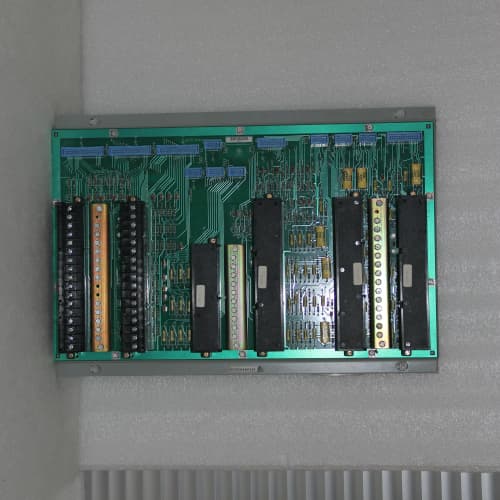
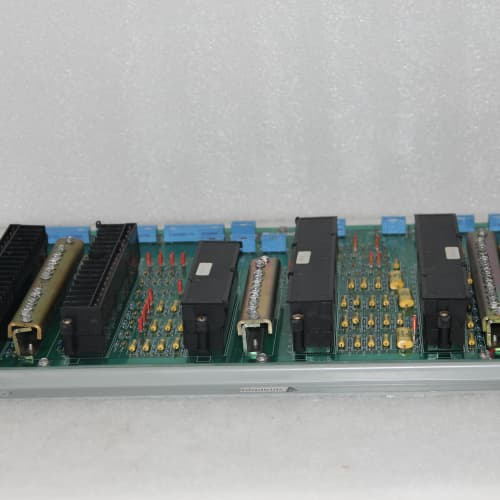
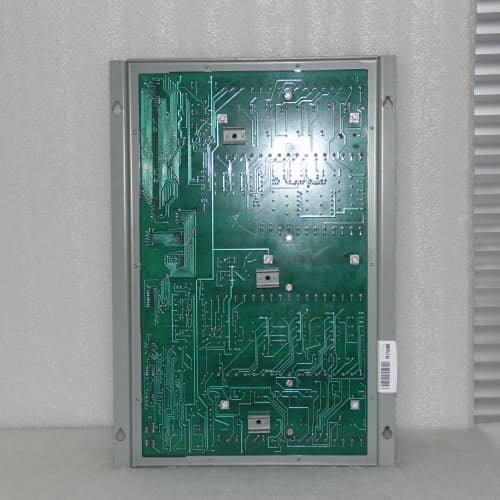
The DS3800HDDD1D1C is the inverse of the 1C1D—it swaps the fuse bank positions. This board has 2.5A fusing on Bank 1 (channels 1-8) and 1A fusing on Bank 2 (channels 9-16), combined with the locking spring-cage terminals (1D). The locking terminals are a significant upgrade over the standard spring-cage—they physically latch the wire in place, preventing pull-out under vibration. If your plant has high-vibration equipment (turbines, compressors, reciprocating engines), the 1D1C is the better choice over the 1C1D. The 1D locking mechanism reduces the risk of intermittent connections due to thermal cycling and mechanical stress.
We’ve installed this board in reciprocating compressor stations where the whole cabinet shakes at 300 RPM. The locking terminals on the 1D1C have eliminated the intermittent “missing output” events that plagued our previous standard terminal block installations. The mixed fusing gives you the flexibility to assign high-current loads (like motor contactors) to the 2.5A bank and low-current loads (like indicator lamps) to the 1A bank. The board’s 2.0A per channel output capacity remains constant—the fuses just limit the total bank current. The trade-off is slightly longer termination time due to the locking mechanism, but the reliability improvement is worth the extra minute per wire.
Key Technical Specifications
| Parameter | Value / Range |
|---|---|
| Model Suffix | 1D1C (factory termination and fusing config) |
| Discrete Output Channels | 16 (triac outputs) |
| Output Voltage Range | 100-132V AC (50/60Hz) |
| Output Current (Resistive) | 2.0A per channel (continuous) |
| Output Current (Inductive) | 1.0A per channel (continuous) |
| Peak Surge Current | 10A (for 1 cycle) |
| Isolation Voltage | 2500V AC (field-to-logic) |
| Terminal Block Type | Spring-cage with locking tab, pitch 5.08mm |
| Wire Gauge Capacity | 0.2mm² to 2.5mm² (24-14 AWG) |
| Field Supply Fusing | Bank 1: 2.5A slow-blow / Bank 2: 1A slow-blow |
| Logic Supply Voltage | 5 VDC (from backplane) |
| Backplane Current Draw (5V) | 1.5A (max) |
| Channel Status Indicators | Green LEDs per channel |
| Operating Temperature | 0°C to 55°C (derate above 45°C) |
Compatible Replacement Models
| Model | Compatibility Class | Notes & Caveats |
|---|---|---|
| DS3800HDDD1C1D | ⚠️ Software Compatible | Same high-current output capacity and locking terminals, but with swapped fuse banks (Bank 1: 1A, Bank 2: 2.5A). The 1D1C is the inverse configuration. Electronics identical. No software changes needed. |
| DS3800HDDD1D1D | ⚠️ Software Compatible | Locking terminals on both banks, but with 2.5A fusing on both banks. If you don’t need mixed fusing, the 1D1D is the alternative. |
| DS3800HDDD1A1A | ⚠️ Software Compatible | Same high-current output capacity, but with screw-clamp terminals and 0.5A fusing. The 1D1C is an upgrade for locking terminals and higher fuse ratings. No software changes needed. |
| DS3800HDDB1D1C | ⚠️ Software Compatible | 1.0A output version—not high-current. The HDDD is an upgrade for higher loads. |
| DS3800HDDD (no suffix) | ⚠️ Software Compatible | No factory fusing or termination. Not recommended for field use. |
| DS3800HDDD1D1C (same suffix) | ✅ Drop-in Replacement | Exact match on all hardware, firmware, and suffix. No adjustments required. |
| DS3800HDDA1D1C | ❌ Hardware Incompatible | Input board, not output. The HDDD is for outputs. |
Frequently Asked Questions (FAQ)
Q: What’s the difference between the 1D1C and the 1C1D?
A: The 1D1C has 2.5A fusing on Bank 1 (channels 1-8) and 1A fusing on Bank 2 (channels 9-16). The 1C1D has 1A on Bank 1 and 2.5A on Bank 2. Both have locking spring-cage terminals on both banks. The choice depends on which bank you want to have higher current capacity. If your high-current loads are on channels 1-8, use the 1D1C. If they’re on channels 9-16, use the 1C1D.
Q: How do the locking terminals work?
A: The locking terminal is a spring-cage with an additional plastic latch. After inserting the wire into the spring cage, you flip the latch down until it clicks. The latch presses against the wire insulation, preventing the wire from pulling out even if the spring tension loosens due to vibration or thermal cycling. To release the wire, lift the latch with a small screwdriver, then press the spring release. The locking mechanism is a simple but effective solution for high-vibration environments.
Q: Can I use the 2.5A bank for a 2.0A load on every channel?
A: No. The 2.5A fuse limits the total current on that bank. If you have four 2.0A loads on the 2.5A bank, the total current is 8A—the fuse will blow. The bank’s total current must be under 2.5A. In practice, you won’t run all channels at full load simultaneously. If you need to drive multiple 2.0A loads, consider using external per-channel fuses and a higher-capacity field supply.
Q: The 1D1C has locking terminals. Does that make termination slower than the 1C1C?
A: Yes, slightly. The locking tab adds an extra step—you need to push the wire in, then flip the latch down. It adds about 5-10 seconds per channel compared to standard spring-cage. For a 16-channel board, that’s about 1-2 minutes extra total. The reliability improvement in high-vibration environments justifies the extra time. If your cabinet is in a stable environment, the 1C1C might be sufficient.
Q: Can I replace an HDDB1D1C with an HDDD1D1C without changing the wiring?
A: Yes. The terminal block layout and pin assignments are identical. The HDDD has the same physical footprint and wiring positions as the HDDB—the only difference is the output capacity and the heatsink. If your HDDB wiring harness is already terminated, you can swap it directly. The Mark V will see the same channel numbers. No software changes are required.
Q: Does the 1D1C have conformal coating?
A: Not by default. The 1D suffix indicates locking terminals, and the 1C suffix indicates the fuse rating. Conformal coating is a separate option—typically indicated by a “G” suffix. If you need conformal coating, look for the 1G variant (e.g., DS3800HDDD1G1G). The 1D1C is not coated, so it’s suitable for standard indoor environments. If you’re in a harsh environment, consider a coated variant.
Q: The 1D1C has a 1.5A backplane current draw. Will that affect my power supply?
A: Yes, the HDDD1D1C draws 1.5A from the 5V backplane, which is higher than the HDDB’s 1.2A. The Mark V power supply is typically rated at 6A on the 5V rail. If your rack already has multiple high-current boards, adding an HDDD could exceed the supply limit. Check your total backplane current before adding an HDDD. If you’re near the limit, consider using a higher-capacity power supply or redistributing boards across racks.
GE DS200STBAG1A
GE DS200STCAG1A
GE DS200STCAP1AAB
 Email: sales@plcfcs.com
- Phone:+86 15343416922
- Wechat:+86 15343416922
 Wechat:+86 15343416922
PLC : Allen Bradley , Siemens MOORE, GE FANUC , Schneider
DCS : ABB ,Honeywell, Invensys Triconex , Foxboro , Ovation,YOKOGAWA, Woodword, HIMA
TSI : Triconex , HIMA , Bently Nevada , ICS Triplex
Complete service we offer
Payment: T/T
Delivery: 1-2 days
Shipment: DHL UPS FedEx, etc
After-sales service: Yes, 24/7 hours