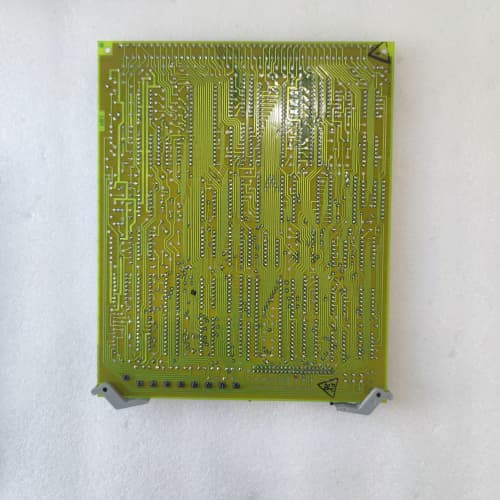
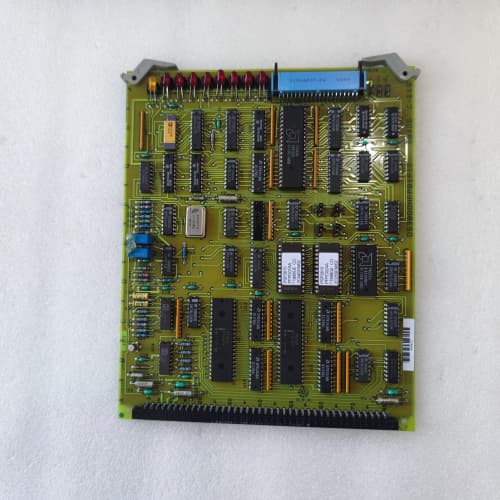
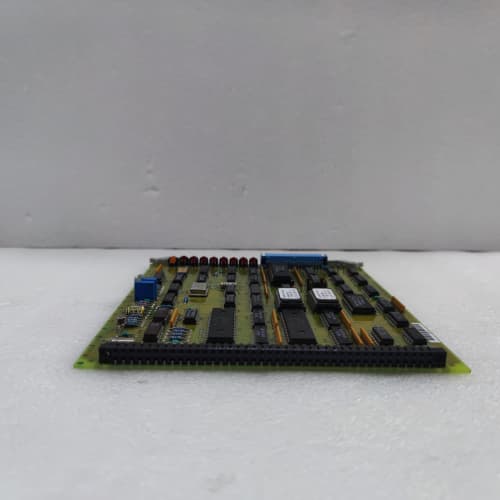
 Email: jiedong@sxrszdh.com
 Phone / Wechat:+86 15340683922
Description
Product Introduction
The HCVA1C1F variant combines the basic vibration monitoring functionality with two practical field upgrades: spring-cage terminals for faster wiring and 1A fusing for better inrush protection on sensor power circuits. The “1C” termination means you’re using the spring-cage system we’ve already covered on other boards—push-in, tool-free (unless you need to release), and quicker than screw-clamp. The “1F” fusing, at 1A on the field supply, is a useful upgrade over the 0.5A fuses found on the base HCVA.
The 1A fuses provide better protection for the internal sensor excitation circuits, which can draw up to 4mA per channel (IEPE accelerometer current source). At 8 channels, that’s 32mA—well under 1A. However, if you’re also using the board’s proximity probe bias supply, that can add another 20mA. The 1A rating gives you plenty of margin for inrush on power-up. We’ve seen 0.5A fuses blow on boards with multiple accelerometers that have high inrush currents. The 1A upgrade typically eliminates those nuisance trips. The “1C1F” suffix also indicates that the board is configured with the same spring-cage terminals and fusing across both banks.
Key Technical Specifications
| Parameter | Value / Range |
|---|---|
| Model Suffix | 1C1F (factory termination and fusing config) |
| Vibration Input Channels | 8 (single-ended or differential, configurable) |
| Input Types Supported | Accelerometer (IEPE), Proximity Probe (eddy current) |
| Input Voltage Range | -24V to +24V (with input protection) |
| Terminal Block Type | Spring-cage (push-in), pitch 5.08mm |
| Wire Gauge Capacity | 0.2mm² to 2.5mm² (24-14 AWG) |
| Field Supply Fusing | 1A slow-blow (field supply rail) |
| Sensor Power (IEPE) | 4mA constant current at 24V |
| Proximity Probe Bias | -24V DC (programmable) |
| Resolution | 12-bit (4096 counts) |
| Amplitude Accuracy | ±2% of full scale (typical) |
| Frequency Response | 5Hz to 5kHz (standard) |
| Update Rate (All Channels) | 20ms (typical) |
| Logic Supply Voltage | 5 VDC (from backplane) |
| Operating Temperature | 0°C to 55°C (derate above 45°C) |
Compatible Replacement Models
| Model | Compatibility Class | Notes & Caveats |
|---|---|---|
| DS3800HCVA1B1E | ⚠️ Software Compatible | Same vibration electronics, but 0.8A fusing. The 1C1F is a direct upgrade with slightly higher fuse rating. No software changes needed. |
| DS3800HCVA1A1E | ⚠️ Software Compatible | Screw-clamp terminals with 0.8A fusing. Swapping to 1C1F requires re-termination. Spring-cage and screw-clamp don’t mix—you’ll need to adapt your harness. |
| DS3800HCVA (no suffix) | ⚠️ Software Compatible | No factory fusing or termination. Not recommended for field use. |
| DS3800HCVA1C1F (same suffix) | ✅ Drop-in Replacement | Exact match on all hardware, firmware, and suffix. No adjustments required. |
| DS3800HCVB1C1F | ❌ Hardware Incompatible | Upgraded vibration board with different backplane addressing and data format. Requires software changes and is not a direct drop-in. |
| DS3800HCMA1C1F | ❌ Hardware Incompatible | Standard analog input board. Lacks the signal conditioning needed for vibration sensors—no constant current source or proximity probe bias. |
Frequently Asked Questions (FAQ)
Q: The 1C1F has 1A fuses. Is that enough for my vibration sensors?
A: Yes, and then some. Your sensors draw only a few milliamps each. The 1A rating is about protecting the board from a fault in the sensor power circuit, not about supplying current. If a sensor shorts out, the 1A fuse will clear before the board’s power supply is damaged. The 0.5A fuses on earlier variants were marginal for some sensors with high inrush; the 1A gives you a wider margin.
Q: How do I know if my sensor requires the IEPE constant current supplied by the HCVA1C1F?
A: Most modern accelerometers are IEPE type (also called ICP). They have a built-in amplifier that requires a constant current source (typically 2-10mA at 18-30V). The HCVA1C1F provides 4mA at 24V, which is compatible with most IEPE sensors. If you’re unsure, check your accelerometer’s data sheet—it will specify the current requirement. Some older sensors use charge-mode output and require a charge amplifier; the HCVA1C1F does not support them directly.
Q: Can I use the HCVA1C1F with a proximity probe that requires -24V bias?
A: Yes. The board has a programmable bias supply that can be configured to provide -24V for eddy current probes. The bias is set via the Mark V configuration tool, not by jumpers on the board. Check your probe’s data sheet for the correct bias voltage—most Bently Nevada probes use -24V, but some older probes require -18V. The HCVA1C1F supports both.
Q: The spring-cage terminals on the 1C1F require ferrules for stranded wire. Is that mandatory?
A: We’ve given this advice on other boards, and it’s the same here: ferrules are strongly recommended. Stranded wire under spring pressure can splay, causing intermittent connections, especially with vibration sensors where signal integrity is critical. If your sensor wiring is solid core, you’re fine. If stranded, use ferrules. Also, the terminal release requires a small screwdriver—keep one in your toolkit.
Q: What’s the update rate on the HCVA1C1F? Can I use it for real-time vibration control?
A: The update rate is 20ms—fast enough for trend monitoring and alarm generation, but not fast enough for active vibration control. The HCVA is designed for protection (alarm/trip) and data logging, not for closed-loop control. If you need active vibration control (e.g., active magnetic bearings), you’d need a separate high-speed system. The HCVA’s 20ms update is standard for turbine protection; it’s not a limitation for its intended purpose.
Q: How do I configure the HCVA1C1F for accelerometer versus proximity probe inputs?
A: The configuration is done in the Mark V software. Each channel can be independently set for IEPE or proximity probe input. The software also sets the measurement range (e.g., 0-100µm or 0-10mm/s). There are no physical jumpers on the HCVA for this—it’s entirely software-configurable. If you’re swapping an older HCVA with physical jumpers, you’ll need to update the Mark V configuration to match the new board’s settings. This typically takes 30-60 minutes if you have the configuration tool.
Q: The HCVA1C1F has a 5kHz frequency response. What does that mean for turbine monitoring?
A: A 5kHz frequency response means the board can detect vibrations up to 5kHz. For a standard 60Hz turbine, this covers up to the 80th harmonic—far more than needed for shaft vibration. For gearboxes, this is marginal if you’re monitoring high-speed gears (e.g., 10kHz range). If you have a high-speed turbine with gearbox, you’ll need a separate vibration analysis system. The HCVA1C1F is for protection, not detailed analysis. If you’re monitoring bearing vibrations on a 60Hz turbine, it’s sufficient.
GE DS200SDCCF1AEB
GE DS200SDCCF1AIA
GE DS200SDCCF1AJC
 Email: sales@plcfcs.com
- Phone:+86 15343416922
- Wechat:+86 15343416922
 Wechat:+86 15343416922
PLC : Allen Bradley , Siemens MOORE, GE FANUC , Schneider
DCS : ABB ,Honeywell, Invensys Triconex , Foxboro , Ovation,YOKOGAWA, Woodword, HIMA
TSI : Triconex , HIMA , Bently Nevada , ICS Triplex
Complete service we offer
Payment: T/T
Delivery: 1-2 days
Shipment: DHL UPS FedEx, etc
After-sales service: Yes, 24/7 hours