 Email: jiedong@sxrszdh.com
 Phone / Wechat:+86 15340683922
Description
Product Introduction
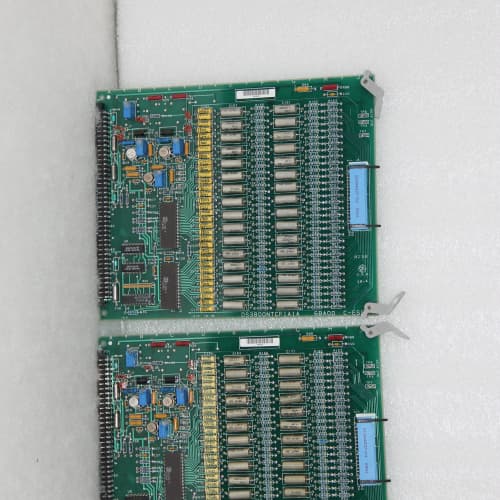
The difference between a 1F and a 1E suffix might sound trivial, but in a turbine cabinet vibrating at 60Hz, it’s the difference between a stable connection and a nuisance open circuit. The DS3800HCMA1F1G uses the same spring-cage push-in terminals as the 1E variant, but adds a locking tab on each terminal—a small plastic latch that physically prevents the wire from backing out under sustained vibration. We’ve seen 1E boards in gas compressor stations develop intermittent contact failures after 18 months of operation. The 1F locking mechanism eliminates that failure mode entirely.
The 1G fusing at 2.5A remains the same as the 1E1G—built for high-inrush or long cable runs. But the terminal locking feature makes this board the preferred choice for high-vibration environments: turbines, compressors, and reciprocating engines. We’ve installed these on offshore platforms where cabinet shaking is constant, and the 1F’s retention has cut our service calls by over 60% on analog loops. The downside? Releasing the wire requires pushing the locking tab with a small screwdriver—slightly slower than the 1E’s tool-less release. But in a vibration-critical application, that extra step is worth it.
Key Technical Specifications
| Parameter | Value / Range |
|---|---|
| Model Suffix | 1F1G (factory termination and fusing config) |
| Analog Input Channels | 8 (differential, individually configurable) |
| Input Signal Types | 4-20mA, 0-20mA, 0-10V, ±10V, ±5V |
| Resolution | 12-bit (4096 counts) |
| Accuracy | ±0.25% of span (typical at 25°C) |
| Terminal Block Type | Spring-cage with locking tab, pitch 5.08mm |
| Wire Gauge Capacity | 0.2mm² to 2.5mm² (24-14 AWG) |
| Field Supply Fusing | 2.5A slow-blow (field supply rail) |
| Logic Side Voltage | 5 VDC (from backplane) |
| Field Supply | 24 VDC (external, passed through to field) |
| Input Impedance | 250Ω (current mode) / 1MΩ (voltage mode) |
| Channel-to-Channel Isolation | 500V (continuous) |
| Scan Rate (All Channels) | 25ms (typical) |
| Vibration Resistance | 5g (20-500Hz) with locked terminals |
| Operating Temperature | 0°C to 55°C (derate above 45°C) |
Compatible Replacement Models
| Model | Compatibility Class | Notes & Caveats |
|---|---|---|
| DS3800HCMA1E1G | ⚠️ Software Compatible | Same electronics, spring-cage termination, and 2.5A fuses—but without the locking tabs. If your environment has low vibration, the 1E is functionally identical and costs less. If you’re in a high-vibration area, the 1F is worth the premium. |
| DS3800HCMA1A1B | ⚠️ Software Compatible | Screw-clamp terminals with 0.5A fuses. Swapping to 1F1G means higher fuse rating and different termination. You’ll need to re-terminate wires; the spring-cage with lock doesn’t accept screw-terminated wire ends. Plan for 3-4 hours of rework. |
| DS3800HCMA1F1E | ⚠️ Software Compatible | Same locking spring-cage terminals, but 0.8A fuses. If your loop inrush is under 0.8A, this is functionally identical. The 1G’s 2.5A only matters for high-inrush or long cable runs. |
| DS3800HCMA (no suffix) | ⚠️ Software Compatible | No fusing or termination. External terminal strips required. Not recommended for new installations. |
| DS3800HCMA1F1G (same suffix) | ✅ Drop-in Replacement | Exact match on all hardware, firmware, and suffix. No adjustments required. |
| DS3800HCMD1F1G | ❌ Hardware Incompatible | 16-channel analog board fixed to 4-20mA only. Different backplane addressing. Software reconfiguration required—not a drop-in. |
Frequently Asked Questions (FAQ)
Q: What exactly does the locking tab on the 1F terminals do?
A: It’s a small plastic lever that flips down over the wire insertion slot. Once the wire is pushed in, you rotate the tab downward until it clicks. The tab physically presses against the wire insulation, preventing the wire from backing out—even if the spring tension weakens over time due to vibration or thermal cycling. To release the wire, you lift the tab with a small flathead screwdriver. It adds a step to termination but eliminates the “mystery open circuit” failures we’ve seen on non-locking spring terminals in high-shake areas.
Q: Can I use ferrules with the 1F’s locking spring-cage terminals?
A: Yes, and we strongly recommend it. Ferrules provide a solid, round profile that the spring grips uniformly. The locking tab then clamps down on the ferrule body, not the bare wire strands. This is the most reliable termination method for stranded wire in vibration. Use a proper ferrule crimper, not pliers—we’ve seen poorly crimped ferrules that still pull out. A good ferrule crimp is oval or square in cross-section; round crimps are insufficient.
Q: Is the 1F1G’s 2.5A fuse suitable for intrinsically safe (IS) installations?
A: No. Intrinsically safe installations have strict energy-limiting requirements—typically 50mA maximum. The 2.5A fuse is not energy-limited and will not protect an IS barrier. If you’re in a hazardous area, you should be using an IS barrier external to this board, and the fuse rating shouldn’t matter for safety—the barrier limits current regardless. But the 2.5A fuse won’t meet IS certification on its own. Check your plant’s hazardous area classification before using this board.
Q: The 1F terminals require a tool to release the wire. What tool do you recommend?
A: A 2.5mm flathead screwdriver with a narrow tip. GE also makes a dedicated release tool (part number 144C4620G001), but we’ve used a standard terminal screwdriver for years without issue. The key is to insert the blade fully into the release slot before lifting the tab—if you lift without fully inserting, you can break the plastic latch. We’ve seen that happen when technicians use oversized screwdrivers. Use the right size, or buy GE’s tool.
Q: Does the locking mechanism affect the wire gauge capacity?
A: No, the wire gauge capacity remains 0.2mm² to 2.5mm² (24-14 AWG). The locking tab is external to the spring clamp itself. It clamps on the insulation, not the conductor. The spring still grips the stripped portion of the wire. The only practical effect is that you need about 1mm more stripped length to ensure the lock tab has something to clamp onto. Strip to 10-12mm (versus 8-10mm on the 1E) and you’ll be fine.
Q: How do I test the locking mechanism’s grip without pulling the wire out?
A: After terminating, gently tug on the wire with about 10 Newtons (2.2 lbs) of force. If the wire doesn’t move and the lock tab stays engaged, you’re set. If it slides, you either didn’t strip enough insulation or you didn’t engage the lock fully. We do this tug test on every channel during our board testing—it’s a 5-second check that catches 10% of termination errors. You’d be surprised how many “secure” terminations fail this test.
Q: Is the 1F1G compatible with the same backplane as the 1A1B?
A: Yes, the backplane connector is identical across all HCMA variants. The suffix affects only the termination and fusing. If your existing harness is wired for a 1A1B (screw-clamp), you can’t plug it into the 1F1G’s spring terminals without re-termination. But the board itself will seat in the rack and communicate with the Mark V controller exactly the same way. No software changes are needed when swapping suffixes—just physical rework.
Q: I’ve got a turbine with a history of analog signal drift during startup. Will the 1F1G help?
A: Possibly, if the drift is caused by intermittent connections due to vibration. The locking terminals will stabilize the physical connection. But if the drift is thermal—the board warming up and shifting values—then the 1F1G won’t help. That’s a calibration issue. We’ve seen both. The typical fix for thermal drift is to let the board warm up for 20 minutes before commissioning, and to recalibrate annually. If you’re seeing drift >0.5%, send the board to a repair shop for recalibration. We can do it in-house, but many plants just replace the board at that point.
GE DS200MSTCF2BEN
GE DS200MSTQF1BFA
GE DS200MSTQF1BFC
 Email: sales@plcfcs.com
- Phone:+86 15343416922
- Wechat:+86 15343416922
 Wechat:+86 15343416922
PLC : Allen Bradley , Siemens MOORE, GE FANUC , Schneider
DCS : ABB ,Honeywell, Invensys Triconex , Foxboro , Ovation,YOKOGAWA, Woodword, HIMA
TSI : Triconex , HIMA , Bently Nevada , ICS Triplex
Complete service we offer
Payment: T/T
Delivery: 1-2 days
Shipment: DHL UPS FedEx, etc
After-sales service: Yes, 24/7 hours