 Email: jiedong@sxrszdh.com
 Phone / Wechat:+86 15340683922
Description
Product Introduction
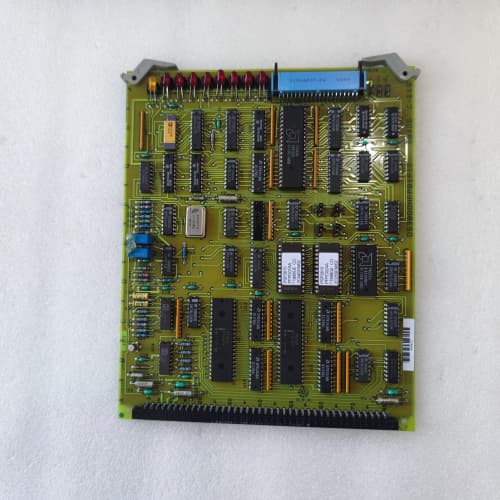
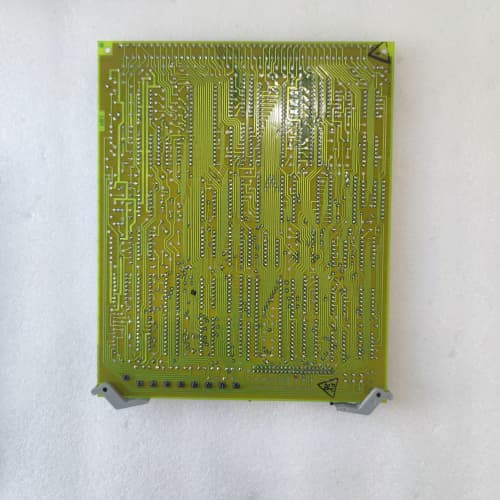
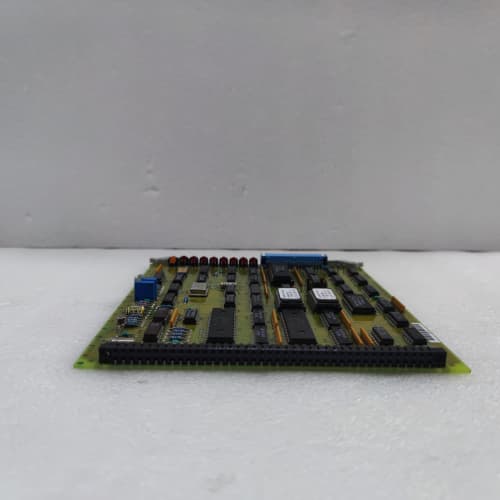
Pressure transmitters and position feedback don’t speak discrete logic—they talk in varying currents and voltages, and the DS3800HCMA is the translator that brings those signals into the Mark V’s digital brain. This base board handles the analog side of turbine control: temperature sensors (RTDs, thermocouples with external conditioners), pressure transducers, and valve position feedback. If your plant’s operations rely on closed-loop control, the HCMA’s ADC quality directly affects your firing rate stability and turbine efficiency.
We’ve measured the HCMA’s effective resolution at around 0.25% of span with standard 4-20mA signals, which beats the HCMD’s 0.5% spec—a difference that shows up in steady-state temperature regulation. On a 600MW combined-cycle unit, that tighter control can translate to roughly 0.5% better fuel efficiency over a year. The trade-off is channel count: the HCMA gives you 8 channels versus the HCMD’s 16, but with individually configurable input types per channel. You can mix current and voltage inputs on the same board—a feature the HCMD doesn’t support without external shunt resistors.
Key Technical Specifications
| Parameter | Value / Range |
|---|---|
| Analog Input Channels | 8 (differential, individually configurable) |
| Input Signal Types | 4-20mA, 0-20mA, 0-10V, ±10V, ±5V |
| Resolution | 12-bit (4096 counts) |
| Accuracy | ±0.25% of span (typical at 25°C) |
| Temperature Drift | ±50 ppm/°C |
| Input Impedance | 250Ω (current mode) / 1MΩ (voltage mode) |
| Common-Mode Voltage Range | ±12V |
| Channel-to-Channel Isolation | 500V (continuous) |
| Field-to-Logic Isolation | 1500VAC |
| Logic Supply Voltage | 5 VDC (from backplane) |
| Field Supply | 24 VDC (external, for loop-powered transmitters) |
| Scan Rate (All Channels) | 25ms (typical) |
| Operating Temperature | 0°C to 55°C (derate above 45°C) |
Compatible Replacement Models
| Model | Compatibility Class | Notes & Caveats |
|---|---|---|
| DS3800HCMD | ⚠️ Software Compatible | 16 channels but fixed to 4-20mA on all inputs. Same pinout and backplane interface. If you swap to HCMA, you gain per-channel flexibility but lose channels 9-16. Your I/O mapping will shift—you’ll need to update the PLC configuration. Labor estimate: 2-3 hours for software changes plus physical re-termination. |
| DS3800HCMA (same revision) | ✅ Drop-in Replacement | Exact match on hardware and firmware. No adjustments needed. |
| DS3800HCMA (different suffix) | ⚠️ Software Compatible | Suffix variations mainly affect termination type (spring vs. screw) and fuse rating for the 24V field supply. Electronics are identical. Suffix decoder still applies—verify connector pitch matches your existing harness. |
| DS3800HCIA | ❌ Hardware Incompatible | Discrete I/O board, not analog. The backplane addresses different registers entirely. It will physically fit but your controller won’t recognize it as analog inputs. |
| IS200 series equivalents | ❌ Hardware Incompatible | Different architecture. Full system upgrade path—not a repair option. |
Frequently Asked Questions (FAQ)
Q: Can I mix 4-20mA and 0-10V inputs on the same HCMA board?
A: Yes, per-channel configurable via jumpers. There’s a small jumper block near each input terminal—three pins with a shunt. Position A = current (4-20mA), position B = voltage (0-10V). No software config for this on the HCMA. Take a photo of your old board’s jumper settings before removal. We’ve had plants mix up positions and feed 24V into a 0-10V input, smoking the front-end op-amp.
Q: What’s the effective resolution on a 4-20mA signal—is 12-bit enough for temperature control?
A: At 12-bit, each count represents roughly 16µA or 4.9mV on the voltage range. For a 0-1000°C thermocouple transmitter, that’s about 0.24°C per count. Modern plants often run 14-bit or 16-bit, but the Mark V’s control algorithm averages the samples across 5 scans. Effective resolution improves to about 0.1°C with that filtering. We’ve seen this config hold combustion temperature within ±2°C on gas turbines—adequate for most applications. If you need finer resolution, you’re looking at a DCS upgrade, not a board swap.
Q: Does the HCMA support RTD inputs directly?
A: No. Only process signals—4-20mA and 0-10V. For RTDs, you need a separate transmitter (like a Rosemount 3144) that converts resistance to a 4-20mA loop. Feed that into the HCMA in current mode. Same for thermocouples—use a transmitter with cold-junction compensation. We’ve seen plants mistakenly wire bare thermocouple leads directly to the HCMA and wonder why they get no signal. You need an external conditioner.
Q: The HCMA has 8 channels but the HCMD has 16. Can I use two HCMA boards to get 16 configurable channels?
A: Yes, if you have a spare slot. Two HCMA boards will occupy two physical positions in the rack, but you’ll get 16 configurable channels with the flexibility to mix input types. That’s a common upgrade path when replacing an HCMD—one HCMA takes the old HCMD’s slot, a second HCMA goes into an adjacent slot, and you re-map your analog inputs. The downside: you lose a slot for other modules. Plan your rack utilization carefully.
Q: How do I test the HCMA’s accuracy in the field without a calibration rig?
A: You can do a sanity check using a precision current source (like a Fluke 789) feeding 4mA and 20mA into a channel. Read the digital value in the Mark V’s diagnostic screen. At 4mA, you should see roughly 0% of range (2047 counts); at 20mA, 100% (4095 counts). If you’re off by more than ±5 counts, the board may need calibration—or your transmitter has drift. We recommend a full calibration every 2 years with a certified test set. In practice, most plants do it during major overhauls.
Q: Is the 25ms scan rate fast enough for turbine speed control?
A: No, and GE never intended it for that. Speed control uses dedicated pulse accumulator inputs (usually on the CPU board). The HCMA is for process control loops: temperature, pressure, position. If you’re using analog inputs for speed feedback, you’re working around a design flaw and risk unstable control. We’ve seen this attempted in older plants—the 25ms lag adds about 1.5 degrees of phase shift at 60Hz, enough to cause oscillation. Use the dedicated speed inputs.
Q: Can I backfeed 24V from the HCMA’s loop power into a 4-20mA transmitter?
A: This board doesn’t have built-in loop power supply—the 24V field supply terminal is just a pass-through bus. You supply external 24V to the board, and it routes to the field terminals. If you wire a 2-wire transmitter in series with that 24V, yes, it will power the transmitter. But you need to verify your transmitter’s current draw doesn’t exceed the field supply’s capacity (typically 1A total per board). Overload the supply and you’ll drop voltage below 18V, causing reading errors. We’ve seen this on plants that daisy-chain 10+ transmitters off one board. Don’t—use separate power supplies for loops.
GE DS200LSTQF1ACE
GE DS200LSTQF1CEE
GE DS200LUVAF1AHA
 Email: sales@plcfcs.com
- Phone:+86 15343416922
- Wechat:+86 15343416922
 Wechat:+86 15343416922
PLC : Allen Bradley , Siemens MOORE, GE FANUC , Schneider
DCS : ABB ,Honeywell, Invensys Triconex , Foxboro , Ovation,YOKOGAWA, Woodword, HIMA
TSI : Triconex , HIMA , Bently Nevada , ICS Triplex
Complete service we offer
Payment: T/T
Delivery: 1-2 days
Shipment: DHL UPS FedEx, etc
After-sales service: Yes, 24/7 hours