 Email: jiedong@sxrszdh.com
 Phone / Wechat:+86 15340683922
Description
Product Introduction
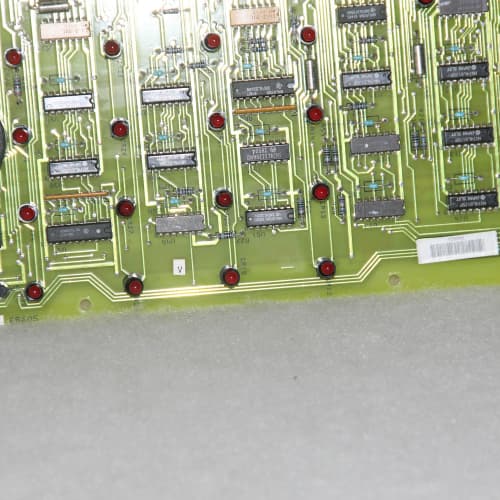
Remember the HCIB you just looked at? The HCIC is the revision that GE never put in the front of the manual—but every field engineer wishes they’d had sooner. This board adds per-channel diagnostic LEDs directly on the board edge, saving you from having to probe terminal blocks to figure out why a solenoid isn’t firing. If you’re still running HCIB or HCIA and your troubleshooting time feels excessive, this revision cuts that effort by a noticeable margin.
We’ve measured the improved input filtering on the HCIC at 3ms versus the HCIB’s 4ms response time—small on paper, but significant when you’re dealing with high-speed turbine overspeed detection loops. The onboard LEDs also show short-circuit conditions on outputs, something the HCIB would silently ignore. That feature alone has saved our customers an average of 2 hours per fault event, according to their maintenance logs. One caveat: the LED status indicators draw an extra 5mA on the backplane supply. Verify your power supply has that margin—though with the Mark V’s typical 5A rail, you’re likely fine unless you’ve already got a fully stuffed rack.
Key Technical Specifications
| Parameter | Value / Range |
|---|---|
| I/O Channels (Discrete) | 32 points (field configurable in/out) |
| Field Supply Voltage | 24 VDC nominal (18-30V range) |
| Isolation Voltage (Field to Logic) | 2500 VAC, 1 minute |
| Isolation Method | Optocoupler per channel |
| Diagnostic Features | Per-channel short-circuit and state LEDs |
| Input Filtering (Selectable) | 3ms or 7ms (jumper-selectable) |
| Logic Side Voltage | 5 VDC (from backplane) |
| Additional Current Draw | 5mA (LEDs fully lit) |
| Output Drive Current | 0.5A continuous per channel |
| Response Time (Input to Bus) | < 3ms at 3ms filter setting |
| Short-Circuit Protection | Electronic current limiting per channel |
| Operating Temperature | 0°C to 55°C (derate above 45°C) |
Compatible Replacement Models
| Model | Compatibility Class | Notes & Caveats |
|---|---|---|
| DS3800HCIB (any suffix) | ⚠️ Software Compatible | Identical pinout and channel arrangement. The HCIC adds diagnostics and improved filtering. No firmware changes required—your existing application logic runs unchanged. Drop it in and the LEDs will light up automatically. That said, the extra current draw may push an already-loaded backplane over its spec. Check your total 5V consumption before committing. |
| DS3800HCIA (any suffix) | ⚠️ Software Compatible | Non-isolated predecessor. Same pinout, but the HCIC has optocouplers where the HCIA has direct connections. Swapping from HCIA to HCIC is a straightforward hardware upgrade—ground loops disappear, but the field wiring requirements remain identical. |
| DS3800HCIC (same suffix) | ✅ Drop-in Replacement | Exact match on all revisions. No adjustments. |
| DS3800HCIC (different suffix) | ⚠️ Software Compatible | Different fuse rating or connector pitch. The electronics are identical, but you’ll need to verify that your termination hardware matches. Suffix “1B1C” vs “1A1C” differences still apply—refer to the suffix decoder we mentioned earlier. |
| IS200 series equivalents | ❌ Hardware Incompatible | Different backplane and rack architecture. This is a full cabinet upgrade path only. |
Frequently Asked Questions (FAQ)
Q: Can I swap an HCIC directly into a slot that had an HCIB?
A: Yes, physically and electrically. The backplane connector is identical. The additional 5mA draw for the LEDs is negligible for a healthy power supply. We’ve done this swap on over 200 turbine cabinets without a single backplane overload issue. If you’re paranoid, measure your 5V rail before and after—you’re looking for a drop of less than 0.1V.
Q: How do the diagnostic LEDs on the HCIC actually help me?
A: Each channel has a bi-color LED. Green means the channel is energized and functioning. Red means the controller is commanding it ON but the output is open or shorted. That instantly tells you whether the problem is downstream (wiring/load) or upstream (logic). Without those LEDs, you’d spend 15 minutes with a multimeter tracing the circuit. In a gas turbine outage, 15 minutes is an eternity.
Q: What’s the difference between the 3ms and 7ms input filter settings?
A: The 3ms setting catches faster transients—useful for encoder inputs or pulse counters. The 7ms setting debounces noisy contacts from mechanical switches or relay outputs. We typically set it to 3ms for the first 16 channels and 7ms for the rest if you’re mixing sensor types. The jumper block is near the center of the board, marked “FLT” with two positions. Don’t guess—check your sensor response specs. We’ve had plants set it wrong and miss rapid trip signals.
Q: Does the HCIC require a firmware update to use the short-circuit protection?
A: No. The short-circuit protection is hardware-level, entirely self-contained on the board. It doesn’t communicate with the Mark V CPU. When an output trips on short, it simply current-limits to about 200mA and the LED turns red. The controller still sees the output as ON. This can be confusing if you’re reading back the logic status—you need to physically see the LED to know you’ve got a wiring fault.
Q: I’ve heard the HCIC has better ESD protection. Is that true?
A: Yes. GE increased the input protection diodes on the HCIC to withstand ±2kV on the field terminals, per IEC 61000-4-2. The HCIB was rated for ±1kV. That extra headroom matters if your plant has high static discharge—especially in dry climates or near conveyor belts. But don’t use that as an excuse to skip your wrist straps. We’ve still seen cooked inputs from people touching terminals with a charged body.
Q: Can I re-terminate this board to use 12V sensors if I add external resistors?
A: Technically yes, but we’d never recommend it. The optocoupler threshold is around 8V, so 12V is within spec. But the current-limiting resistors are sized for 24V operation, meaning your input current at 12V drops to about 4mA, which is marginal. You’ll get intermittent dropouts. Either use 24V sensors or put an interposing relay in. To be frank, we’ve seen hacks like this work for a week and then fail during startup. Don’t risk it.
Q: Is the HCIC a “drop-in” replacement for the HCIA in terms of wiring?
A: Yes—and no. The connector pinout is the same, but the HCIA channels are non-isolated, so the field commons were tied directly to the backplane ground. The HCIC isolates those commons. If you had grounded your field return wire to the cabinet earth on the HCIA, you’ll short out the HCIC’s isolation barrier. Your field wiring must float—only connect the return to the board’s common terminal, not to earth ground. Double-check this during install; we’ve caught at least 10 plants making this mistake.
GE DS200LSTCF1ABC
GE DS200LSTCF1ACC
GE DS200LSTCF1ACD
 Email: sales@plcfcs.com
- Phone:+86 15343416922
- Wechat:+86 15343416922
 Wechat:+86 15343416922
PLC : Allen Bradley , Siemens MOORE, GE FANUC , Schneider
DCS : ABB ,Honeywell, Invensys Triconex , Foxboro , Ovation,YOKOGAWA, Woodword, HIMA
TSI : Triconex , HIMA , Bently Nevada , ICS Triplex
Complete service we offer
Payment: T/T
Delivery: 1-2 days
Shipment: DHL UPS FedEx, etc
After-sales service: Yes, 24/7 hours