 Email: jiedong@sxrszdh.com
 Phone / Wechat:+86 15340683922
Description
Product Introduction (Anti-Template)
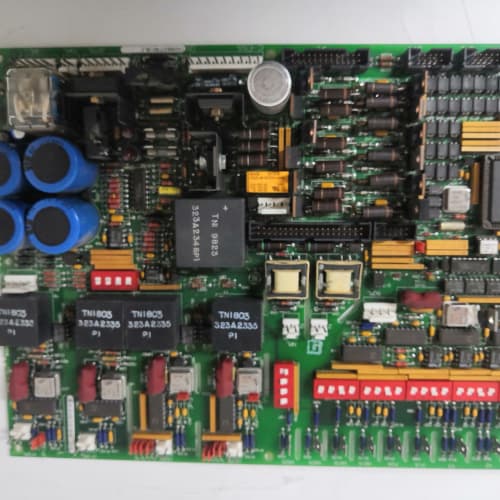
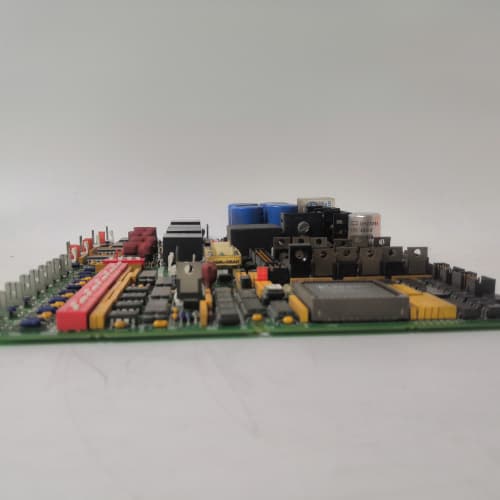
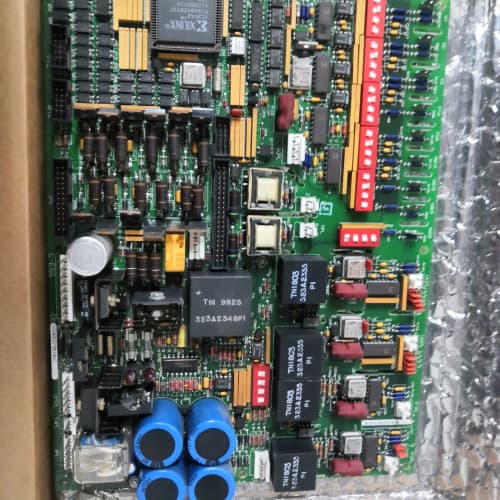
The DS200TCCAG1A is where analog signals from your turbine sensors become digital data that the controller can act on. It’s the board that takes the 4-20mA from your pressure transmitters, the 0-10V from your LVDT position sensors, and the thermocouple signals from your temperature sensors, and converts them into the 1s and 0s that run your turbine logic.
The ‘A’ revision improves the A/D converter from 14-bit (on the base model) to 16-bit resolution—that means four times the measurement precision. For a 0-10V input, 14-bit gives you about 0.6mV resolution; 16-bit gives you 0.15mV. That extra resolution matters when you’re measuring turbine exhaust temperature gradients or steam pressure differentials. Compared to the TCCAG1 (no suffix), the ‘A’ also adds galvanic isolation between the input channels—reducing noise pickup from ground loops and improving common-mode rejection to about 80dB. The board fits directly into the Mark VI backplane and interfaces with the termination boards (TBCAG1A for general-purpose analog, TBCBG1A for thermocouples) that handle the field wiring.
Key Technical Specifications
| Parameter | Value / Range |
|---|---|
| Manufacturer | General Electric (GE) |
| Part Number | DS200TCCAG1A |
| Board Type | Analog Input Board |
| Number of Channels | 8 (isolated inputs) |
| Input Range | 0-10V, ±10V, 4-20mA (configurable per channel) |
| Resolution | 16-bit (65535 counts) |
| Accuracy | ±0.1% of full scale (at 25°C) |
| Temperature Drift | ±50ppm/°C |
| Input Impedance | >1MΩ (voltage mode), 250Ω (current mode) |
| Common Mode Rejection | 80dB (DC to 60Hz) |
| Isolation | Channel-to-backplane: 1500Vrms |
| Update Rate | 10ms (all channels sampled simultaneously) |
| Input Power | 24 or 48 VDC (via backplane) |
| Mounting | VME rack (fits standard Mark VI backplane) |
| Operating Temp | 0°C to +60°C |
| Firmware | Version 2.0 or later recommended |
| Connectors | 1 x 96-pin DIN backplane connector |
Compatible Replacement Models
Replacement options depend on your resolution requirements and input voltage/current needs.
✅ Drop-in Replacement: The DS200TCCAG1 (no suffix) is a drop-in replacement with a lower resolution (14-bit). It uses the same pinout and fits the same backplane. If 14-bit resolution (about 0.6mV for 0-10V) is sufficient for your application, the base model is a cheaper option (typically 15-20% less). However, the base model lacks the galvanic isolation of the ‘A’ revision.
✅ Drop-in Replacement: The DS200TCCAG1A is the only ‘A’ revision—there is no ‘AB’ or ‘AC’ variant in this family.
⚠️ Software Compatible: The DS200TCCAG1B (if available—verify with your supplier) may be a different firmware revision. If you find a ‘B’ version, it may require a controller firmware update to work. Always verify firmware compatibility before ordering.
❌ Hardware Incompatible: The DS200TCCBG1A (thermocouple input board) uses a different pinout and is designed for millivolt-level signals—it cannot handle 0-10V or 4-20mA inputs.
❌ Hardware Incompatible: Any discrete I/O board (TCCX series, TCCP series) uses different backplane pins and is not suitable for analog inputs.
Frequently Asked Questions (FAQ)
What’s the difference between the TCCAG1A and the TCCBG1A?
The TCCAG1A is a general-purpose analog input board for 0-10V and 4-20mA signals. The TCCBG1A is a thermocouple input board designed for millivolt-level signals. Key differences:
- Signal range: TCCAG1A handles 0-10V/4-20mA; TCCBG1A handles ±100mV.
- Input impedance: TCCAG1A has 1MΩ+ (voltage mode); TCCBG1A has very high impedance (>10MΩ) for thermocouple signals.
- Isolation: TCCAG1A has channel-to-backplane isolation; TCCBG1A has channel-to-channel isolation.
- Excitation: TCCAG1A has no excitation; TCCBG1A has no excitation (thermocouples generate their own voltage).
You cannot use a TCCBG1A for 4-20mA signals—the input range is wrong, and you’d damage the board. The TCCAG1A is the correct board for standard analog signals.
How do I configure the input range (0-10V vs. 4-20mA) on this board?
The TCCAG1A has a combination of hardware jumpers and software configuration. In the base model, the input range was set with jumpers on the board. On the ‘A’ revision, most of the configuration is done in software (ToolboxST), but you still need to set a hardware jumper for voltage vs. current mode. The jumpers are labeled J1-J8 on the board (one per channel). Consult the GE manual for your specific firmware revision—the jumper positions changed slightly between versions. The software configuration sets the scaling (0-10V, ±10V, 4-20mA) in the I/O map.
Can I use this board with a Mark VIe controller?
No—the TCCAG1A uses the older Mark VI backplane pinout. Mark VIe uses a different assignment and typically uses the IS200TCCAG1A for analog inputs. If you plug a Mark VI analog board into a Mark VIe rack, the signals will map to the wrong channels and the isolation may not work correctly. Use the Mark VIe-specific board for new installations.
How do I test this board before installation?
Testing an analog input board requires a precision signal source:
- Visual inspection: Check for burnt or discolored components, especially around the A/D converter and isolation transformer. Look for cracked solder joints on the backplane connector.
- Power-up test: Install the board in a test rack and apply 24 VDC. The board’s status LED (green) should illuminate within 2 seconds. If the LED is red or flashing, there’s a firmware or hardware issue.
- Firmware check: Read the firmware version via ToolboxST (or the board’s diagnostic registers). Verify it matches your controller’s version. If it doesn’t, you may need to update the controller or flash the board.
- Input test – voltage: Apply a precision 5.00V DC to channel 1. In ToolboxST, read the scaled value—it should be 5.00V ± 0.005V (0.1% of full scale). Repeat for channels 1-8.
- Input test – current: Apply 12.00mA to a channel configured for 4-20mA. The read value should be 12.00mA ± 0.012mA. Repeat for all channels.
- Isolation test: Measure the resistance between an input terminal and the board’s ground (backplane). Should be >10MΩ. This verifies the isolation is intact.
- Channel crosstalk: Apply a full-scale signal to channel 1 and a zero signal to channel 2. Read channel 2—it should be within ±0.05% of full scale. If it’s higher, the isolation is compromised.
What’s the most common failure on this board?
Two issues specific to the analog input board:
- A/D converter drift. The 16-bit A/D converter can drift over time, especially if the board is exposed to high temperatures (above 60°C). The ‘A’ revision uses a better reference than the base model, but drift is still possible after 10+ years. The symptom is a consistent offset on all channels—all readings are too high or too low by 0.2-0.5%. The fix is a recalibration (requires GE-specific software and equipment).
- Isolation transformer failure. The channel-to-backplane isolation transformer is a common failure point. When it fails, the channel will read intermittently or show high noise. The symptom is an erratic reading that fluctuates even with a steady input. If one channel fails this way, the isolation transformer for that channel needs replacement (not a user-serviceable part—the board needs to be replaced).
If I’m using this board in a SIL-rated safety application, what’s the recommended maintenance interval?
For SIL-2 and SIL-3 applications (IEC 61508), we recommend:
- Visual inspection: Every 6 months (check for discoloration, burn marks)
- Power-up test: Annually (verify board boots correctly and status LED is green)
- Input accuracy check: Annually (verify each channel reads within 0.1% of a precision source)
- Isolation check: Every 2 years (verify isolation resistance between channels is >10MΩ)
- Full calibration: Every 5 years (requires a precision calibrator and GE software)
What’s the lead time for a replacement TCCAG1A?
These boards are moderately available:
- New surplus: 2-4 weeks. The ‘A’ version with 16-bit resolution is the most common.
- Refurbished: 1-2 weeks. Ensure the refurbisher tests all 8 channels—some only test a subset.
- Used/as-is: Available, but the A/D converters drift over time—used boards may be out of spec.
Is there a direct Mark VIe equivalent?
Yes—the IS200TCCAG1A (Mark VIe version). But the backplane pinout and communication protocol are different between Mark VI and Mark VIe. If you’re migrating to Mark VIe, plan to replace all analog input boards as part of the rack conversion. For existing Mark VI systems, the TCCAG1A is the correct board.
Can I mix TCCAG1A boards with TCCAG1 boards in the same system?
Yes—electrically, they’re compatible. The TCCAG1 (14-bit) and TCCAG1A (16-bit) have the same pinout and use the same backplane signals. You can mix them in the same rack. However, your control software must be configured to handle the different resolution—the TCCAG1A will give you more counts per volt. If your logic uses engineering units (volts, mA), the resolution difference doesn’t matter—both boards scale to the same engineering units. If your logic uses raw counts, you’ll need to adjust the scaling for the TCCAG1A channels.
What update rate can I expect from this board?
The TCCAG1A samples all 8 channels simultaneously at 10ms intervals. That’s a 100Hz update rate, which is sufficient for most turbine control applications (governor loops typically run at 20-50ms). The ‘A’ revision’s 16-bit A/D converter has a slightly slower conversion time than the 14-bit base model, but GE optimized the firmware to maintain the 10ms update rate. If you need faster update rates, you’d need a different board (the TCCAG1 series is not designed for high-speed applications).
51400700-100 PLC DCS
CC-TDOB11 PLC DCS
CC-PCNTOX PLC DCS
 Email: sales@plcfcs.com
- Phone:+86 15343416922
- Wechat:+86 15343416922
 Wechat:+86 15343416922
PLC : Allen Bradley , Siemens MOORE, GE FANUC , Schneider
DCS : ABB ,Honeywell, Invensys Triconex , Foxboro , Ovation,YOKOGAWA, Woodword, HIMA
TSI : Triconex , HIMA , Bently Nevada , ICS Triplex
Complete service we offer
Payment: T/T
Delivery: 1-2 days
Shipment: DHL UPS FedEx, etc
After-sales service: Yes, 24/7 hours