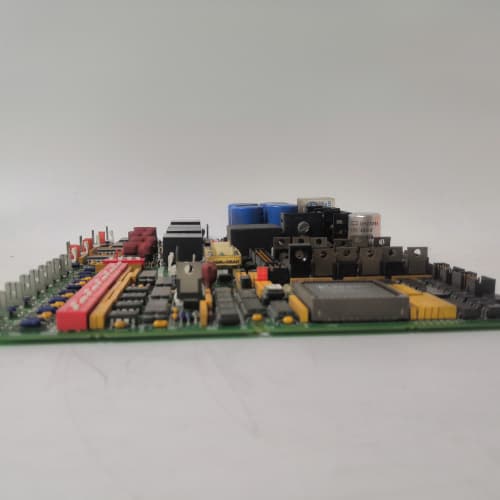
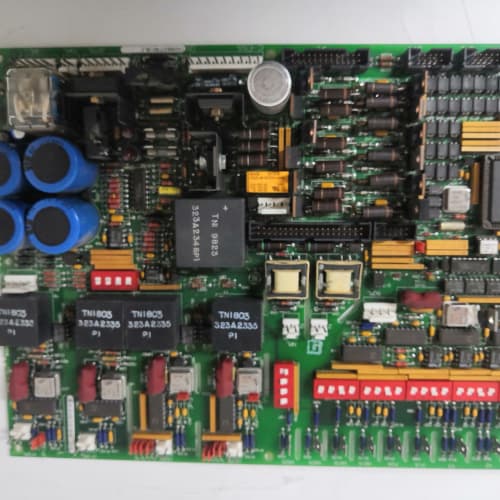
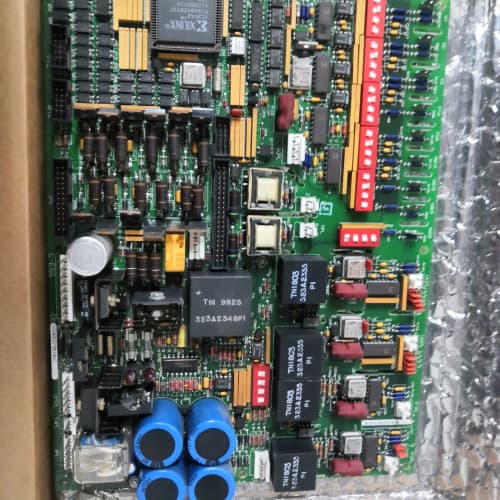
 Email: jiedong@sxrszdh.com
 Phone / Wechat:+86 15340683922
Description
Product Core Brief
- Model: DS200SSRAG1A
- Brand: General Electric (GE)
- Series: Mark V DS200
- Core Function: SIL 3 safety relay output board
- Product Type: SIL 3 Safety Relay Board (8 channels)
- Key Specs: 8 x 10 A relays | 1oo2 architecture | SIL 3 | Force-guided contacts | >99% diagnostics
- Condition: New Original.
Product Introduction
The DS200SSRAG1A is a SIL 3 certified safety relay output board for GE’s Mark V DS200 series, used in Safety Instrumented Systems (SIS) for turbine control. It provides eight independent safety relay outputs, each with 1oo2 (one out of two) redundant contacts for high reliability.
Each output channel uses two force-guided relays in series. To energize the output, both relays must close. To de-energize (trip), only one needs to open. Force-guided contacts are mechanically linked, allowing the board to detect welded contacts through its diagnostic circuitry. Use it to drive turbine trip solenoids, emergency shutdown valves, burner management shutoffs, and other safety-critical actuators requiring SIL 3.
Key Technical Specifications
| Parameter | Value |
|---|---|
| Safety outputs | 8 (independent, 1oo2 per channel) |
| Relays per output | 2 x force-guided, Form A (NO) |
| Contact rating (resistive) | 10 A @ 250 VAC / 30 VDC |
| Contact rating (inductive) | 5 A @ 250 VAC / 30 VDC |
| Minimum contact load | 10 mA @ 5 VDC (force-guided contacts) |
| Relay response time | <20 ms |
| Mechanical life | 10,000,000 operations |
| Electrical life | 100,000 operations at 10 A |
| Diagnostic coverage | >99% (welded contact detection, stuck coil, power failure) |
| Safety integrity level | SIL 3 (IEC 61508, IEC 61511) |
| HFT (Hardware Fault Tolerance) | 1 |
| PFDavg | <1.0 × 10⁻⁴ (1 year) |
| Proof test interval | 1 year |
| Force-guided contact monitoring | Continuous (welded contact detection) |
| Backplane isolation | 2500 VAC |
| Operating temperature | −40°C to +70°C |
| Backplane current | 24 VDC @ 600 mA typical, 1.0 A max |
| Dimensions | 6U x 4HP x 160 mm (single slot) |
| Accessories | SIL 3 certificate, safety manual, diagnostic software, terminal blocks |
Key Selling Points & Differentiators
- SIL 3 certified safety outputs – TÜV certified per IEC 61508. Suitable for SIL 3 safety functions.
- 1oo2 architecture per channel – Two relays in series. Single contact weld does not prevent tripping. Single failure to energize does not cause spurious trip.
- Force-guided contacts – Mechanically linked NO and NC contacts (NC used for diagnostics). Board can detect welded contacts online.
- Diagnostic coverage >99% – Continuous monitoring: coil continuity, contact welding, power supply, backplane communication.
- 8 independent safety outputs – Drive 8 separate trip solenoids or valves. Each channel isolated.
- Welded contact detection – Board tests each relay pair during self-test. Reports welded contacts before they cause failure.
- Automatic proof test – Daily self-test verifies all diagnostics. No manual proof test required for 1 year.
- QC includes SIL 3 validation – Verified by TÜV-certified test house.
- 10-year warranty
Frequently Asked Questions (FAQ)
Q: How does 1oo2 relay output work?
A: Each output channel has two relays in series (K1 and K2). To energize the output, both K1 and K2 must be closed. To de-energize (trip), only one needs to open. If K1 welds closed, K2 can still open to trip. If K1 fails to close, output stays de-energized (safe). This achieves SIL 3.
Q: What are force-guided contacts?
A: Mechanically linked NO and NC contacts. When the relay is energized, NO closes and NC opens (simultaneously). When de-energized, NO opens and NC closes. The board monitors the NC contacts to verify the relay actually changed state. If NO is welded, NC will not close—board detects fault.
Q: How does the board detect welded contacts?
A: During the self-test, the board briefly energizes each relay (one at a time) and monitors the NC contact. If NC does not open, the NO contact is likely welded. Output is marked faulty and safe state (de-energized) is maintained. No unsafe output.
Q: Can I use the SSRAG1A to drive a 24 VDC solenoid directly?
A: Yes—24 VDC solenoid at 10 A is within rating. Use flyback diode across solenoid (not included, but recommended). For inductive loads above 5 A, derate to 5 A.
Q: What is the proof test requirement?
A: IEC 61508 requires proof testing every 1 year for SIL 3 with HFT=1. The board performs automatic self-tests daily, reducing the manual proof test burden. Manual proof test: force a trip command and verify outputs de-energize. Procedure in safety manual.
Q: What QC tests are specific to the SSRAG1A?
A: Twelve tests:
- Force-guided contact verification: NO/NC timing
- Welded contact detection: simulate welded contact, verify fault
- 1oo2 operation: disable one relay, verify other trips
- Contact rating: 10 A resistive, 100,000 cycles
- Diagnostic coverage: >99% via fault injection
- Response time: <20 ms
- PFDavg calculation: <1.0 × 10⁻⁴
- HFT verification: HFT = 1
- Isolation: 3000 VAC
- Temperature: −40°C to +70°C
- Self-test: daily schedule verified
- Burn-in: 168 hours at +65°C
Q: What shipping protection?
A: Anti-static bag, ESD foam cradle, hard plastic clamshell case, desiccant. Double-wall box with “SAFETY CERTIFIED,” “SIL 3” labels. SIL 3 certificate laminated. Safety manual (200 pages) included. Diagnostic software on USB drive. Each board ships individually. Factory site visit recommended for first-time SIL 3 integration. Contact us for safety application engineering support.
APP-DRV-AB PLC DCS
APP-MBP-PCI PLC DCS
APP-MBP-PCI-RC PLC DCS
APP-CON-MBP PLC DCS
 Email: sales@plcfcs.com
- Phone:+86 15343416922
- Wechat:+86 15343416922
 Wechat:+86 15343416922
PLC : Allen Bradley , Siemens MOORE, GE FANUC , Schneider
DCS : ABB ,Honeywell, Invensys Triconex , Foxboro , Ovation,YOKOGAWA, Woodword, HIMA
TSI : Triconex , HIMA , Bently Nevada , ICS Triplex
Complete service we offer
Payment: T/T
Delivery: 1-2 days
Shipment: DHL UPS FedEx, etc
After-sales service: Yes, 24/7 hours