 Email: jiedong@sxrszdh.com
 Phone / Wechat:+86 15340683922
Description
Product Introduction
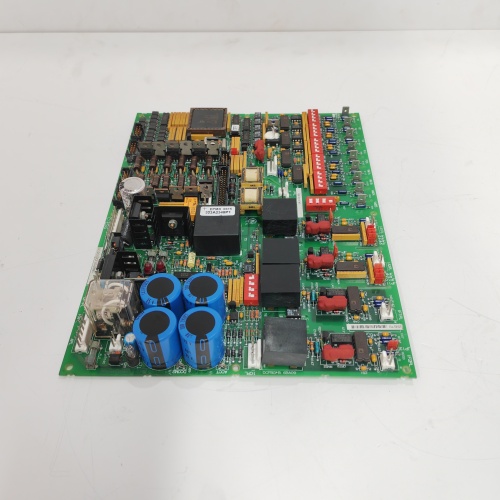
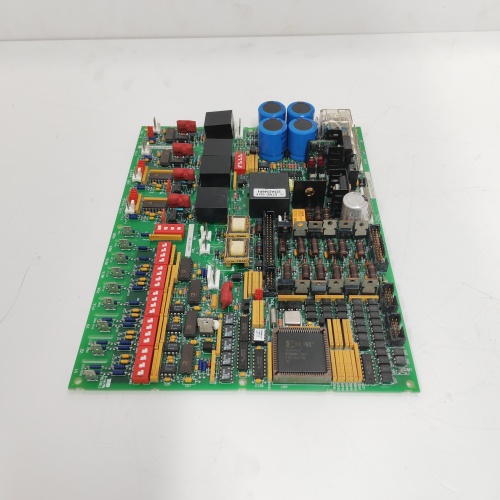
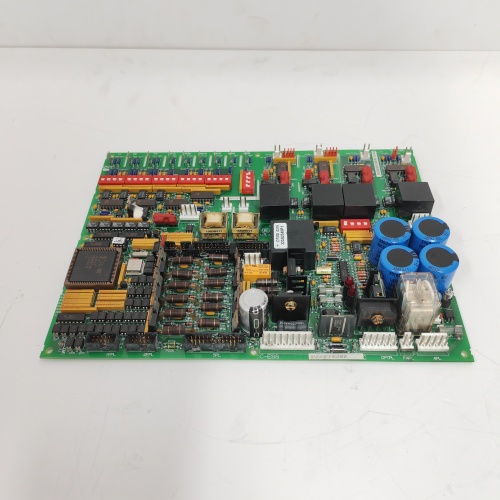
The DS200SDCCG1AGD is a dual-channel servo drive controller with direct LVDT position feedback inputs for GE’s Mark V DS200 series, used in Speedtronic turbine control systems. It provides two independent servo control loops where the valve position feedback comes directly from an LVDT (Linear Variable Differential Transformer) without external signal conditioning.
The “AGD” suffix indicates an LVDT input variant. Standard SDCCG1 boards accept 4–20 mA or 0–10 VDC feedback only, requiring an external LVDT-to-current converter (e.g., LVDT to 4–20 mA transmitter). The AGD integrates the LVDT excitation oscillator (2.5 kHz) and synchronous demodulator on board, converting LVDT position directly to engineering units. This eliminates a failure point, improves accuracy (no conversion errors), and reduces cabinet space. It is designed for turbines where LVDTs are the primary position feedback device—most GE heavy-duty gas and steam turbines.
Key Technical Specifications
| Parameter | Channel 1 | Channel 2 |
|---|---|---|
| Control algorithm | Digital PID with feedforward | Digital PID with feedforward (independent) |
| Output type | ±10 VDC, 10 mA max | ±10 VDC, 10 mA max |
| Output resolution | 16-bit (0.3 mV) | 16-bit (0.3 mV) |
| LVDT input (primary feedback) | 3-wire or 5-wire LVDT | 3-wire or 5-wire LVDT |
| LVDT excitation | 2.5 kHz ±1%, 2.5 Vrms nominal (adjustable 1–5 Vrms) | 2.5 kHz ±1%, 2.5 Vrms nominal (adjustable 1–5 Vrms) |
| LVDT excitation current | 50 mA max per channel | 50 mA max per channel |
| LVDT sensitivity range | 1–25 mV/V/mm (adjustable) | 1–25 mV/V/mm (adjustable) |
| LVDT linearity error | <0.1% of full scale (after calibration) | <0.1% of full scale (after calibration) |
| 4–20 mA feedback (secondary) | 1 x 4–20 mA (redundant) | 1 x 4–20 mA (redundant) |
| Feedback resolution (LVDT) | 16-bit (0.0015% of excitation) | 16-bit (0.0015% of excitation) |
| Update rate | 1 ms (1000 Hz) | 1 ms (1000 Hz) |
LVDT Features (AGD Revision)
| Parameter | Value |
|---|---|
| LVDT wiring options | 3-wire (single secondary), 5-wire (dual secondary with center tap) |
| Excitation frequency stability | ±0.1% over temperature |
| Excitation voltage stability | ±0.5% over temperature |
| Demodulation type | Synchronous (phase-sensitive) |
| Phase adjustment | 0–360 degrees in 1 degree steps (to match LVDT phase shift) |
| Built-in LVDT test | Open coil detection, shorted coil detection, ratio check |
| Calibration method | Software auto-calibration (press button in CST) |
Shared Parameters (Both Channels)
| Parameter | Value |
|---|---|
| Isolation (field I/O to backplane) | 1500 VAC |
| Isolation (channel to channel) | 1000 VAC (shared isolated ground) |
| Operating temperature | −30°C to +65°C |
| Storage temperature | −40°C to +85°C |
| Backplane current | 5 VDC @ 1.0 A typical, 1.4 A max |
| Dimensions | 6U x 8HP x 160 mm (double-width) |
| Accessories included | Removable terminal blocks (4 sets), spare blocks (1 set), LVDT calibration cable (for auto-calibration), termination resistors (for 4–20 mA inputs), LVDT configuration guide |
Key Selling Points & Differentiators (AGD Specific)
- Direct LVDT input – no external converter needed – Standard SDCCG1 requires an external LVDT-to-4–20 mA converter (e.g., Schaevitz, Macromatic). The AGD integrates excitation and demodulation, saving panel space ($500–1000 per channel) and eliminating a failure point.
- Supports 3-wire and 5-wire LVDTs – 3-wire (single secondary, common center tap) and 5-wire (dual secondary, separate center tap) LVDTs are both supported. Most GE turbines use 5-wire LVDTs for fuel valves and steam valves. Wiring diagrams included.
- Adjustable excitation voltage (1–5 Vrms) – Match LVDT manufacturer’s specified excitation. Too low: poor signal-to-noise ratio. Too high: overheating of LVDT coils. Default: 2.5 Vrms (common for GE LVDTs).
- Phase adjustment (0–360 degrees) – LVDT output phase shifts due to cable length and LVDT internal characteristics. The AGD allows digital phase adjustment to align demodulator with LVDT secondary signal. Maximizes output signal and linearity.
- Built-in LVDT diagnostics – Open coil detection (any of primary or secondary wires broken), shorted coil detection (between primary/secondary), and ratio check (primary to secondary voltage ratio). Alarm reported via backplane fault bits.
- Auto-calibration via software – Connect calibration cable, press button in Control System Toolbox (CST). Board automatically measures LVDT sensitivity, null position, and linearity. No potentiometers, no manual trimming.
- Redundant feedback options – Each channel also accepts 4–20 mA feedback as secondary signal. Configure for “LVDT primary, 4–20 mA backup” or “average of both” or “select best.” Standard SDCCG1 has two 4–20 mA inputs per channel for redundancy. AGD replaces one of them with LVDT input.
- QC includes full LVDT sweep with calibrated LVDT simulator – Each channel tested with a precision LVDT simulator (0.01% linearity). 10–90–10% sweep. Linearity error <0.1% of full scale.
- 2-year warranty – Covers LVDT excitation, demodulation, feedback inputs, outputs, and all I/O.
Frequently Asked Questions (FAQ)
Q: What is the difference between SDCCG1 (4–20 mA feedback), SDCCG1AFD (4–20 mA output), and SDCCG1AGD (LVDT input)?
| Feature | SDCCG1 | SDCCG1AFD | SDCCG1AGD |
|---|---|---|---|
| Output type | ±10 VDC | 4–20 mA | ±10 VDC |
| Primary feedback | 4–20 mA | 4–20 mA | LVDT (3-wire or 5-wire) |
| Secondary feedback | 4–20 mA (redundant) | 4–20 mA (redundant) | 4–20 mA |
| External LVDT converter needed | Yes | Yes | No |
| LVDT excitation | N/A | N/A | Onboard (2.5 kHz) |
| Phase adjustment | N/A | N/A | Yes (0–360°) |
| Typical turbine | Retrofit with 4–20 mA position feedback | I/P converters | Original GE turbines with LVDTs |
Choose AGD for GE heavy-duty turbines (Frame 5, 6, 7, 9) where fuel valves and steam valves have built-in LVDT position feedback. Most common application.
Q: Can I replace a standard SDCCG1 (with external LVDT converter) with an SDCCG1AGD without changing my configuration?
A: Yes—with signal path changes. The AGD eliminates the external LVDT-to-4–20 mA converter. Wire the LVDT directly to the AGD (3 or 5 wires). Remove the converter. Reprogram the Mark V configuration to read LVDT engineering units directly instead of 4–20 mA scaled to position. The output (±10 VDC) and PID parameters remain the same. Allow 2–4 hours for re-wiring and software changes. We provide configuration conversion guide.
Q: My LVDT has 4 wires (primary, primary return, secondary, secondary return). Is this 3-wire or 5-wire?
A: 4-wire is a variant of 3-wire (secondary has two wires, but no center tap). Connect as 3-wire: primary (P1, P2), secondary (S1, S2). The board treats as 3-wire. Calibration accounts for missing center tap. For 5-wire LVDT (P1, P2, S1, S2, center tap), connect center tap to COM terminal. If unsure, send us LVDT model number—we provide wiring diagram.
Q: How do I calibrate the LVDT channel?
A: Using Control System Toolbox (CST) or Toolbox for Mark V software:
- Connect calibration cable (included) from board front panel to your PC (RS-232).
- Move valve to mechanical stop (fully closed). Press “Set Zero” in software.
- Move valve to mechanical stop (fully open). Enter known position in engineering units (e.g., 100% or 50 mm). Press “Set Span”.
- (Optional) Move valve to mid-position. Press “Auto-Cal” for linearity correction.
Calibration constants stored on board flash. No potentiometers. Auto-cal takes 2 minutes per channel.
Q: What is the maximum cable length between AGD and LVDT?
A: 500 ft (150 m) with 18 AWG shielded twisted pair per LVDT lead. Beyond 500 ft, cable capacitance (30 pF/ft) distorts the 2.5 kHz excitation waveform, causing phase shift and amplitude loss. For longer runs, use an external LVDT driver (we sell ACC-LVDT-LD) that transmits DC voltage over long cable, with local LVDT excitation at the valve.
Q: What happens if an LVDT coil opens or shorts?
A: The board detects fault within 100 ms. Specific fault detection:
- Open primary: excitation current <5 mA → fault
- Open secondary: demodulated signal <0.1% of expected → fault
- Short between primary and secondary: ratio (secondary/primary) <0.1 or >10 → fault
Fault LED lights on front panel, fault bit set in backplane status register. Configurable failsafe output (0 V, ±10 V, or hold last).
Q: Can I use the AGD with a 60 Hz LVDT (not 2.5 kHz)?
A: No. The AGD excitation is fixed at 2.5 kHz ±1%. 60 Hz LVDTs (old designs) have poor frequency response (cannot update at 1 kHz). Replace LVDT with 2.5 kHz unit (GE part numbers available). We sell compatible LVDTs (ACC-LVDT-2.5K, $350). If replacement not possible, use external 60 Hz LVDT conditioner feeding 4–20 mA to standard SDCCG1.
Q: The AGD has a 4–20 mA input as secondary feedback. Can I use that as primary and ignore LVDT?
A: Yes. Configure the channel to use “4–20 mA only” mode via software. The LVDT excitation can be disabled to save power. This makes the AGD functionally identical to standard SDCCG1 (but with extra features). Useful if you have a mix of LVDT and non-LVDT valves in your system.
Q: What is the LVDT null voltage specification?
A: At mechanical null (valve position midpoint), the LVDT secondary output should ideally be 0 V. In practice, null voltage is 10–100 mV due to residual coupling. The AGD’s synchronous demodulator rejects null voltage up to 20% of excitation (0.5 V at 2.5 Vrms excitation). Higher null voltages indicate LVDT mechanical misalignment or internal damage. Calibration procedure compensates for null voltage up to 50% (1.25 V). If null voltage exceeds 50% of excitation, LVDT may be faulty.
Q: What QC tests are specific to the AGD revision?
A: Fourteen tests, all documented:
Standard servo tests (output calibration, PID loop test, etc.) plus:
- LVDT excitation voltage: Measure at output terminals: 2.5 Vrms ±1%, frequency 2.5 kHz ±0.1%.
- LVDT excitation stability: Measure over 1 hour at +65°C. Drift <0.5%.
- LVDT simulator test: Connect precision LVDT simulator (0.01% linearity). Sweep from 10% to 90% to 10% position. Readback error <0.1% of full scale.
- Phase adjustment test: Inject LVDT signal with 45° phase shift. Adjust phase in software until readback correct. Verify phase setting matches injected phase within 2°.
- 3-wire LVDT test: Simulate 3-wire LVDT (single secondary). Verify correct operation, calibration within <0.15% error.
- 5-wire LVDT test: Simulate 5-wire LVDT (dual secondary with center tap). Verify correct operation, improved linearity (<0.08% error).
- Open primary detection: Disconnect primary wire, verify fault within 100 ms.
- Open secondary detection: Disconnect secondary wire, verify fault within 100 ms.
- Short detection: Short primary to secondary, verify ratio fault within 200 ms.
- Auto-calibration test: Run auto-cal procedure on simulator. Verify zero error <0.02%, span error <0.05%.
- Cross-channel LVDT interference: Run Channel 1 LVDT at full excitation, measure induced signal on Channel 2 LVDT input. <1 mV peak-peak.
- 4–20 mA secondary input test: Inject 4–20 mA, verify readback accuracy ±0.1% (standard test).
- Redundant mode test: Configure “LVDT primary, 4–20 mA backup”. Simulate LVDT failure, verify switch to 4–20 mA within one scan (1 ms).
- Burn-in: 72 hours at +65°C, both channels running closed-loop simulation with LVDT simulators. No drift >0.1%, no faults.
Q: What shipping protection?
A: Anti-static bag, ESD foam cradle with cutouts for terminal blocks. Double-wall box with “FRAGILE,” “ESD SENSITIVE” labels. Shock indicator. LVDT calibration cable included. Spare terminal blocks in separate bag. LVDT configuration guide (12 pages) included. Each board ships individually. Configuration extraction service available—ship your old board for parameter transfer. LVDT compatibility check service: send us your LVDT model number, we verify compatibility before shipping.
DIO248 PLC DCS
DIO232 PLC DCS
DIO216 PLC DCS
 Email: sales@plcfcs.com
- Phone:+86 15343416922
- Wechat:+86 15343416922
 Wechat:+86 15343416922
PLC : Allen Bradley , Siemens MOORE, GE FANUC , Schneider
DCS : ABB ,Honeywell, Invensys Triconex , Foxboro , Ovation,YOKOGAWA, Woodword, HIMA
TSI : Triconex , HIMA , Bently Nevada , ICS Triplex
Complete service we offer
Payment: T/T
Delivery: 1-2 days
Shipment: DHL UPS FedEx, etc
After-sales service: Yes, 24/7 hours