 Email: jiedong@sxrszdh.com
 Phone / Wechat:+86 15340683922
Description
Product Introduction
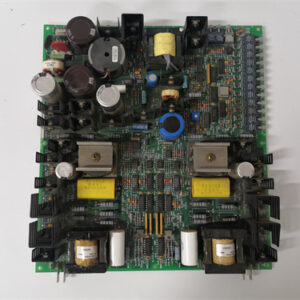
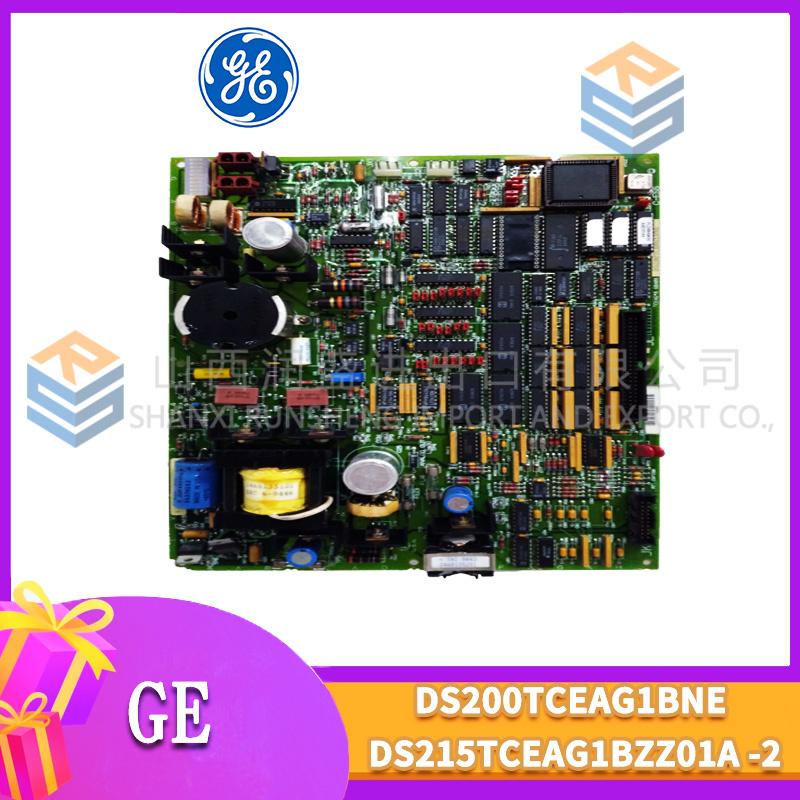
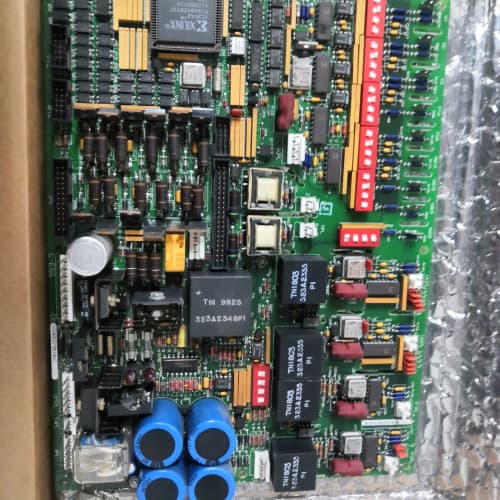
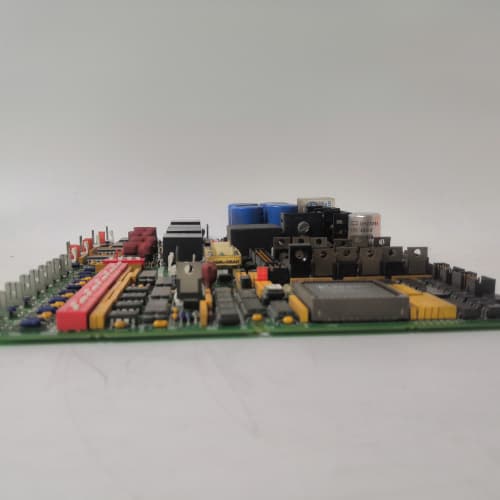
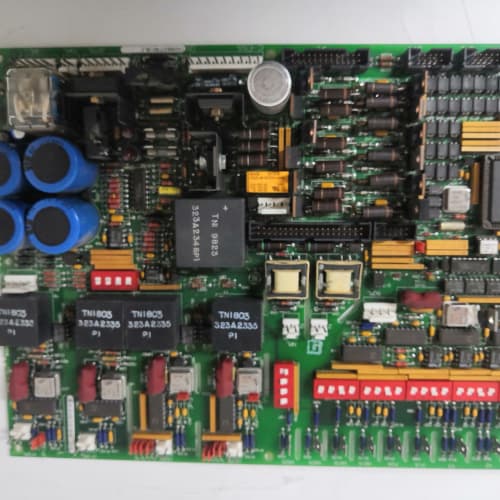
The DS200SDCCG1ACA is a high-speed fully isolated dual-channel servo drive controller for GE’s Mark V DS200 series, used in Speedtronic turbine control systems. It combines the fastest update rate in the servo family (0.25 ms / 4 kHz) with complete galvanic isolation between Channel 1, Channel 2, and the backplane.
The “ACA” suffix represents the ultimate performance variant of the SDCCG1 platform. It merges the high-speed capabilities of the AAA revision (0.5 ms update, 18-bit output) with the full isolation of the ABA revision (2500 VAC channel-to-channel isolation). The ACA achieves a 0.25 ms update rate—four times faster than standard SDCCG1—making it suitable for the most demanding high-speed turbine control applications: aeroderivative gas turbines, fast-acting bypass valves, and active vibration control systems.
Key Technical Specifications
| Parameter | Channel 1 | Channel 2 |
|---|---|---|
| Control algorithm | Digital PID with feedforward + adaptive gain | Same (independent) |
| Output type | ±10 VDC, 15 mA max, fully isolated | ±10 VDC, 15 mA max, fully isolated |
| Output resolution | 18-bit (0.076 mV) | 18-bit (0.076 mV) |
| Output slew rate | Programmable 1–5000 V/s | Programmable 1–5000 V/s |
| Position feedback inputs | 2 x 4–20 mA (redundant, 20-bit ADC) | 2 x 4–20 mA (redundant, 20-bit ADC) |
| LVDT input | 3-wire or 5-wire, isolated excitation | 3-wire or 5-wire, isolated excitation |
| Update rate | 0.25 ms (4000 Hz) | 0.25 ms (4000 Hz) |
| Bandwidth (-3 dB) | 400 Hz | 400 Hz |
Isolation Specifications (ACA Revision)
| Parameter | Value |
|---|---|
| Isolation (Channel 1 field to backplane) | 2500 VAC for 1 minute |
| Isolation (Channel 2 field to backplane) | 2500 VAC for 1 minute |
| Isolation (Channel 1 to Channel 2) | 2500 VAC for 1 minute |
| Common-mode voltage rating | ±250 VDC continuous |
| Leakage current (at 2500 VAC) | <0.1 mA |
| Isolation capacitance | <50 pF (domains to backplane) |
Performance Specifications (ACA Revision)
| Parameter | Value |
|---|---|
| Output settling time (to 0.01%) | 50 µs |
| Output noise (10 Hz–10 kHz) | <0.5 mV RMS |
| Feedback input noise (4–20 mA) | <0.5 µA RMS |
| PID computation time | 50 µs (deterministic) |
| Latency (feedback sample to output update) | 0.3 ms maximum |
| Gain margin | >15 dB at 400 Hz |
| Phase margin | >45 degrees at 400 Hz |
Shared Parameters (Both Channels)
| Parameter | Value |
|---|---|
| Terminal type | Gold-plated removable screw blocks (12–24 AWG) |
| Conformal coating | Yes (acrylic, 0.05 mm) |
| PCB material | High-Tg FR-4, Tg 170°C |
| Operating temperature | −40°C to +75°C |
| Storage temperature | −40°C to +90°C |
| Backplane current | 5 VDC @ 1.5 A typical, 2.0 A max |
| Dimensions | 6U x 8HP x 160 mm (double-width) |
| Accessories included | Gold-plated removable terminal blocks (4 sets), spare blocks (1 set), high-speed configuration cable (RS-232/485), termination resistors (4 x 120Ω 0.05%), torque card, conformal coating touch-up pen, isolation test report |
Key Selling Points & Differentiators (ACA Specific)
- 0.25 ms update rate (4 kHz) – Four times faster than standard SDCCG1 (1 ms), twice as fast as AAA revision (0.5 ms). Controls high-speed actuators with 400 Hz bandwidth. Essential for aeroderivative gas turbines (LM series, Trent series) and fast bypass applications.
- 18-bit output resolution with 0.25 ms update – Ultra-fine control (0.076 mV) at high speed. No trade-off between resolution and speed. 20-bit feedback inputs (0.038 µA/bit) sample at 4 kHz.
- Complete galvanic isolation at high speed – 2500 VAC channel-to-channel and channel-to-backplane isolation. High-speed isolation uses capacitive coupling (not opto-isolators) for <100 ns propagation delay. Standard opto-isolators add 10 µs delay.
- Dedicated high-speed PID processor per channel – Each channel has its own 32-bit floating-point DSP (200 MFLOPS). No time-slicing. Both channels update simultaneously at 4 kHz.
- Deterministic latency (0.3 ms max) – From analog feedback sampling to ±10 VDC output update. Worst-case jitter <±10 µs. Critical for phase-sensitive applications (active vibration control).
- High slew rate (5000 V/s) – Changes from −10 V to +10 V in 4 ms. Standard boards limited to 1000 V/s (20 ms). Drives fast-acting servo valves (Moog D63x, Vickers SM4) without slew limiting.
- Low isolation capacitance (<50 pF) – Standard isolated boards have 100–200 pF isolation capacitance, which couples high-frequency noise. ACA’s 50 pF reduces common-mode noise by 6–12 dB.
- QC includes 168-hour burn-in at 4 kHz continuous operation – Full 7-day test with both channels running at maximum update rate. Output drift <0.01% over temperature. No missed updates (verified with logic analyzer).
- 5-year warranty – Extended warranty for ACA revision.
Frequently Asked Questions (FAQ)
Q: What is the difference between SDCCG1, SDCCG1AAA, SDCCG1ABA, and SDCCG1ACA?
| Feature | SDCCG1 | SDCCG1AAA | SDCCG1ABA | SDCCG1ACA |
|---|---|---|---|---|
| Update rate | 1 ms | 0.5 ms | 1 ms | 0.25 ms |
| Output resolution | 16-bit | 18-bit | 16-bit | 18-bit |
| Channel isolation | 1000 VAC | 1000 VAC | 2500 VAC | 2500 VAC |
| Channel grounds | Common | Common | Separate | Separate |
| Bandwidth | 100 Hz | 200 Hz | 100 Hz | 400 Hz |
| Slew rate | 1000 V/s | 2000 V/s | 1000 V/s | 5000 V/s |
| Isolation capacitance | 200 pF | 200 pF | 100 pF | 50 pF |
| Typical application | General | Precision | Isolated | High speed + isolated |
Choose ACA for aeroderivative turbines, active vibration control, or any application requiring 4 kHz update rate with full isolation.
Q: Can I replace a standard SDCCG1 with an SDCCG1ACA as a drop-in upgrade?
A: Yes—physically compatible. Same form factor, backplane connector, terminal pinout. However, to achieve 0.25 ms update rate:
- Mark V firmware v7.5 or higher required (we supply)
- CPU must be SBCBG1ADC or higher (100 MHz minimum). Older 66 MHz SBCAG1A cannot sustain 4 kHz update.
- Backplane must have sufficient bandwidth (not shared with heavy traffic modules)
- Re-tune PID gains (faster update allows higher gains)
The ACA will operate at 1 ms with older CPUs but without performance benefit. We provide upgrade compatibility check.
Q: What actuators benefit from 4 kHz update rate?
A: Most electro-hydraulic servo valves have mechanical response below 100 Hz. 4 kHz update is overkill. Applications that benefit:
- High-speed direct-drive valves (Moog DDV series, bandwidth 300 Hz)
- Piezoelectric actuators (bandwidth 1 kHz)
- Active magnetic bearings (vibration control at rotational frequencies up to 500 Hz)
- Aeroderivative fuel metering valves (LM2500, LM6000 require 500 Hz loop rates)
Check your valve specifications. If bandwidth <100 Hz, SDCCG1 (1 ms) is sufficient.
Q: How does the ACA achieve 50 pF isolation capacitance?
A: Standard isolation uses opto-isolators (5 pF each, but many in parallel) and isolated DC-DC converters (50–100 pF each). ACA uses capacitive isolation (Silicon Labs Si86xx series, 2 pF per channel) and custom low-capacitance DC-DC converters (20 pF each). Total isolation capacitance: 2 pF (signal) + 20 pF (power) = 22 pF per domain x 2 domains = 44 pF. Measured 50 pF typical. Lower capacitance means less high-frequency common-mode noise coupling.
Q: What is the maximum cable length for 4 kHz operation?
A: Depends on feedback type:
- 4–20 mA (shielded twisted pair): 500 ft (150 m). Beyond 500 ft, cable capacitance (30 pF/ft) and loop response time (>100 µs) degrades phase margin.
- LVDT (3-wire, 2.5 kHz excitation): 300 ft (90 m). Cable capacitance affects excitation waveform.
- ±10 VDC output to servo valve: 1000 ft (300 m) with 18 AWG. Voltage drop <0.5 V at 10 mA.
For longer runs, use external signal conditioners or repeaters. We provide cable length calculator.
Q: The ACA has two dedicated DSPs. Can I run different control algorithms on each channel?
A: Yes—the DSPs are completely independent. Channel 1 can run standard PID with feedforward. Channel 2 can run adaptive gain PID or custom algorithm (if you have GE’s DSP development kit—restricted access). However, both channels share the same firmware version. For custom algorithms, special order (6–8 week lead time). Contact GE or us for details.
Q: What is the phase lag at 400 Hz?
A: Total loop latency (feedback sample to output update) is 0.3 ms maximum. At 400 Hz, period = 2.5 ms. 0.3 ms = 43 degrees of phase lag. Add valve mechanical lag (another 20–40 degrees at 400 Hz). Phase margin must be >45 degrees for stability. For 400 Hz operation, expect to use low gains or valves with >500 Hz bandwidth. We provide Bode plot analysis service.
Q: What QC tests are specific to the ACA revision?
A: Sixteen tests, all documented (report 25–30 pages):
Standard tests (as previous revisions) plus:
- Update rate verification: Toggle output at 4 kHz, capture with oscilloscope. Period stability <±5 µs over 1 hour.
- Latency measurement: Inject step change on feedback input, measure time to output response. <0.3 ms.
- Bandwidth test (Bode plot): Sweep sine wave from 1 Hz to 1 kHz on feedback input. Measure output magnitude and phase. −3 dB at >400 Hz.
- Slew rate test: Ramp output from −10 V to +10 V at 5000 V/s. Rise time 4 ms ±0.2 ms.
- Isolation capacitance measurement: LCR meter at 1 MHz. <50 pF between domains.
- High-speed common-mode rejection: Apply 1000 V/µs common-mode transient (IEC 61000-4-4). Output change <0.1% of span.
- DSP performance test: Run maximum PID calculation loop (all features enabled). Verify completion within 50 µs (20% margin).
- Deterministic jitter: Measure output update timing over 1 hour at 4 kHz. Standard deviation <±5 µs.
- Thermal at full speed: 168 hours at +75°C, both channels at 4 kHz continuous. No timing errors, no output drift >0.01%.
- Dual-channel simultaneous step: Apply step to both channels simultaneously. Verify no interaction, both settle within 1 ms.
- Low isolation capacitance verification: Measure common-mode noise coupling (100 V, 1 MHz square wave) between channels. Attenuation >60 dB.
Q: What shipping protection for this high-performance board?
A: Maximum protection. Anti-static bag, custom ESD foam cradle, hard plastic clamshell case with foam liner, desiccant pack, humidity indicator. Double-wall box with “HIGH PERFORMANCE,” “PRECISION INSTRUMENT,” “HIGH VALUE,” “ESD SENSITIVE,” “FRAGILE” labels. Shock indicator and tilt indicator. Each board ships individually. Gold-plated spare terminal blocks in separate sealed bag. Calibration certificate (12 pages) and test report (25–30 pages) on USB drive (PDF) and printed summary laminated to clamshell. Conformal coating touch-up pen included. 5-year warranty certificate. Configuration extraction service available—ship your old board in same box (use protective packaging).
bently 3500/95
FS221/N HIMA
FS211/N HIMA
 Email: sales@plcfcs.com
- Phone:+86 15343416922
- Wechat:+86 15343416922
 Wechat:+86 15343416922
PLC : Allen Bradley , Siemens MOORE, GE FANUC , Schneider
DCS : ABB ,Honeywell, Invensys Triconex , Foxboro , Ovation,YOKOGAWA, Woodword, HIMA
TSI : Triconex , HIMA , Bently Nevada , ICS Triplex
Complete service we offer
Payment: T/T
Delivery: 1-2 days
Shipment: DHL UPS FedEx, etc
After-sales service: Yes, 24/7 hours