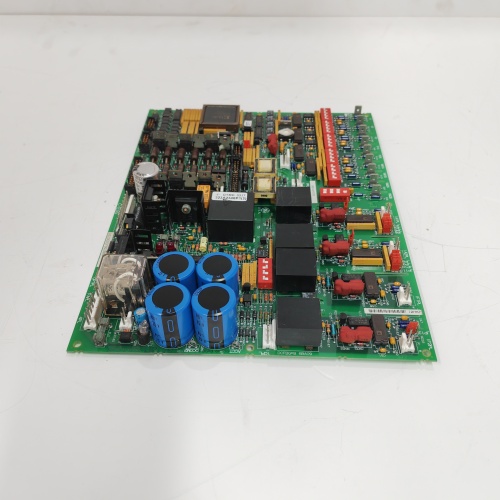
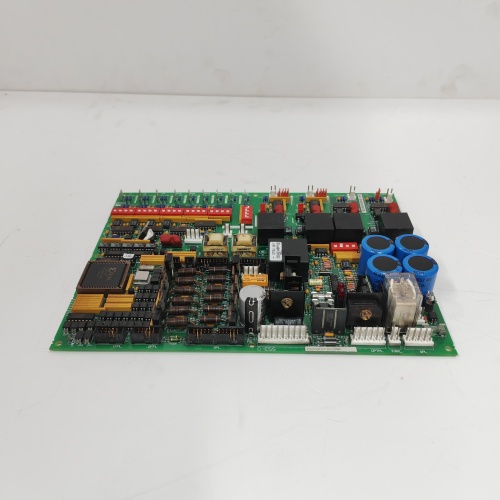
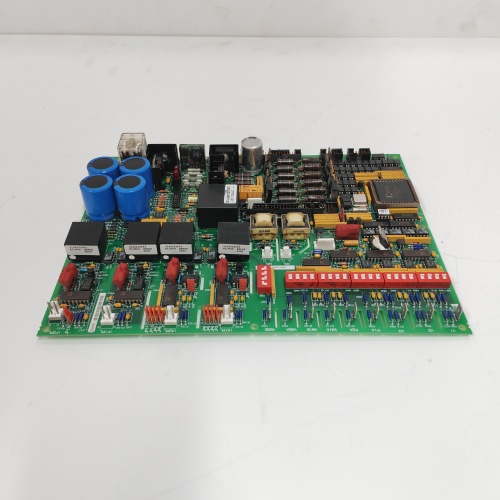
 Email: jiedong@sxrszdh.com
 Phone / Wechat:+86 15340683922
Description
Product Core Brief
- Model: DS200RTBAG3AGC
- Brand: General Electric (GE)
- Series: Mark V DS200
- Core Function: High-power triple-bank relay board with 10 A contacts and monitoring
- Product Type: High Power Relay Board with Monitoring (48 channels, 3 banks)
- Key Specs: 48 Form C relays | 10 A contacts | Overload + thermal alarms | Fixed terminals
- Condition: New Original.
Product Introduction
The DS200RTBAG3AGC is a high-power relay output termination board with monitoring for GE’s Mark V DS200 series, used in Speedtronic turbine control systems. It provides 48 independent Form C relay outputs rated for 10 A continuous, arranged as three isolated banks of 16 relays each, with per-bank overload current monitoring and thermal alarming.
The “3AGC” suffix indicates a triple-bank high-power board with diagnostics. This is the most advanced high-power relay board in the RTBA family. It combines the 10 A contact rating of the RTBAG3AEB with per-bank overload monitoring (current sum and temperature), per-bank external coil power option, and Form C alarm relays for remote annunciation. It is designed for critical high-power applications where preventive maintenance and remote diagnostics are required: turbine auxiliary control panels, large pump stations, heater banks, and motor control centers.
Key Technical Specifications
| Parameter | Value |
|---|---|
| Number of relay outputs | 48 (3 banks of 16) |
| Bank A relays | Relays 1–16 |
| Bank B relays | Relays 17–32 |
| Bank C relays | Relays 33–48 |
| Relay type | Electromechanical, Form C (SPDT), bifurcated silver-tin oxide contacts |
| Contact rating (resistive) | 10 A @ 250 VAC, 10 A @ 30 VDC |
| Contact rating (inductive) | 5 A @ 250 VAC (cosφ = 0.4), 5 A @ 30 VDC (L/R = 40 ms) |
| Maximum switching voltage | 250 VAC, 125 VDC |
| Maximum switching current | 10 A |
| Minimum switching load | 100 mA @ 12 VDC |
| Coil voltage | 24 VDC nominal (selectable: backplane or external supply per bank) |
| Coil current per relay | 30 mA ±3 mA at 24 VDC |
| Total backplane current (internal power) | 1440 mA (48 x 30 mA) |
| External coil power option | Per bank jumper selectable; external 24 VDC supply (8 A min for full bank) |
| Coil suppression | RCD snubber (diode + 470 nF + 47Ω) per relay |
| Per-channel indication | Red LED (coil energized) + Green LED (contact closed, field power sense) |
| Per-bank overload monitoring | Current transformer per bank measures sum of all 16 channel currents |
| Overload threshold | 16 A ±1 A (adjustable via potentiometer per bank) |
| Per-bank thermal monitoring | Thermistor on PCB, 85°C ±3°C warning threshold |
| Per-bank alarm output | Form C relay (1 A @ 24 VDC) for overload OR overtemperature |
| Alarm reset | Auto-reset when condition clears (latching option via jumper) |
| Contact material | Silver-tin oxide (AgSnO2) with bifurcated (twin) contacts |
| Electrical life (10 A resistive) | 50,000 operations |
| Electrical life (5 A inductive) | 25,000 operations |
| Operating time | 15 ms typical |
| Release time | 8 ms typical |
| Isolation (bank-to-bank) | 2500 VAC for 1 minute |
| Isolation (coil to contacts) | 2500 VAC for 1 minute |
| Terminal type | Fixed heavy-duty screw terminal, rising cage, 10–18 AWG |
| Terminal torque | 0.8–1.0 Nm (7–9 lb-in) |
| Connection to output modules | Three 64-pin ribbon cables (included, shielded) |
| External coil power connector | Three 2-position terminal blocks (10–18 AWG) |
| Alarm output connector | 9-pin D-sub (female, for all 3 banks) |
| Operating temperature | −30°C to +60°C (derate to 7 A at +60°C) |
| Storage temperature | −40°C to +85°C |
| Dimensions | 420 mm x 250 mm x 65 mm |
| Weight | 3.8 kg (8.4 lbs) |
| Accessories included | External coil power jumpers (pre-installed), 9-pin D-sub cable (1 m), spare relays (3), labeling strips (1–48), torque card, thermal pad kit, bank ID labels, overload adjustment tool (plastic hex key), DIN rail end clips (6) |
Key Selling Points & Differentiators
- 48 high-current relays with per-bank overload monitoring – Each bank has a current transformer that measures the sum of all 16 channel currents. When total exceeds 16 A (adjustable 12–20 A), the yellow overload LED lights and the bank’s alarm relay closes. Prevents cumulative overload that standard boards cannot detect.
- Per-bank thermal monitoring – Thermistor on each bank’s PCB area triggers alarm at 85°C. Useful for detecting cooling fan failures or high ambient temperatures before relay damage occurs.
- Form C alarm relay per bank – Each bank provides a dedicated alarm relay (rated 1 A @ 24 VDC) that closes on overload OR overtemperature. Wire to PLC, DCS, or annunciator panel for remote alarming. Latching option available via jumper (alarm stays latched until manually reset).
- Adjustable overload threshold – 12–20 A range via potentiometer per bank. Set to match your actual load profile. Factory default: 16 A. Adjustment tool included.
- Per-bank external coil power option – Move a jumper per bank to use external 24 VDC supply (8 A min for full bank). Essential when backplane cannot supply 1440 mA for all 48 coils. Relays still controlled by Mark V output modules.
- Dual LED status per channel – Red LED = coil energized. Green LED = contact closed AND field voltage present (12–250 VAC/DC). Instant verification of contact closure and field power.
- Fixed screw terminals rated for 10 A continuous – Rising cage terminals with 6 mm² capacity (10 AWG). Torque to 0.9 Nm. No removable blocks—higher current rating and reliability.
- Triple bank-to-bank isolation at 2500 VAC – Bank A, B, and C fully isolated. Connect each to different voltage systems.
- QC includes 24-hour 10 A load test on all 48 relays – Every relay runs at 10 A resistive for 24 hours. Overload and thermal alarms verified at threshold points.
- 2-year warranty – Covers all 48 relays, monitoring circuits, alarm relays, external coil power circuits, and any manufacturing defect.
Frequently Asked Questions (FAQ)
Q: What’s the difference between RTBAG3AEB (10 A, no monitoring) and RTBAG3AGC (10 A with monitoring)?
| Feature | RTBAG3AEB | RTBAG3AGC |
|---|---|---|
| Contact rating | 10 A | 10 A |
| Overload monitoring | No | Yes (current sum per bank) |
| Thermal monitoring | No | Yes (85°C threshold) |
| Alarm relay per bank | No | Yes (Form C) |
| Adjustable threshold | N/A | 12–20 A (potentiometer) |
| Alarm latching option | No | Yes (jumper selectable) |
| Dimensions | 420 x 240 x 65 mm | 420 x 250 x 65 mm (10 mm taller) |
| Weight | 3.5 kg | 3.8 kg |
Choose AGC for critical applications requiring remote alarming, preventive maintenance indication, or when cumulative overload is a concern (e.g., many channels sharing a common power supply).
Q: How does the overload monitoring work?
A: Each bank has a current transformer (CT) that surrounds the common return path for all 16 relays in that bank. The CT measures the sum of currents from all channels that are closed at any given time. When the sum exceeds the threshold (set via potentiometer), the yellow LED lights and the alarm relay closes. The board does NOT disable outputs—alarm is warning only. This detects scenarios where individually each channel is within rating (e.g., 10 A each) but only 2 channels closed (20 A total—overload). With 16 channels, 2 channels at 10 A each exceeds the bank rating.
Q: How do I set the overload threshold?
A: Each bank has a small potentiometer (accessible from the board edge). Use the included plastic hex key (non-conductive). Turn fully counterclockwise for 12 A, fully clockwise for 20 A. Factory default: 16 A (mid-position). Measure with an external ammeter on the common return while adjusting: apply a known total current (e.g., 15 A from a test load), adjust pot until yellow LED just lights, then back off slightly. Calibration procedure included.
Q: What triggers the thermal alarm?
A: Thermistor bonded to the PCB near the bank’s power traces. At 85°C ±3°C, the yellow thermal LED lights and the alarm relay closes (same relay as overload—OR logic). The thermal alarm resets automatically when temperature drops below 75°C. If you see repeated thermal alarms, check cooling fan operation, ambient temperature, and load current.
Q: How do I wire the alarm relays for remote monitoring?
A: Each bank has a Form C alarm relay with terminals on the 9-pin D-sub connector (pinout provided on board silkscreen and in manual). Relay coil is energized during normal condition (no alarm). When overload OR overtemperature occurs, relay de-energizes. This is fail-safe: loss of power to the RTBAG3AGC also triggers alarm. Wire the NO contact to a PLC input for “alarm” indication, or wire NC for “normal” indication. Relay rating: 1 A @ 24 VDC resistive.
Q: What is the latching option for alarms?
A: Each bank has a jumper for alarm latching. Default position: non-latching (alarm clears automatically when condition clears). Move jumper to latching position: once an alarm occurs, the yellow LED and alarm relay stay latched even after condition clears. Reset by cycling power to the board or pressing the reset button (located near each bank’s potentiometer). Latching is useful for capturing intermittent overloads.
Q: Can I replace a standard RTBAG3A (5 A) or RTBAG3AEB (10 A) with the AGC without changing my Mark V configuration?
A: Yes—electrically, the relay pinout and ribbon cables are identical. However:
- The AGC uses fixed screw terminals, not removable blocks. Re-land all 144 field wires (8–12 hours).
- The AGC is physically larger (420 x 250 mm vs 420 x 240 mm for AEB). Verify cabinet height.
- Coil current is 1440 mA versus 720 mA (RTBAG3A). Use external coil power if backplane limited.
- The AGC requires 10 AWG wire for loads above 5 A.
- You must connect the alarm D-sub cable to your monitoring system (optional—board works without it).
Q: How do I choose between backplane coil power and external coil power per bank?
A: Calculate your backplane 24 VDC load. RTBAG3AGC draws 480 mA per bank (16 x 30 mA) if all relays in that bank are energized. Total possible = 1440 mA. Mark V power supplies typically provide 2–5 A. If total backplane load exceeds 80%, use external power for one or more banks. Each bank requires an external 24 VDC supply rated at 1 A minimum (480 mA + margin). You can use one 5 A supply for all three banks. External coil power does not affect relay control—only the coil energy source.
Q: What is the thermal mounting requirement for 10 A operation?
A: The AGC has significant thermal dissipation at 10 A (approx 5 W per relay at 10 A resistive = 240 W total theoretical—not practical). Practical maximum: 16 A total per bank (1 A average per channel) with panel mounting. For any channel above 5 A, you MUST panel mount the board using the included thermal pad to a metal backplate (3 mm minimum thickness, 0.5 m² minimum area). For mixed loads (some 10 A, some 1 A), forced air cooling (200 LFM) is recommended. Do NOT use DIN rail mounting for any channel above 5 A. Thermal derating chart included.
Q: What QC tests are specific to the AGC revision?
A: Fourteen tests, all documented:
- Visual: 20x magnification of all 48 relays, current transformers, thermistors.
- Coil resistance: 800Ω ±3% (sample).
- Contact resistance: <30 mΩ at 1 A, four-wire.
- Bank-to-bank isolation: 3000 VAC for 5 seconds between A-B, B-C, A-C.
- Coil-to-contacts isolation: 3000 VAC.
- Operate test: Cycle each relay 500 times at 2 Hz.
- Load test (all 48 relays): 10 A resistive at 30 VDC, 24 hours continuous. Contact resistance final <100 mΩ.
- Overload monitor calibration: Apply 12 A, 16 A, 20 A total per bank. Verify alarm triggers at setpoint ±1 A. Adjust potentiometer, re-verify.
- Thermal monitor test: Heat bank to 85°C (external heater), verify alarm triggers at 85°C ±3°C.
- Alarm relay test: Verify Form C relay changes state on overload and overtemperature. Test latching option.
- Green LED sense test: Apply 24 VDC, 120 VAC, 250 VAC to C terminal.
- External coil power test: Verify jumper operation per bank.
- Thermal imaging: 16 A total per bank (mixed loads) for 4 hours with panel mounting. Hot spots <85°C.
- D-sub cable test: Continuity and shorts on all 9 pins.
Q: What shipping protection for this heavy high-power board?
A: The AGC weighs 3.8 kg (8.4 lbs)—heaviest RTBA board. Anti-static bag, custom ESD foam cradle with cutouts for all 144 fixed screw terminals, three ribbon cable headers, D-sub connector, and potentiometers. Hard plastic clamshell case with foam liner. Double-wall box with “HEAVY,” “FRAGILE,” “ESD SENSITIVE,” “DO NOT STACK,” “THIS SIDE UP” labels. Shock indicator and tilt indicator on outside. Each board ships individually. Thermal pad kit in separate sealed bag. Spare relays (3) and adjustment tool in ESD bag inside the same box. Alarm D-sub cable coiled and secured. Load calculation worksheet, thermal derating chart, and calibration procedure laminated and attached to clamshell.
.DKC02.3-200-7-FW PLC DCS
3300030300 PLC DCS
22010303 PLC DCS
3300351101010 PLC DCS
 Email: sales@plcfcs.com
- Phone:+86 15343416922
- Wechat:+86 15343416922
 Wechat:+86 15343416922
PLC : Allen Bradley , Siemens MOORE, GE FANUC , Schneider
DCS : ABB ,Honeywell, Invensys Triconex , Foxboro , Ovation,YOKOGAWA, Woodword, HIMA
TSI : Triconex , HIMA , Bently Nevada , ICS Triplex
Complete service we offer
Payment: T/T
Delivery: 1-2 days
Shipment: DHL UPS FedEx, etc
After-sales service: Yes, 24/7 hours