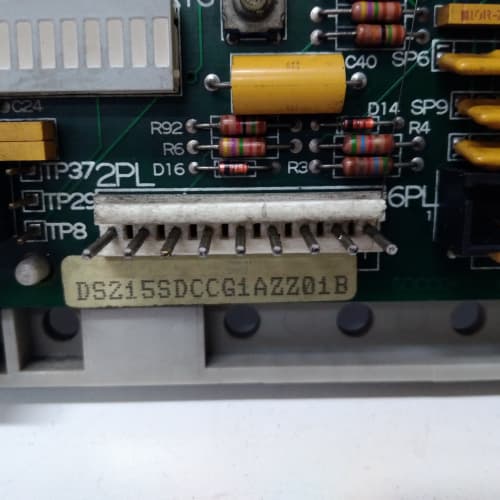
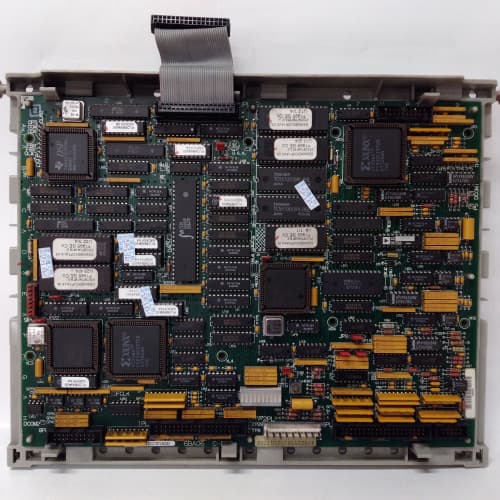
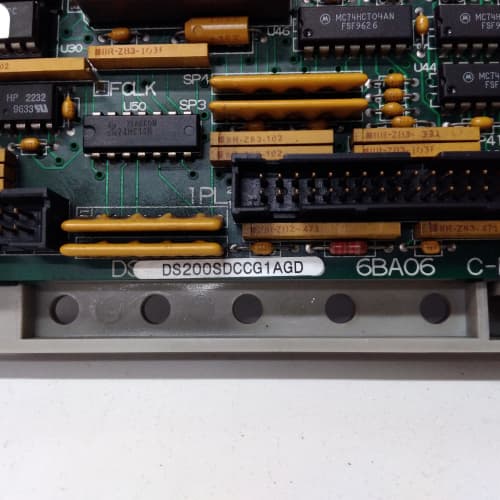
 Email: jiedong@sxrszdh.com
 Phone / Wechat:+86 15340683922
Description
Product Core Brief
- Model: DS200RTBAG2AGC
- Brand: General Electric (GE)
- Series: Mark V DS200
- Core Function: High-current dual-bank relay output board
- Product Type: High Power Relay Board (32 channels)
- Key Specs: 32 Form C relays | 10 A contacts | Two isolated banks | Fixed screw terminals
- Condition: New Original.
Product Introduction
The DS200RTBAG2AGC is a high-current relay output termination board for GE’s Mark V DS200 series, used in Speedtronic turbine control systems. It provides 32 independent Form C relay outputs rated for 10 A continuous, arranged as two isolated banks of 16 relays each—combining the high current capacity of the RTBAG1AEB with the channel density of the RTBAG2 platform.
The “2AGC” suffix indicates a dual-bank high-power board. This is essentially two RTBAG1AEB boards integrated onto a single PCB with bank-to-bank isolation. It is designed for heavy industrial applications requiring direct switching of motor starters (up to 1 HP), large solenoid valves, pump controls, heater contactors, and other high-current loads—all in a single rack slot.
Key Technical Specifications
| Parameter | Value |
|---|---|
| Number of relay outputs | 32 (2 banks of 16) |
| Bank A relays | Relays 1–16 |
| Bank B relays | Relays 17–32 |
| Relay type | Electromechanical, Form C (SPDT), bifurcated silver-tin oxide contacts |
| Contact arrangement | Common (C), Normally Open (NO), Normally Closed (NC) per relay |
| Contact rating (resistive) | 10 A @ 250 VAC, 10 A @ 30 VDC |
| Contact rating (inductive) | 5 A @ 250 VAC (cosφ = 0.4), 5 A @ 30 VDC (L/R = 40 ms) |
| Maximum switching voltage | 250 VAC, 125 VDC |
| Maximum switching current | 10 A |
| Maximum switching power | 2500 VA, 300 W |
| Minimum switching load | 100 mA @ 12 VDC (bifurcated contacts) |
| Coil voltage | 24 VDC nominal (selectable: backplane or external supply per bank) |
| Coil current per relay | 30 mA ±3 mA at 24 VDC |
| Total backplane current (internal power mode) | 960 mA (all 32 relays energized from backplane) |
| External coil power option | Per bank jumper selectable; use external 24 VDC supply (5 A minimum for full bank) |
| Coil suppression | RCD snubber (diode + 470 nF + 47Ω) across each coil |
| Per-channel indication | Red LED (coil energized) + Green LED (contact closed, field power sense) |
| Per-bank status | Power LED (bank enabled), Overload LED (bank current >16 A or overtemperature) |
| Contact material | Silver-tin oxide (AgSnO2) with bifurcated (twin) contacts |
| Mechanical life | 10,000,000 operations (no load) |
| Electrical life | 50,000 operations at 10 A resistive, 25,000 operations at 5 A inductive |
| Operating time | 15 ms typical |
| Release time | 8 ms typical |
| Isolation (bank-to-bank) | 2500 VAC for 1 minute |
| Isolation (coil to contacts per bank) | 2500 VAC for 1 minute |
| Isolation (contact to contact, same relay) | 1500 VAC for 1 minute |
| Isolation (adjacent relays, same bank) | 1000 VAC for 1 minute |
| Terminal type | Fixed heavy-duty screw terminal, rising cage, 10–18 AWG (not removable—higher current rating) |
| Terminal torque | 0.8–1.0 Nm (7–9 lb-in) |
| Connection to output modules | Two 64-pin ribbon cables (one per bank, included, shielded) |
| External coil power connector | Two 2-position terminal blocks (1 per bank, 10–18 AWG) |
| Operating temperature | −30°C to +60°C (derate to 7 A at +60°C, 5 A at +70°C) |
| Storage temperature | −40°C to +85°C |
| Dimensions | 380 mm x 220 mm x 60 mm |
| Weight | 3.2 kg (7.1 lbs) |
| Accessories included | External coil power jumpers (pre-installed to backplane power), spare relays (2, field replaceable with soldering), labeling strips (1–32), torque card, thermal pad kit (for panel mounting), bank identification labels |
Key Selling Points & Differentiators
- 32 high-current relays in one slot – Two independent banks of 16 relays each, rated 10 A continuous. Replaces two RTBAG1AEB boards. Directly switch motor starters, large solenoids, and pump contactors. No external interposing relays needed for most applications.
- Per-bank external coil power option – Standard backplane 24 VDC may not have 960 mA available for all 32 coils. Move a jumper per bank to use an external 24 VDC supply (field wired). Relays still controlled by Mark V output modules; only coil power comes from external source. Essential for heavily loaded backplanes.
- Bifurcated (twin) contacts on all 32 relays – Each contact has two parallel touching surfaces. Reduces contact resistance by 50% and provides redundancy. Standard 10 A relays use single contacts. Rated for 100 mA minimum load (versus 500 mA on standard power relays).
- Dual LED status per channel – Red LED = coil energized (command from output module). Green LED = contact closed AND field voltage present. Green LED requires field power sense (24–250 VAC/DC). Instant verification that the contact actually closed and field power is available.
- Per-bank overload monitoring – Yellow LED lights when bank current exceeds 16 A (sum of all channels) or bank temperature exceeds 85°C. Does not disable the bank—warning only. Connect the per-bank alarm output (Form C relay, 1 A rating) to a PLC input for remote monitoring.
- Fixed screw terminals rated for 10 A continuous – Removable terminal blocks cannot safely handle 10 A long-term (contact resistance too high). The AGC uses fixed rising cage terminals with 6 mm² wire capacity (10 AWG). Torque to 0.9 Nm.
- RCD snubber across every coil – Standard flyback diode plus 470 nF capacitor and 47Ω resistor. Reduces EMI from coil switching by 40 dB compared to diode-only suppression. Prevents false triggering on nearby analog inputs.
- QC includes 24-hour 10 A load test on all 32 relays – Every relay runs at 10 A resistive, 30 VDC for 24 hours continuous. Contact resistance measured at 0, 1, 2, 4, 8, 12, 24 hours. Final <100 mΩ. Thermal imaging verifies no hot spot >85°C on PCB or terminals.
- 2-year warranty – Covers contact welding, coil failure, LED failure, external coil power circuit, or any manufacturing defect on either bank. Includes high-current switching duty.
Frequently Asked Questions (FAQ)
Q: What’s the difference between RTBAG2A (5 A), RTBAG2AEB (5 A? no—RTBAG1AEB is 10 A single bank), and RTBAG2AGC (10 A dual bank)?
| Feature | RTBAG2A | RTBAG2AGC |
|---|---|---|
| Contact rating | 5 A | 10 A |
| Total relays | 32 | 32 |
| Banks | 2 (isolated) | 2 (isolated, 2500 VAC) |
| Terminal type | Removable pluggable | Fixed screw (10 AWG) |
| Coil current (all relays) | 480 mA | 960 mA (or external supply) |
| Minimum load | None (silver contacts) | 100 mA (bifurcated contacts) |
| Green LED (contact sense) | No | Yes |
| Per-bank overload alarm | No | Yes |
| Typical application | General purpose | Motor starters, pumps, heaters |
The AGC is for heavy loads (10 A). Do not use it for low-level signals (<100 mA)—the bifurcated contacts still require minimum load for self-cleaning, unlike gold-flashed contacts.
Q: Can I replace a mechanical RTBAG2A (5 A) with the AGC (10 A) without changing my wiring?
A: Yes—electrically, the pinout is identical. However:
- The AGC uses fixed screw terminals, not removable blocks. You will need to re-land all 96 field wires (32 relays x 3 terminals). Allow 4–6 hours.
- The AGC is physically larger (380 mm vs 350 mm width). Verify cabinet space.
- Coil current is 960 mA versus 480 mA on the RTBAG2A. Your backplane may need the external coil power option.
- The AGC requires 10 AWG wire for loads above 5 A. The RTBAG2A used 14–16 AWG typical.
Q: How do I choose between backplane coil power and external coil power?
A: Calculate your backplane 24 VDC load. List all modules: CPU (500 mA), each I/O module (100–300 mA), communication boards (200–400 mA), and relays (30 mA each). The RTBAG2AGC draws 960 mA if all 32 relays are energized simultaneously from the backplane. Mark V power supplies (DS200PCCAG series) typically provide 2–5 A on the 24 VDC rail. If total exceeds 80% of supply rating, use external coil power per bank. We provide a load calculation worksheet with each board.
Q: How do I wire external coil power?
A: Each bank has a dedicated 2-position terminal block (labeled “EXT 24V+” and “EXT 24V-“). Remove the jumper (shunt) from the backplane power header (located near the terminal block). Connect an external 24 VDC supply (5 A minimum per bank) to the terminals. The Mark V output module still provides the control signal (opto-isolated). The external supply powers only the relay coils. Polarity matters: + to +, – to -.
Q: What is the green LED sense voltage range?
A: The green LED illuminates when the relay contact is closed (NO to C) AND field voltage is present on the Common (C) terminal. Sense voltage range: 12–250 VAC or 12–125 VDC. The LED is bidirectional (works with AC or DC). If you do not want the green LED, leave the C terminal unconnected (relay still switches, but LED stays off). The green LED draws <2 mA and does not affect load current.
Q: The board has per-bank overload monitoring. What triggers the yellow LED?
A: Two conditions. First: total current through all 16 relays in the bank exceeds 16 A (sum of individual channel loads). Second: bank temperature (measured by thermistor on PCB) exceeds 85°C. The yellow LED lights but does not disable outputs—it is a warning only. Each bank also has a Form C alarm relay (rated 1 A @ 24 VDC) that closes when either condition occurs. Wire this to a PLC input for remote alarming.
Q: Can I use the AGC for 240 VAC motor loads (1 HP, 4 A running, 25 A inrush)?
A: Yes, but with an external contactor. The AGC contacts are rated for 5 A inductive at 250 VAC. A 1 HP motor at 240 VAC draws 4 A running but 25 A inrush. The inrush will weld the AGC contacts within a few starts. Use the AGC to control a properly sized contactor (e.g., 25 A NEMA size). The AGC switches the contactor coil (5 VA, well within rating). We sell suitable contactors (part MTR-CONT-25A).
Q: The AGC has fixed screw terminals. How do I replace a damaged terminal?
A: You cannot—the terminals are soldered to the PCB. If a terminal strip is damaged (bent, cracked, stripped threads), return the board for repair. We replace individual terminals ($45 + return shipping). For field repair, we sell a terminal repair kit (part ACC-TRM-REPAIR) that includes a drill bit, replacement terminal, and epoxy. Most plants keep a spare AGC board instead of attempting field repair.
Q: What QC tests are specific to the AGC revision?
A: Twelve tests, all documented with thermal images and contact resistance logs:
- Visual: 20x magnification of power traces (6 mm width, 4 oz copper), relay solder joints.
- Coil resistance per relay: 800Ω ±3% at 25°C (30 mA at 24 VDC).
- Coil current (backplane power): 30 mA ±3 mA per relay.
- Coil current (external power): 30 mA ±3 mA, verify jumper operation.
- Contact resistance (NO and NC): Four-wire measurement at 1 A (not 100 mA—higher current for power relay). <30 mΩ initial.
- Bank-to-bank isolation: 3000 VAC for 5 seconds between Bank A and Bank B terminals. Leakage <0.5 mA.
- Coil-to-contacts isolation per bank: 3000 VAC for 5 seconds.
- Operate test: Cycle each relay 500 times at 2 Hz. Operate time <20 ms, release <12 ms.
- Load test (all 32 relays): 10 A resistive at 30 VDC, 24 hours continuous. Contact resistance measured at 0, 1, 2, 4, 8, 12, 24 hours. Final <100 mΩ.
- Inductive load test (sample of 8 relays): 5 A at 30 VDC, L/R = 40 ms, 25,000 cycles. No contact welding.
- Thermal imaging: Full load (10 A on all 32 relays) for 2 hours (reduced from 24 hours for QC efficiency). Hot spots <85°C. Thermal image included.
- Overload monitor test: Apply 17 A total to one bank, verify yellow LED lights and alarm relay closes within 10 seconds.
- Green LED sense test: Apply 24 VDC, 120 VAC, and 250 VAC to C terminal, verify LED illuminates when relay energized.
Q: What shipping protection for this heavy board?
A: The AGC weighs 3.2 kg (7.1 lbs)—heaviest RTBA variant. Maximum protection: anti-static bag, custom-molded ESD foam cradle with cutouts for all 96 screw terminals and both ribbon cable headers, hard plastic clamshell case with foam liner. Double-wall box with “HEAVY,” “FRAGILE,” “ESD SENSITIVE,” “DO NOT STACK,” and “THIS SIDE UP” labels. Shock indicator and tilt indicator on outside. Each board ships individually. Thermal pad kit (for panel mounting—required for loads >5 A per bank) in separate sealed bag. Spare relays (2) in ESD bag inside the same box. Load calculation worksheet laminated and attached to outside of clamshell.
608830222
608820103
0608820103 PLC DCS
 Email: sales@plcfcs.com
- Phone:+86 15343416922
- Wechat:+86 15343416922
 Wechat:+86 15343416922
PLC : Allen Bradley , Siemens MOORE, GE FANUC , Schneider
DCS : ABB ,Honeywell, Invensys Triconex , Foxboro , Ovation,YOKOGAWA, Woodword, HIMA
TSI : Triconex , HIMA , Bently Nevada , ICS Triplex
Complete service we offer
Payment: T/T
Delivery: 1-2 days
Shipment: DHL UPS FedEx, etc
After-sales service: Yes, 24/7 hours