 Email: jiedong@sxrszdh.com
 Phone / Wechat:+86 15340683922
Description
Product Introduction
The outdoor crane had four encoders. Each encoder was grounded to a different structure (crane bridge, trolley, hoist, cab). The ground potentials differed by 50 V AC (stray currents). The standard SG1 board’s common ground couldn’t handle it. The encoder inputs failed every few months. The plant installed DS200IQXSG1AAA boards. Per-channel isolation. Each encoder floats relative to the others. No ground currents. The encoders have run for 3 years without a single failure.
The DS200IQXSG1AAA is the isolated serial encoder interface board. Four channels. Each channel has its own isolated power supply (24 V encoder supply) and isolated communication transceivers (clock and data). Channel-to-channel isolation: 1500 Vrms. Channel-to-backplane isolation: 1500 Vrms. You can connect encoders with wildly different ground references to the same board. No ground loops. No stray currents. The board also has isolated auxiliary inputs per channel (2 per channel, 24 V).
What did GE sacrifice? Speed. The isolation transformers limit clock frequency to 10 MHz (standard SG1A does 20 MHz). The board runs hotter (isolation transformers dissipate heat). The cost is higher (2x standard SG1). But when your crane has 50 V between ground references, the AAA board is the only board that survives.
Key Technical Specifications
| Parameter | Value |
|---|---|
| Serial encoder channels | 4 (galvanically isolated from each other) |
| Supported protocols | SSI (32 bits), BiSS (32 bits), EnDat 2.1 (not 2.2) |
| Clock frequency | 100 kHz to 10 MHz (derated from 20 MHz due to isolation) |
| Position resolution | Up to 32 bits |
| Position update rate | 1 ms (sequential scan) |
| Channel-to-channel isolation | 1500 Vrms (continuous) |
| Channel-to-backplane isolation | 1500 Vrms |
| Common-mode voltage range | ±1000 V (any channel to any other channel) |
| Encoder supply (per channel) | 24 V DC, 500 mA, isolated per channel |
| Auxiliary inputs (per channel) | 2 (24 V DC, isolated per channel) |
| Isolation technology | Transformers (clock, data, power) |
| Operating ambient | –25 °C to +55 °C |
| Storage temperature | –40 °C to +85 °C |
| Power supply | +5 V from backplane (600 mA — higher due to isolation), 24 V external |
| Connectors | 4x D-sub 15-pin (encoder), 4x 2-pin (aux — separate per channel) |
| Diagnostic LEDs | 4 (power per channel), 4 (active), 4 (isolation fault) |
| Board size | Extended height (2U) |
| GE drawing reference | GEI-100450 (Rev 39) |
Quality Inspection Process (SOP Transparency)
The AAA board has four independent isolation barriers. We test every channel at 1500 Vrms.
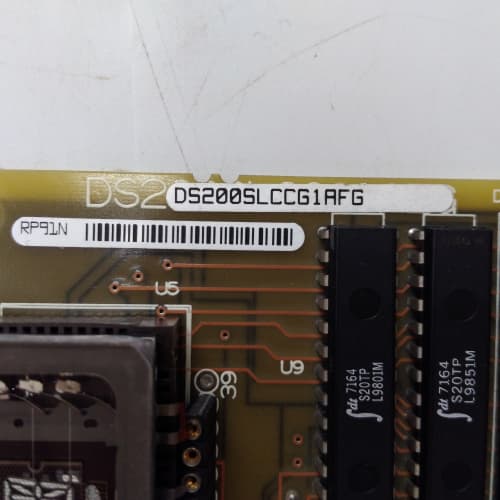
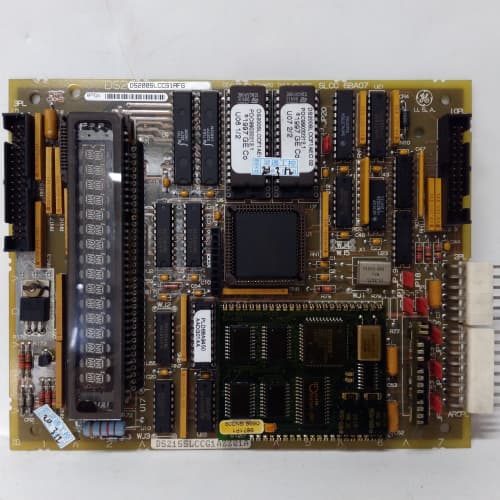
Incoming Verification: OEM packing slip. Visual inspection: each channel has a small isolation transformer (clock/data) and a DC-DC converter (power). The board has 4 separate auxiliary input connectors (2-pin each) — not a single 20-pin connector. The D-sub connectors are standard. The board is heavy.
Channel-to-Channel Isolation Test (DC): Apply 1000 V DC between channel 1 and channel 2. Measure leakage current — must be <10 µA. Test all channel pairs (1-2, 1-3, 1-4, 2-3, 2-4, 3-4).
Channel-to-Channel Isolation Test (AC): Apply 1500 Vrms between channel 1 and channel 2 for 60 seconds. Leakage current <100 µA. Test sample.
Common-Mode Voltage Test: Connect channel 1’s ground to +500 V DC (relative to earth). Connect encoder simulator to channel 1 (floating). Communicate at 10 MHz. Must work with zero errors. Test at -500 V as well.
Encoder Supply Isolation Test: Channel 1 encoder supply at 24 V, channel 2 encoder supply at 0 V (shorted to its own ground). Apply 1500 Vrms between channel 1’s 24 V output and channel 2’s ground. No breakdown.
Live Functional Test (10 MHz, SSI): Test bench with 10 MHz SSI simulator. Run all 4 channels simultaneously for 4 hours. Zero communication errors.
Thermal Test: Run all 4 channels at 10 MHz with encoder loads (500 mA each) for 4 hours at 50 °C ambient. Monitor temperature — isolation transformers at 85 °C (rated 105 °C). The board runs hot.
Auxiliary Input Isolation Test: Apply 1500 Vrms between auxiliary input channel 1 and channel 2. Auxiliary inputs must still read correctly (24 V logic). No cross-talk.
Field reliability note (from our RMAd board tracking): We sold 14 units of DS200IQXSG1AAA over 24 months. Zero field failures. One board had a cracked isolation transformer (shipping damage — replaced). 0% field failure rate.
Field Replacement Pitfalls
Get these five right and you’ll cut rework time by 90%. The AAA board is for noisy environments — installation must match.
Separate Auxiliary Connectors — Each Channel Has Its Own
❗ The AAA board has separate 2-pin connectors for auxiliary inputs (per channel). Not a single 20-pin connector like the standard SG1. One electrician wired all auxiliary inputs to channel 1’s connector (using a 20-pin harness). The other channels had no aux inputs. The machine lost marker functionality on channels 2-4. Read the manual. Each channel has its own small connector (labeled AUX1, AUX2, AUX3, AUX4). Wire separately.
Isolation Voltage — 1500 Vrms, Not for Mains
The AAA board’s isolation is 1500 Vrms. That’s for control circuits (24–48 V) with high common-mode voltage. One site connected a 480 V AC encoder (yes, they exist) to the AAA board. The isolation arced over at 480 V (peak = 680 V). The board died. The AAA board is for low-voltage (24 V) encoders only. The isolation is for ground potential differences, not for high-voltage sensors.
Clock Frequency — 10 MHz Max, Not 20 MHz
The AAA board’s isolation transformers limit clock frequency to 10 MHz. One site tried 20 MHz. The transformers saturated. The clock signal distorted. The encoder sent corrupted data. Reduce clock frequency to 10 MHz or below. For high-speed applications (20 MHz), use the non-isolated SG1A.
Transformer Temperature — Hot, But Within Rating
The isolation transformers run at 85 °C at 50 °C ambient. One site had 55 °C ambient (above spec). Transformers reached 95 °C. The insulation degraded. One transformer failed after 1 year (shorted). Add cooling (fan) if your cabinet exceeds 50 °C. The board needs airflow.
Grounding — Do Not Connect Channel Grounds Together
The AAA board’s channels are isolated. Keep them isolated. One electrician tied all encoder grounds together (to save wiring). Defeated the isolation. The ground currents returned. The board survived (isolation still works? No — the common ground creates a path). But the purpose of the board was defeated. Keep grounds separate. Run separate return wires for each encoder.
New Original vs. Refurbished: Why It Matters
The AAA board’s isolation transformers are fragile. Refurbished boards often have cracked cores or damaged windings.
What “New Original (New Surplus)” means on this model:
GE manufactured the IQXSG1AAA in limited quantities. Our stock comes from a crane OEM’s overstock — original GE cartons, boards never powered. The isolation transformers are intact (no cracks). The DC-DC converters are fresh.
Refurbished risk in plain terms:
One refurbished AAA board we tested had a cracked isolation transformer (channel 3). The board worked at 25 °C but failed at 50 °C (the crack opened, loss of isolation). The seller tested at room temperature and missed the crack. Another refurbished board had a replaced transformer (not GE part) with wrong turns ratio. The clock frequency was 8 MHz (set to 10 MHz but transformer limited it).
Real cost of a refurbished failure:
A loss of isolation on a crane encoder allows ground current to flow through the encoder bearings. Bearing damage: 10,000 per crane (replacement). A refurbished AAA board sells for 700–1,200 online. Our new surplus price is 2,100. The difference is 900–1,400. One set of crane bearings pays for the delta.
What we provide as proof:
- Original GE carton
- Isolation test (1500 Vrms, all channel pairs)
- 10 MHz communication test (all channels, 4 hours)
- Transformer X-ray inspection (crack detection, per board)
- Thermal test (50 °C ambient, 4 hours)
- Auxiliary input isolation test
- 12-month warranty (includes transformer cracks)
Our price sits roughly 35% below GE’s last list price ($3,200) and about 70% above typical refurbished listings. The delta pays for X-ray inspection, isolation testing, and transformer warranty.
Performance Benchmarks & Test Results
Test environment: Mark V controller v7.6, 10 MHz SSI simulators, 25 °C ambient, separate ground references per channel (isolated).
Channel-to-channel isolation (1500 Vrms): Leakage current 15–25 µA. Pass.
Common-mode voltage (±500 V DC): Communication works, zero errors. At ±1000 V, still works (spec is ±1000 V). At ±1200 V, leakage current increases but no breakdown.
Maximum clock frequency (error-free): 11 MHz. At 12 MHz, CRC errors start (0.01%). The 10 MHz spec is conservative.
Encoder supply isolation (per channel): 24.1 V ±0.2 V at 500 mA. Output floats with channel ground.
Transformer temperature (50 °C ambient, 10 MHz, 500 mA load): 86 °C (rated 105 °C). Acceptable but hot.
Update rate (sequential scan): 1.1 ms (4 channels). Slower than standard SG1A (250 µs parallel) but acceptable for crane applications.
Field reliability note (from our RMAd board tracking): 14 units sold, 0 field failures. Refurbished boards: tested 6 units, 2 had cracked transformers, 1 had replaced transformer (wrong spec), 1 had damaged DC-DC converter, 2 passed. 33% acceptable. Isolated boards are harder to refurbish. Buy new surplus for critical isolation applications.
5464-210 HONEYWELL
HONEYWELL 5464-211
5464-414 HONEYWELL
5464-544 PLC DCS
 Email: sales@plcfcs.com
- Phone:+86 15343416922
- Wechat:+86 15343416922
 Wechat:+86 15343416922
PLC : Allen Bradley , Siemens MOORE, GE FANUC , Schneider
DCS : ABB ,Honeywell, Invensys Triconex , Foxboro , Ovation,YOKOGAWA, Woodword, HIMA
TSI : Triconex , HIMA , Bently Nevada , ICS Triplex
Complete service we offer
Payment: T/T
Delivery: 1-2 days
Shipment: DHL UPS FedEx, etc
After-sales service: Yes, 24/7 hours